Every second of every day, your body is performing countless invisible miracles.
Your heart beats without asking for permission. Your lungs fill with air and release it again. Tiny cuts on your skin begin to heal. New blood cells replace old ones. Your brain processes memories, emotions, and thoughts. Your immune system searches for harmful bacteria and viruses. Even while you sleep, trillions of cells are hard at work keeping you alive.
But have you ever wondered how each cell knows exactly what to do?
After all, almost every cell in your body contains essentially the same DNA. If every cell has the same genetic instructions, why does one become a skin cell while another becomes a nerve cell, a muscle cell, or a liver cell?
The answer begins with one of the most important processes in biology: DNA transcription.
Transcription is the first step in turning the information stored inside DNA into something a cell can actually use. It is the process that allows your genes to become active. Without transcription, DNA would simply remain a silent library of instructions, locked away inside the nucleus and never put into action.
Think of DNA as a giant cookbook filled with thousands of recipes. Every recipe is carefully written, but the cookbook itself never leaves the library. Instead, when a chef needs to prepare a meal, they copy one recipe onto a separate piece of paper and take that copy into the kitchen.
Your cells work in a remarkably similar way.
Instead of using DNA directly, cells first create a temporary copy of the needed instructions. This copy is called messenger RNA, or mRNA. The cell then uses this copy to build proteins—the molecules responsible for nearly everything your body does.
Every heartbeat, every movement, every thought, every immune response, and every stage of growth depends on proteins. And every protein begins with transcription.
Scientists often describe DNA as the blueprint of life, but blueprints only become useful when builders actually read them. Transcription is how cells read those blueprints.
Understanding transcription not only explains how life functions but also helps us understand genetic diseases, cancer, evolution, biotechnology, and many modern medical breakthroughs.
It is one of the most elegant and fascinating processes occurring inside every living cell.
What Is DNA?
Before understanding transcription, it’s important to understand DNA itself.
DNA, short for deoxyribonucleic acid, is the molecule that stores the genetic information needed to build, maintain, and operate living organisms.
Nearly every cell in your body contains DNA.
If stretched end to end, the DNA inside a single human cell would measure about two meters (more than six feet) long. Yet it fits inside a microscopic nucleus because it is tightly wrapped around proteins called histones and organized into chromosomes.
DNA carries the instructions for making proteins.
These instructions are written using just four chemical building blocks known as bases.
These bases are adenine (A), thymine (T), cytosine (C), and guanine (G).
The specific order of these four letters forms the genetic code.
Just as countless words can be created from only twenty-six letters in the English alphabet, millions of biological instructions arise from countless combinations of these four DNA bases.
What Is a Gene?
DNA is incredibly long.
Not every part of it contains instructions for building proteins.
The sections that do contain these instructions are called genes.
Humans have roughly 20,000 protein-coding genes, although the exact number continues to be refined as scientists learn more.
Each gene provides instructions for making a particular protein or helping regulate cellular functions.
Some genes produce proteins involved in muscle contraction.
Others build enzymes that digest food.
Some help the immune system recognize infections.
Others control growth, development, or communication between nerve cells.
Genes are like individual chapters in the enormous instruction manual that is your genome.
Why DNA Cannot Leave the Nucleus
In most human cells, DNA remains safely protected inside the nucleus.
There are good reasons for this.
DNA is extremely valuable.
Damage to DNA can lead to harmful mutations.
Keeping it protected reduces the risk of accidental injury.
Meanwhile, protein production occurs outside the nucleus on structures called ribosomes.
This creates an important challenge.
If DNA stays inside the nucleus, how can its instructions reach the ribosomes?
The solution is transcription.
Rather than moving the original DNA, the cell creates a temporary copy.
This copy carries the genetic message safely from the nucleus to the ribosome.
What Is DNA Transcription?
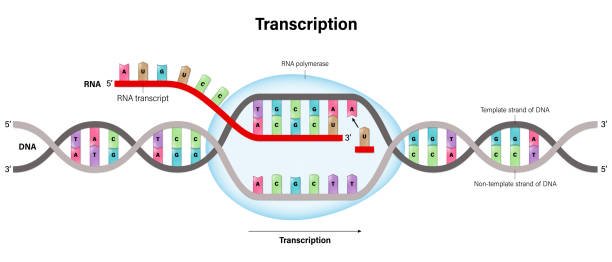
DNA transcription is the process of copying genetic information from DNA into messenger RNA (mRNA).
This is the first major step of gene expression.
Gene expression refers to the process through which genetic information is used to produce functional molecules, especially proteins.
During transcription, only one specific gene is copied rather than the entire DNA molecule.
The resulting RNA contains instructions needed for building a particular protein.
Because RNA acts as an intermediate copy, the original DNA remains safely protected.
This elegant system allows cells to use genetic information without risking constant damage to their permanent genetic library.
Why Transcription Is So Important
Without transcription, genes would remain inactive.
Cells could not manufacture proteins.
Without proteins, life would quickly stop.
Proteins perform an astonishing variety of jobs.
They build muscles.
They transport oxygen.
They digest food.
They send signals through the nervous system.
They repair damaged tissues.
They defend against disease.
They regulate metabolism.
Nearly every biological process depends upon proteins.
And every protein begins with transcription.
In many ways, transcription represents the moment when genetic information becomes biologically useful.
The Central Dogma of Molecular Biology
Biologists often summarize the flow of genetic information using a simple concept called the central dogma.
Information flows from DNA to RNA to protein.
First, DNA undergoes transcription to produce RNA.
Then RNA undergoes translation, where ribosomes use its instructions to build proteins.
Although additional complexities exist, this basic pathway explains how genetic information becomes physical structures and biological functions.
Transcription is the crucial bridge connecting DNA and proteins.
Meet RNA
RNA stands for ribonucleic acid.
Although similar to DNA, RNA differs in several important ways.
RNA usually consists of only one strand rather than two.
It contains the sugar ribose instead of deoxyribose.
Instead of thymine, RNA uses another base called uracil.
Whenever RNA encounters adenine, it pairs with uracil rather than thymine.
These differences make RNA well suited for its temporary role.
Unlike DNA, which must remain stable for decades, RNA molecules are often produced, used, and broken down relatively quickly.
Messenger RNA: The Cellular Messenger
Several kinds of RNA exist.
The best-known is messenger RNA, or mRNA.
Messenger RNA carries genetic instructions from DNA inside the nucleus to ribosomes in the cytoplasm.
You can think of mRNA as a carefully written photocopy of one page from an enormous instruction manual.
Only the needed information is copied.
Once the protein has been produced, many mRNA molecules are eventually broken down and recycled.
This temporary system helps cells carefully regulate protein production.
Where Transcription Happens
In plants, animals, fungi, and other organisms with complex cells, transcription occurs inside the nucleus.
This is where DNA is stored.
Once transcription finishes, the completed messenger RNA exits the nucleus through tiny openings called nuclear pores.
It then enters the cytoplasm, where ribosomes read its instructions.
In bacteria, which lack a nucleus, transcription occurs directly within the cell’s interior.
Because DNA is not separated by a nuclear membrane, transcription and protein production can happen almost simultaneously.
The Enzyme That Makes Everything Possible
The central player in transcription is an enzyme called RNA polymerase.
Enzymes are specialized proteins that speed up chemical reactions.
RNA polymerase reads DNA and builds the complementary RNA strand.
Without RNA polymerase, transcription could not occur.
This remarkable molecular machine moves along DNA, selecting one nucleotide after another with extraordinary precision.
Its accuracy helps preserve the correct genetic message.
Step One: Finding the Right Gene
Cells do not transcribe every gene all the time.
Instead, they activate only the genes currently needed.
Before transcription begins, RNA polymerase must locate the correct starting point.
Special DNA sequences called promoters mark where transcription should begin.
Various proteins called transcription factors help RNA polymerase recognize these promoters.
Only after the proper signals arrive does transcription start.
This careful regulation ensures cells produce the right proteins at the right time.
Step Two: Opening the DNA
DNA normally exists as a tightly wound double helix.
To read the genetic code, a small section must temporarily unwind.
RNA polymerase separates the two DNA strands at the gene being copied.
Only one strand serves as the template.
The opposite strand remains temporarily unused during this particular transcription event.
This exposed template provides the sequence needed for building RNA.
Step Three: Building the RNA Molecule
RNA polymerase begins moving along the template strand.
As it travels, it adds RNA nucleotides one by one.
Each nucleotide pairs according to complementary base-pairing rules.
DNA adenine pairs with RNA uracil.
DNA thymine pairs with RNA adenine.
DNA cytosine pairs with RNA guanine.
DNA guanine pairs with RNA cytosine.
Gradually, a complete messenger RNA molecule grows.
The sequence faithfully reflects the information stored in the original gene.
Step Four: Ending Transcription
Eventually, RNA polymerase reaches a DNA sequence signaling that transcription should stop.
These termination sequences tell the enzyme its job is complete.
RNA polymerase releases the newly formed RNA molecule.
The DNA strands reconnect into their familiar double helix.
The gene remains intact and ready for future use.
Meanwhile, the messenger RNA continues toward the next stage of protein production.
RNA Processing
In complex organisms such as humans, newly synthesized messenger RNA requires additional processing before leaving the nucleus.
This immature RNA is called pre-mRNA.
Several important modifications occur.
A protective cap is added to one end.
A long tail composed mainly of adenine nucleotides is added to the opposite end.
Sections called introns are removed.
The remaining coding regions, called exons, are joined together.
These modifications improve stability, facilitate transport, and help ribosomes recognize the messenger RNA during protein production.
Introns and Exons
One fascinating feature of human genes is that many contain both coding and non-coding regions.
Exons contain protein-coding information.
Introns are removed before translation.
Scientists once assumed introns served little purpose.
Today, researchers recognize that they play important roles in regulating gene expression and allowing alternative splicing.
Alternative splicing enables a single gene to produce multiple proteins by combining exons in different ways.
This remarkable mechanism greatly increases biological complexity without requiring vastly more genes.
Transcription Is Carefully Controlled
Not every gene should remain active continuously.
Imagine if cells constantly produced digestive enzymes inside the brain or muscle proteins inside the eye.
Life would become chaotic.
Cells therefore regulate transcription with extraordinary precision.
Special proteins activate certain genes.
Others silence genes.
Chemical modifications to DNA and associated proteins also influence transcription.
Environmental factors such as nutrition, stress, hormones, temperature, and infections can alter gene activity.
This regulation allows cells to adapt to changing conditions.
Why Different Cells Look Different
Almost every cell contains essentially identical DNA.
Yet skin cells differ dramatically from neurons, liver cells, or heart muscle cells.
The difference lies largely in transcription.
Different cell types activate different sets of genes.
A neuron transcribes genes needed for electrical signaling.
A muscle cell activates genes involved in contraction.
A liver cell produces enzymes for metabolism and detoxification.
Thus, transcription determines cellular identity.
The same genetic blueprint gives rise to many specialized cell types simply by activating different instructions.
Transcription During Development
Human development begins with a single fertilized egg.
As this cell divides repeatedly, billions of specialized cells eventually form the human body.
Transcription directs this remarkable transformation.
Genes switch on and off in carefully timed sequences.
Some genes guide brain development.
Others shape the heart, lungs, bones, skin, or immune system.
Each developmental stage depends upon precise transcriptional regulation.
Small errors can have significant consequences.
Mistakes During Transcription
Although remarkably accurate, transcription is not perfect.
Occasional errors occur.
Fortunately, cells possess quality-control mechanisms that reduce mistakes.
Unlike permanent DNA mutations, most transcription errors affect only temporary RNA molecules.
Since messenger RNA eventually breaks down, these mistakes usually have limited long-term effects.
Nevertheless, transcription errors sometimes contribute to disease if important proteins become abnormal.
Transcription and Disease
Many diseases involve abnormal transcription.
Certain cancers result when genes controlling cell division become excessively active or fail to switch off.
Some inherited disorders affect proteins regulating transcription.
Viruses often manipulate host-cell transcription to reproduce themselves.
Scientists continue discovering new ways transcription influences health and disease.
Understanding these mechanisms helps researchers develop targeted therapies.
Transcription and Modern Medicine
Recent medical advances increasingly rely upon knowledge of transcription.
Messenger RNA vaccines represent one remarkable example.
Rather than containing weakened viruses, these vaccines provide temporary genetic instructions allowing cells to produce harmless viral proteins.
The immune system learns to recognize these proteins and prepares defenses against future infections.
The messenger RNA never changes human DNA.
Instead, it functions temporarily before naturally degrading.
This technology highlights the practical importance of understanding transcription.
Scientists Continue Learning
Although transcription has been studied for decades, researchers continue making exciting discoveries.
Advanced imaging techniques allow scientists to observe transcription almost in real time.
Single-cell sequencing reveals differences in gene activity among individual cells.
Artificial intelligence helps analyze enormous genetic datasets.
New regulatory molecules continue being identified.
Each discovery deepens our understanding of life’s remarkable complexity.
Why DNA Transcription Matters
Transcription lies at the heart of biology.
It connects genetic information with living function.
Without transcription, DNA would remain silent.
Cells could not grow.
Organs could not function.
Healing would stop.
Development would cease.
Every heartbeat, breath, memory, and movement ultimately depends upon countless transcription events occurring every second throughout the body.
This invisible molecular process enables life itself.
Conclusion
DNA transcription is one of the most remarkable processes in all of biology. It transforms the information stored within DNA into messenger RNA, allowing cells to access the instructions they need to build proteins. These proteins, in turn, perform nearly every task required for life—from carrying oxygen through the bloodstream and fighting infections to repairing tissues, enabling movement, and supporting thought and memory.
What makes transcription especially extraordinary is its precision and control. Cells do not simply read their entire genetic code at once. Instead, they carefully select which genes to activate, when to activate them, and how much of each protein to produce. This precise regulation allows the same DNA to create the incredible diversity of cells that make up the human body, from brain cells and heart muscle to skin and bone.
The importance of transcription extends far beyond the classroom. It plays a central role in health, development, evolution, and modern medicine. Scientists studying transcription have gained valuable insights into genetic disorders, cancer, infectious diseases, and revolutionary technologies such as messenger RNA vaccines. As research continues, new discoveries are expanding our understanding of how genes work and opening the door to innovative treatments for many diseases.
In many ways, DNA truly is the blueprint of life, but a blueprint has little value unless it can be read and put into action. Transcription is the process that brings those instructions to life. Hidden inside every one of your trillions of cells, this extraordinary molecular machinery works continuously and quietly, ensuring that your body grows, adapts, heals, and survives. It is a powerful reminder that even the smallest processes inside our cells can shape every moment of our lives.