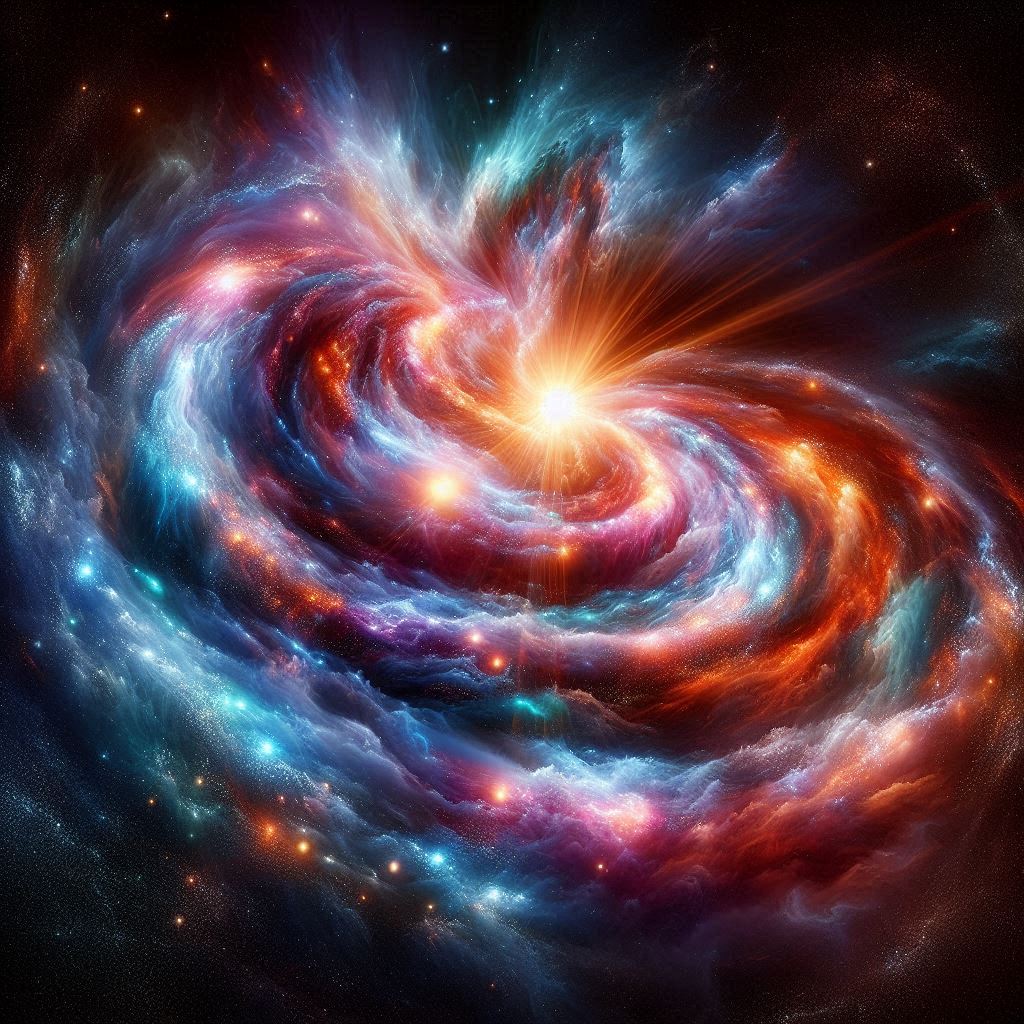
If you could watch the universe in fast-forward, one of the most breathtaking sights would not be exploding stars or blazing comets. Instead, you would witness entire galaxies drifting toward one another in a slow but unstoppable cosmic dance. At first, they would appear as distant islands of light. Then gravity would begin pulling them closer. Their elegant spiral arms would stretch into long glowing streams, stars would be flung into space, clouds of gas would collide, and brilliant new generations of stars would burst into existence.
Eventually, after hundreds of millions or even billions of years, the two galaxies would become one.
These events are known as galactic collisions, and despite the dramatic name, they are among the most beautiful and creative processes in the universe. Rather than simple acts of destruction, galaxy collisions reshape the cosmos. They create new stars, awaken sleeping supermassive black holes, alter the structure of galaxies forever, and help build the giant galaxies we see today.
Even our own home, the Milky Way, is not destined to remain unchanged. Billions of years from now, it will experience one of the greatest collisions in its history when it merges with its neighboring giant, the Andromeda Galaxy.
The universe is constantly changing. Galaxies are not frozen in place. They move, interact, collide, merge, and evolve over cosmic time. Understanding these immense encounters helps astronomers uncover the history of the universe itself.
What Is a Galaxy?
Before exploring galaxy collisions, it helps to understand what a galaxy actually is.
A galaxy is an enormous collection of stars, planets, gas, dust, dark matter, and black holes, all held together by gravity.
Galaxies come in many shapes and sizes. Some contain only a few million stars, while others hold trillions.
The Milky Way, our home galaxy, contains somewhere between 100 and 400 billion stars. It stretches roughly 100,000 light-years across and contains vast clouds of gas where new stars continue to form.
At the center of nearly every large galaxy lies a supermassive black hole millions or even billions of times more massive than the Sun.
Although galaxies appear isolated in photographs, they rarely exist completely alone. Gravity links many of them together into groups and clusters that slowly move through space over billions of years.
Galaxies Are Always Moving
When we look at the night sky, everything appears calm and motionless.
The stars seem fixed.
The constellations barely change during a human lifetime.
But this peaceful appearance is an illusion.
Every galaxy in the universe is moving.
Some travel hundreds of kilometers every second.
Others race through space at more than a thousand kilometers per second.
Gravity constantly pulls galaxies toward one another.
Sometimes they simply pass by.
Sometimes they become trapped in each other’s gravitational pull.
Eventually, many galaxies collide and merge.
These movements happen so slowly that a single collision may take several billion years to complete.
Compared with a human lifetime, the universe moves almost unimaginably slowly.
Why Do Galaxies Collide?
Gravity is responsible for every galactic collision.
Every object with mass attracts every other object.
Although gravity is the weakest of nature’s fundamental forces, it becomes incredibly powerful when enormous masses are involved.
A galaxy contains billions or even trillions of stars.
It also contains vast amounts of dark matter, which adds even more mass.
As galaxies move through space, gravity gradually changes their paths.
Two nearby galaxies may slowly spiral toward one another over billions of years.
The closer they become, the stronger their mutual gravitational attraction.
Eventually, collision becomes unavoidable.
What Does a Galaxy Collision Actually Look Like?
The word “collision” often creates the image of two solid objects crashing together.
Galaxy collisions are very different.
Galaxies are mostly empty space.
Stars are separated by enormous distances.
If the Sun were the size of a tennis ball, the nearest star would still be hundreds of kilometers away.
Because stars are so widely spaced, direct star-to-star collisions are extraordinarily rare.
Instead, gravity does most of the work.
As galaxies pass through one another, their gravitational fields distort their shapes.
Elegant spiral arms stretch into enormous tidal tails.
Stars change their orbits.
Clouds of gas crash together.
New stars ignite.
Black holes begin feeding on fresh material.
The galaxies slowly lose their original identities before eventually becoming one larger galaxy.
The Importance of Dark Matter
Dark matter plays a crucial role in galaxy collisions.
Although it cannot be seen directly, astronomers know it exists because of its gravitational effects.
Every galaxy is surrounded by a vast dark matter halo extending far beyond its visible stars.
When galaxies approach one another, these invisible halos interact first.
Dark matter helps determine how galaxies move, how quickly they merge, and what their final structure becomes.
Without dark matter, the universe would look completely different.
Modern computer simulations show that invisible dark matter dominates the dynamics of most galactic collisions.
The First Encounter
When two galaxies begin approaching each other, the earliest stage appears surprisingly gentle.
At first, nothing dramatic happens.
They continue orbiting within their galaxy group.
Gradually, gravity begins stretching each galaxy.
Stars shift into new orbits.
The graceful spiral arms become distorted.
Long streams of stars extend outward into space.
Astronomers call these structures tidal tails because they form through gravitational tidal forces similar in principle to those that create ocean tides on Earth.
The galaxies may then swing apart temporarily before gravity pulls them back together for another encounter.
The Dance Before the Merger
Most galaxy mergers do not happen in one dramatic event.
Instead, they unfold over multiple close encounters.
After the first pass, gravity slows both galaxies.
They travel apart briefly before turning around.
Each close approach transfers energy.
Stars scatter into different orbits.
Gas clouds become increasingly compressed.
Eventually, the galaxies lose enough orbital energy that they can no longer escape each other.
They spiral inward until their centers merge.
This cosmic dance may last billions of years.
Why Stars Rarely Collide
One of the biggest surprises about galaxy collisions is that individual stars almost never hit one another.
This seems impossible at first.
After all, billions of stars are mixing together.
The explanation lies in scale.
Stars are incredibly small compared with the distances separating them.
Imagine replacing every star with a grain of sand.
The grains would still be separated by kilometers.
Even during a galactic merger, stars usually pass safely by each other.
Instead of collisions, gravity gently redirects their paths.
The galaxies merge because of gravitational interactions rather than direct impacts between stars.
When Gas Clouds Collide
While stars usually avoid direct collisions, enormous clouds of gas do not.
Galaxies contain huge regions filled with hydrogen gas.
These clouds occupy much larger volumes than stars.
As galaxies merge, gas clouds slam together.
The collisions compress the gas.
Compression increases pressure and density.
Eventually, gravity causes portions of the clouds to collapse.
New stars begin forming.
Galaxy collisions often trigger spectacular bursts of star formation known as starbursts.
During these periods, galaxies may produce hundreds or even thousands of times more stars than normal.
Birthplaces of New Stars
Starburst regions are among the brightest places in merging galaxies.
Young stars form rapidly inside dense clouds.
Many of these newborn stars are extremely massive.
Massive stars shine brilliantly but live only a few million years.
Their intense radiation lights up surrounding gas.
They produce enormous stellar winds.
Eventually, they explode as supernovae.
These explosions enrich the galaxy with heavier elements needed for future planets and, ultimately, life.
In this way, galactic collisions become engines of cosmic creation.
Giant Molecular Clouds
The raw material for new stars comes from giant molecular clouds.
These enormous clouds consist mostly of hydrogen molecules mixed with dust.
Some are hundreds of light-years across.
When galaxies collide, these clouds experience intense compression.
Shock waves ripple through them.
Dense knots begin collapsing under gravity.
Each collapsing region eventually forms one or many stars.
Entire star clusters may emerge from a single cloud.
Many of the brightest star-forming regions observed in distant galaxies were likely triggered by mergers.
Supermassive Black Holes Awaken
Almost every large galaxy contains a supermassive black hole at its center.
Normally, many of these black holes remain relatively quiet.
They consume little surrounding material.
Galaxy collisions change that.
The merger funnels enormous amounts of gas toward each galactic center.
The black holes suddenly receive abundant fuel.
As gas spirals inward, it becomes extremely hot.
The infalling material glows brilliantly.
Sometimes the central region becomes so bright that it outshines the entire galaxy.
Astronomers call these incredibly energetic objects active galactic nuclei or quasars, depending on their brightness and distance.
When Black Holes Merge
Eventually, the two central black holes also approach one another.
They orbit each other for millions of years.
As they spiral inward, they emit gravitational waves.
Finally, they merge into one even larger black hole.
The collision releases enormous amounts of energy through gravitational waves that ripple across the universe.
Modern observatories have already detected gravitational waves produced by merging stellar-mass black holes.
Future space-based detectors are expected to observe mergers involving supermassive black holes directly.
The Famous Antennae Galaxies
One of the most spectacular examples of an ongoing galaxy collision is the Antennae Galaxies.
These two spiral galaxies began interacting hundreds of millions of years ago.
Their beautiful tidal tails stretch far into space.
Bright pink star-forming regions shine throughout the system.
Massive clouds of gas continue collapsing into new stars.
Astronomers study the Antennae Galaxies because they provide a glimpse of what many galaxy mergers look like during an active phase.
They offer a remarkable laboratory for understanding galactic evolution.
The Mice Galaxies
Another famous pair is known as the Mice Galaxies.
These two spiral galaxies earned their name because of their long tidal tails, which resemble mouse tails in photographs.
They are in the early stages of merging.
Gravity has already distorted both galaxies.
Future observations over millions of years would reveal increasingly dramatic changes as they continue approaching one another.
The Whirlpool Galaxy
Not every galactic encounter ends with an immediate merger.
The Whirlpool Galaxy provides an excellent example of gravitational interaction.
Its smaller companion has repeatedly passed nearby.
Each close encounter has helped strengthen the Whirlpool Galaxy’s magnificent spiral arms.
The interaction has also stimulated star formation.
Even relatively small neighboring galaxies can dramatically reshape larger galaxies through gravity alone.
Cannibal Galaxies
Large galaxies often grow by absorbing smaller ones.
Astronomers sometimes call this galactic cannibalism.
The Milky Way has likely consumed many dwarf galaxies during its history.
Evidence remains in long streams of stars orbiting our galaxy.
These stellar streams are the remnants of galaxies torn apart by the Milky Way’s gravity.
This process continues today.
Our galaxy is still slowly absorbing smaller companions.
Galactic growth through mergers has played a major role throughout cosmic history.
The Milky Way’s Future Collision
One of the most fascinating future events in astronomy involves our own galaxy.
The Milky Way and the Andromeda Galaxy are moving toward one another.
Their relative speed is about 110 kilometers per second.
Current observations indicate they will begin interacting in roughly 4 to 5 billion years.
Their first close encounter will dramatically reshape both galaxies.
Spiral arms will stretch.
Star formation will increase.
Eventually, after several passes, they will merge into one enormous galaxy.
Astronomers sometimes nickname this future galaxy “Milkomeda.”
Will Earth Survive?
Whenever people hear about the future Milky Way-Andromeda collision, one question naturally follows.
What will happen to Earth?
Fortunately, direct collisions between stars are extremely unlikely.
Our Solar System will probably remain intact.
However, its orbit around the galactic center could change.
The night sky would become astonishingly beautiful.
Andromeda would gradually grow larger over millions of years until it filled much of the sky.
Brilliant streams of stars would arc across the heavens.
If humanity still exists at that distant time, future observers would witness the greatest celestial spectacle imaginable.
Of course, long before the final merger is complete, the Sun itself will be approaching the end of its life, making Earth’s long-term habitability a separate challenge.
How Astronomers Observe Galactic Collisions
Because galaxy collisions unfold over billions of years, astronomers cannot watch a single merger from beginning to end.
Instead, they study many different galaxies.
Some are just beginning to interact.
Others are midway through merging.
Still others have nearly finished.
Together, these galaxies form a kind of cosmic photo album.
By comparing thousands of systems, scientists reconstruct the complete sequence of events.
Computer simulations then test whether the proposed histories match observations.
The agreement is often remarkable.
The Role of Space Telescopes
Modern space telescopes have transformed our understanding of galaxy collisions.
They observe wavelengths of light that Earth’s atmosphere blocks.
Infrared observations reveal hidden star-forming regions buried inside dust.
Ultraviolet light highlights young hot stars.
X-rays expose energetic black holes.
Radio telescopes map enormous hydrogen clouds.
By combining observations across the electromagnetic spectrum, astronomers create a much more complete picture of galactic interactions.
Simulating Galactic Collisions
Powerful supercomputers allow scientists to recreate galaxy mergers digitally.
These simulations include billions of virtual particles representing stars, gas, and dark matter.
Gravity governs every interaction.
As time advances, galaxies naturally collide, stretch, merge, and evolve.
Many simulated galaxies closely resemble real observations.
This agreement strengthens confidence that astronomers understand the basic physics driving galactic evolution.
Simulations also allow researchers to predict future collisions, including the merger between the Milky Way and Andromeda.
Why Galaxy Collisions Were More Common in the Early Universe
The young universe looked very different from today’s cosmos.
Galaxies were much closer together.
Space had expanded less than it has today.
Frequent interactions occurred.
Small galaxies repeatedly merged to create larger ones.
This process helped build the massive galaxies visible today.
Looking deep into space means looking back in time.
Many distant galaxies observed by modern telescopes appear irregular and distorted because collisions were much more common billions of years ago.
Elliptical Galaxies Often Form Through Mergers
Many astronomers believe giant elliptical galaxies are the products of repeated mergers.
Spiral galaxies possess orderly rotating disks.
Major mergers scramble stellar orbits.
The final result often becomes a smooth, rounded elliptical galaxy.
These galaxies contain relatively little cold gas.
Star formation gradually slows.
Most remaining stars become older and redder.
Thus, galaxy collisions influence not only galactic size but also galactic appearance and future evolution.
Cosmic Recycling
Galaxy collisions recycle matter throughout the universe.
Stars explode as supernovae.
Their heavier elements spread into surrounding gas.
New stars form from enriched material.
Planets develop around those stars.
Some planets may eventually support life.
The carbon in our bodies, the oxygen we breathe, the calcium in our bones, and the iron in our blood were forged inside ancient stars long before the Solar System existed.
Galactic collisions help redistribute these essential ingredients across the cosmos.
In a very real sense, cosmic destruction becomes cosmic renewal.
Do Galaxy Collisions Ever Stop?
The answer depends on where we look.
Within galaxy groups and clusters, mergers continue today.
Over immense stretches of time, however, the universe’s expansion driven by dark energy will increasingly separate distant galaxy groups.
Eventually, many groups may become isolated islands surrounded by expanding emptiness.
Local mergers will still occur, but encounters between extremely distant galaxy groups will become increasingly rare.
The universe is constantly evolving.
Its future will differ dramatically from its past.
What Galactic Collisions Teach Us
Studying galaxy mergers teaches astronomers far more than how galaxies interact.
These events reveal the distribution of dark matter.
They help explain black hole growth.
They illuminate the history of star formation.
They provide clues about how galaxies acquired their present shapes.
They even help scientists understand how environments suitable for planets and life developed over cosmic history.
Every collision preserves information about billions of years of cosmic evolution.
The Beauty Hidden Within Destruction
At first glance, the phrase “galactic collision” sounds violent and catastrophic.
Yet these encounters are among the universe’s greatest acts of creation.
They trigger the birth of countless stars.
They reshape galaxies into new forms.
They awaken dormant black holes.
They spread the ingredients needed for future generations of planets.
The destruction we imagine is, in reality, transformation.
Nature rarely wastes anything.
Instead, it continually rebuilds.
Conclusion
Galaxy collisions are among the most magnificent events in the universe. They unfold over billions of years, driven by gravity, reshaping entire galaxies without the dramatic star-to-star crashes that many people imagine. Instead, these immense encounters gently rearrange stars, compress enormous clouds of gas, ignite spectacular waves of star formation, and feed the supermassive black holes hidden within galactic centers.
Far from being rare accidents, galaxy mergers are a fundamental part of cosmic evolution. They have helped build the giant galaxies we observe today, including our own Milky Way. The evidence written across the night sky tells a story of continual growth, interaction, and renewal. Every distorted spiral arm, glowing tidal tail, and brilliant starburst region reveals another chapter in that story.
Perhaps the most remarkable realization is that our own galaxy is part of this grand narrative. Billions of years from now, the Milky Way and Andromeda will begin a slow, graceful merger that will transform both galaxies into something entirely new. Although humanity will almost certainly not witness the final outcome, the knowledge that our cosmic home is still evolving reminds us that the universe is alive with motion and change.
In the end, galaxy collisions teach us one of astronomy’s most profound lessons. Even on the largest scales imaginable, endings often become beginnings. From immense gravitational encounters emerge new stars, new structures, and new possibilities, proving once again that the universe is not simply a place of destruction, but a vast and beautiful engine of continuous creation.