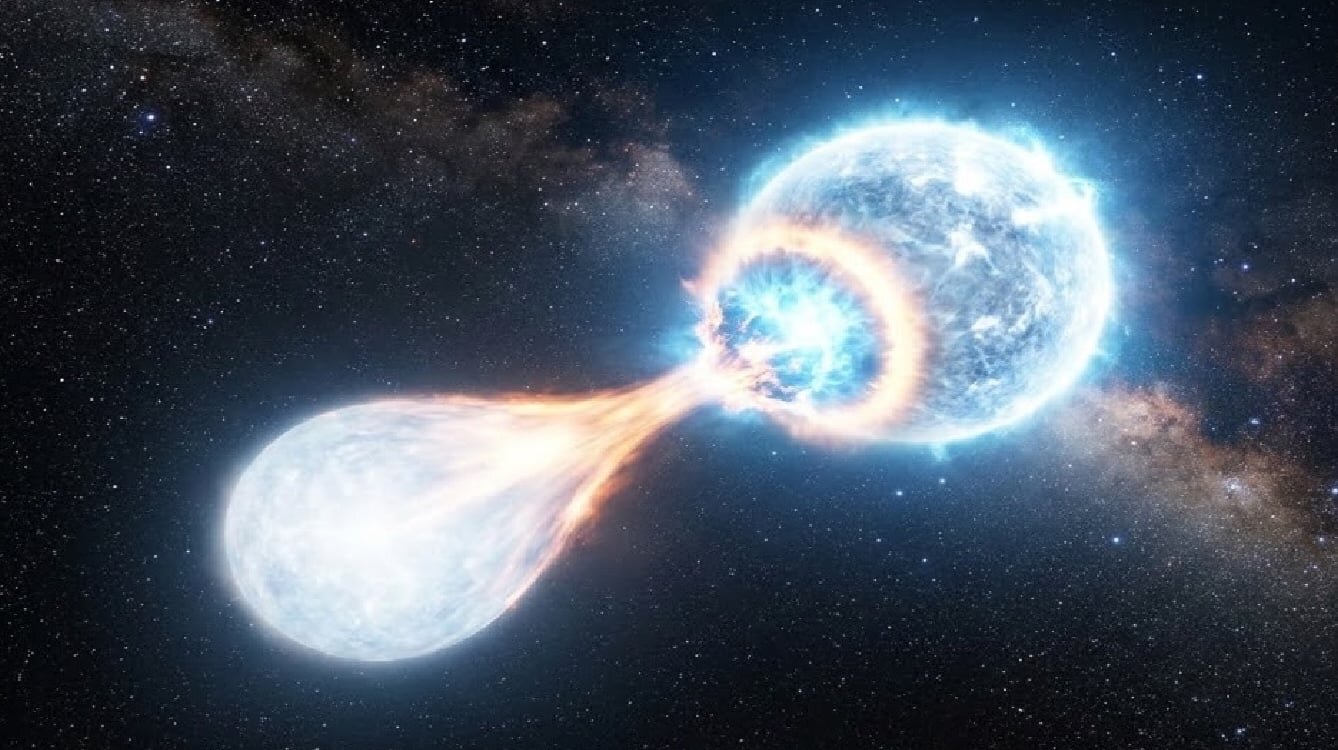
Every 374 seconds, the ultracompact binary eRASSU J060839.5–704014 completes another orbit, but that orbit is getting shorter. Over about 3.5 years of X-ray observations, the system’s orbital period was measured to be shrinking at a rate of 4.7 × 10⁻¹¹ seconds per second, placing it among the most rapidly evolving ultracompact double-white-dwarf systems currently known.
The result comes from a phase-coherent timing analysis that connected observations from NASA’s Neutron Star Interior Composition Explorer, or NICER, the Einstein Probe Follow-up X-ray Telescope, and archival XMM-Newton data. Together, the observations establish a coherent orbital period of 374.15013 seconds and reveal a clear quadratic evolution in the timing of the X-ray pulses.
The source was already known as an ultracompact double-degenerate candidate in the direction of the Large Magellanic Cloud. Its roughly 6.2-minute period places it among the most compact known white dwarf binaries. Systems this compact can have matter transferred directly from one white dwarf onto the surface of the other rather than through a conventional accretion disk, a configuration known as direct-impact accretion.
What makes eRASSU J060839.5–704014 particularly notable is how quickly its orbit is changing.
Three and a half years of timing reveal the shrinking orbit
The researchers first identified a strong orbital signal near 374.15 seconds in the NICER and Einstein Probe observations. A search using the NICER data indicated that the period was already changing, with an estimated derivative of about −4.5 × 10⁻¹¹ seconds per second over roughly a year.
To establish whether that change persisted over a longer interval, the researchers connected measurements from all three X-ray observatories. The NICER and Einstein Probe observations covered about 478 days, while the earlier XMM-Newton observation extended the overall timing baseline to about 3.5 years.
The phase measurements follow a clear quadratic trend. The curvature is important because a simple error in the assumed orbital period would produce a linear timing trend. The observed curvature instead requires a nonzero orbital-frequency derivative.
The combined timing solution gives an orbital period of 374.15013 ± 0.00002 seconds and an orbital period derivative of −4.7 ± 0.1 × 10⁻¹¹ seconds per second.
The measurement is not perfectly described by statistical uncertainties alone. The researchers found additional scatter in the measured phases, particularly in the NICER observations, and modeled it with an intrinsic phase-jitter term of 0.019 ± 0.003 cycles. They note that this type of phase variability has also been seen in NICER observations of HM Cnc, another ultracompact double-degenerate system.
Even with that additional variability accounted for, the long-term timing data support the rapid orbital decay.
Gravitational radiation provides the leading explanation
In an ultracompact binary, the orbit can lose angular momentum through gravitational-wave emission. The researchers examined whether the observed orbital decay could be explained by that process.
They considered the effects of mass transfer as well as other possible sources of angular-momentum loss. Using representative white dwarf masses of 0.6–1.0 solar masses for the accretor and 0.05–0.25 solar masses for the donor, they found that the contribution from the observed mass transfer to the orbital evolution would be about 10⁻¹⁹ seconds per second.
That is many orders of magnitude smaller than the gravitational-radiation contribution estimated for the system. On that basis, the authors conclude that the observed orbital evolution is currently dominated by gravitational radiation.
The conclusion comes with an important qualification. Other mechanisms can contribute to angular-momentum loss. In a unipolar-inductor interpretation, for example, spin-orbit coupling can exchange angular momentum between the stars. For the range of distances considered by the researchers and a typical assumed degree of spin-orbit asynchronism, the associated dissipation can be comparable to the gravitational-wave luminosity.
The authors therefore treat the gravitational-wave interpretation as an assumption when deriving the system’s chirp mass rather than as an independently established measurement of the masses.
Under the assumption that gravitational radiation alone drives the measured orbital decay, the inferred chirp mass is about 0.43 solar masses. The paper notes that this value is higher than those inferred for other double-degenerate binaries in the comparison sample and places eRASSU J060839.5–704014 toward the upper end of the known ultracompact population.
Because additional angular-momentum-loss mechanisms may be present, the authors regard the inferred chirp mass as an upper limit.
The X-rays come from a small, changing region
The timing signal is accompanied by an unusual pattern in the system’s soft X-ray emission.
The X-ray light curve shows nearly 100% modulation, with emission concentrated during roughly half of the orbit. During the remaining part of the cycle, statistically significant source emission is absent and the background dominates.
The phase-averaged X-ray spectrum is supersoft. Both NICER and Einstein Probe data are well described by an absorbed blackbody, with temperatures of 126 ± 3 electron volts and 144 ± 3 electron volts, respectively.
The two instruments give slightly different temperatures and blackbody normalizations. The researchers attribute those differences primarily to instrumental calibration uncertainties and the strong covariance between absorption and temperature when modeling such soft spectra. Intrinsic changes in the accretion flow are also considered possible.
The NICER data give an unabsorbed 0.2–2 keV flux of about 5 × 10⁻¹³ erg cm⁻² s⁻¹. The corresponding emission radius inferred from the blackbody normalization is about 1.5 times the distance in kiloparsecs, in kilometers.
The source is believed to lie in the foreground of the Large Magellanic Cloud, but its distance is uncertain. For a distance of roughly 1–2 kiloparsecs, the inferred emitting region would be about 1–3 kilometers across.
That size and the observed spectral behavior are consistent with the direct-impact accretion interpretation, according to the authors, although better distance measurements are needed to distinguish definitively between direct-impact accretion and the alternative unipolar-inductor scenario.
The emitting region changes across the orbit
The strongest clue about the X-ray-emitting region comes from spectroscopy performed at different orbital phases.
During the bright portion of the orbit, the blackbody temperature changes systematically rather than remaining constant. In the NICER observations, it falls from about 139 electron volts near the pulse peak to about 99 electron volts toward the declining part of the pulse. In the Einstein Probe data, it decreases from about 154 electron volts to about 130 electron volts.
The blackbody normalization and X-ray flux change in the same general pattern. Both reach their highest values near the pulse maximum and decline toward the end of the bright phase.
The authors interpret this smooth evolution as evidence that the emitting region is not simply a point-like hotspot. Instead, they suggest it is an extended structure with significant temperature gradients along the accretion flow.
The absence of significant source emission during the off-state is also consistent with a localized emitting region that is largely self-occulted during part of the orbit.
This behavior resembles the phase-dependent temperature changes seen in HM Cnc, although the emission radius in HM Cnc was found to remain approximately constant with orbital phase, unlike the behavior measured here.
A rapidly evolving member of a rare class
The orbital period and its derivative distinguish eRASSU J060839.5–704014 from many other ultracompact binaries.
Its 374-second period is longer than the 321.5-second period of HM Cnc, yet its measured period derivative of −4.7 × 10⁻¹¹ seconds per second is slightly larger in magnitude than the −3.677 × 10⁻¹¹ seconds per second measured for HM Cnc. It is also substantially larger in magnitude than the −2.27 × 10⁻¹² seconds per second measured for V407 Vul, which has an orbital period of about 569 seconds.
The combination of an extremely short orbital period, nearly complete soft X-ray modulation and rapid long-term orbital decay closely resembles the behavior of HM Cnc and V407 Vul. The authors therefore identify eRASSU J060839.5–704014 as belonging to the same rare class of ultracompact double-degenerate systems.
The study also estimates the gravitational-wave signal expected under its adopted assumptions. For a four-year mission duration, the characteristic strain is estimated at roughly 6 × 10⁻¹⁹ divided by the distance in kiloparsecs, with a gravitational-wave frequency near 5 millihertz. The authors describe the source as a promising candidate for future low-frequency gravitational-wave observations.
For now, however, the central measurement is the changing orbit itself. Continued monitoring is needed to further constrain the system’s orbital evolution, accretion geometry and distance, and to determine more precisely how gravitational radiation and other possible mechanisms contribute to its rapid evolution.
The study was published in The Astrophysical Journal Letters.