Dark matter is one of the greatest mysteries ever encountered by science. It does not glow, reflect, or absorb light. It cannot be seen with telescopes. It does not interact with the world the way ordinary matter does. And yet, without it, the universe as we know it could not exist. Galaxies would fly apart, cosmic structures would never form, and the story of the universe would be radically different.
Dark matter is not science fiction. It is a scientifically grounded concept supported by overwhelming evidence. It is everywhere, surrounding us, passing through us, shaping the cosmos on the largest scales, while remaining profoundly elusive. To contemplate dark matter is to stand at the edge of human understanding and peer into the unknown.
Here are five mind-blowing truths about dark matter that reveal not only what it is, but why it fundamentally changes how we understand reality itself.
1. Most of the Universe Is Made of Something We Cannot See
One of the most unsettling truths about dark matter is how dominant it is. Everything you have ever seen—stars, planets, galaxies, gas clouds, dust, oceans, mountains, and even your own body—makes up only a small fraction of what exists in the universe. Ordinary matter, known scientifically as baryonic matter, accounts for only about five percent of the total cosmic content. Dark matter makes up roughly twenty-seven percent, while the rest is dark energy.
This means that the universe is not primarily composed of the familiar atoms and molecules that form our everyday reality. Instead, it is dominated by an invisible substance that does not emit light and cannot be directly detected by traditional instruments. When astronomers map the mass of galaxies and galaxy clusters, they consistently find far more mass than can be explained by visible matter alone.
The realization that most of the universe is invisible was not immediate. It emerged gradually through careful observation. When scientists measured how fast stars orbit the centers of galaxies, they found something deeply strange. The outer stars were moving far too quickly. According to known laws of physics, they should have been flung into space. The only explanation was that an enormous amount of unseen mass was providing the gravitational glue holding galaxies together.
This invisible mass was not localized in stars or gas. It formed vast halos around galaxies, extending far beyond their visible edges. These halos dominate the gravitational landscape of the cosmos. Without them, galaxies would never have formed or survived.
Emotionally, this truth is humbling. We live in a universe where almost everything that matters gravitationally is hidden from view. Our senses evolved to perceive light, sound, and touch, yet the universe operates largely beyond those channels. Dark matter forces us to confront the limits of human perception and accept that reality is far richer—and stranger—than what we can see.
2. Dark Matter Is Real Because Gravity Never Lies
Despite its invisibility, dark matter leaves unmistakable fingerprints on the universe. Its existence is inferred not through speculation, but through gravity. Gravity is the one force dark matter appears to interact with reliably, and it does so with devastating clarity.
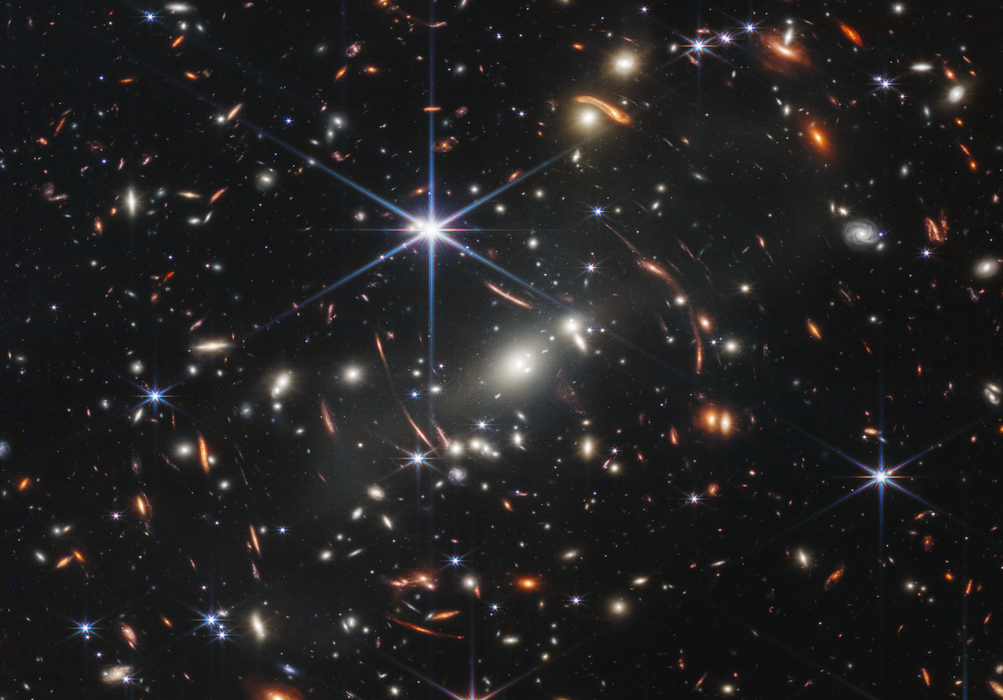
One of the strongest pieces of evidence for dark matter comes from gravitational lensing. Massive objects bend spacetime, causing light from distant sources to curve as it passes by. When astronomers observe how light from background galaxies is distorted, they can map the distribution of mass in the foreground. These maps consistently reveal enormous amounts of mass where no visible matter exists.
In some of the most dramatic observations, galaxy clusters collide with one another. When this happens, ordinary matter—mostly hot gas—slows down and interacts, emitting X-rays. Dark matter, however, passes straight through, unaffected by electromagnetic forces. Gravitational lensing shows that most of the mass moves with the invisible component, not the glowing gas. This separation provides powerful, visual evidence that dark matter is a real, distinct substance.
The early universe offers further proof. Measurements of the cosmic microwave background—the faint afterglow of the Big Bang—reveal tiny fluctuations in temperature that reflect the distribution of matter shortly after the universe began. These patterns can only be explained if dark matter was present, shaping the growth of cosmic structures from the very beginning.
Gravity does not deceive. It responds only to mass and energy. The fact that gravitational effects cannot be accounted for by visible matter alone leaves no room for doubt. Something else is there, exerting its influence silently and persistently.
This truth reshapes our trust in observation. Even when something cannot be seen, it can still be known. Dark matter reminds us that science is not limited to the visible—it is anchored in evidence, logic, and the universal language of physical law.
3. Dark Matter Is Not Just Ordinary Matter Hiding in the Dark
At first glance, one might imagine that dark matter is simply made of familiar things we cannot see, such as faint stars, cold gas, or black holes. Scientists explored these possibilities extensively. However, careful measurements have shown that these objects cannot account for the amount or behavior of dark matter observed in the universe.
The problem is both quantity and behavior. There simply is not enough ordinary matter available to explain the gravitational effects attributed to dark matter. The abundance of light elements produced shortly after the Big Bang places strict limits on how much ordinary matter can exist. These limits are far below what would be needed to explain galaxy rotation and cosmic structure.
Furthermore, dark matter behaves differently from ordinary matter. It does not clump into stars or planets. It does not collapse into disks. It forms diffuse, spherical halos rather than dense structures. This suggests that dark matter does not interact with itself or with other matter in the same way atoms do.
The leading hypothesis is that dark matter is made of new, undiscovered particles. These particles would be electrically neutral, massive, and only weakly interacting. They would pass through ordinary matter almost effortlessly, rarely colliding with atoms or molecules. Trillions of dark matter particles could be passing through your body every second without leaving a trace.
This idea is staggering. It suggests that the universe contains entire categories of matter fundamentally different from anything we have directly observed. The particles that make up dark matter may obey laws we have not yet uncovered, hinting at deeper layers of reality beneath the Standard Model of particle physics.
Emotionally, this truth expands our sense of wonder. The universe is not just bigger than we imagined—it is more diverse. Nature may be filled with forms of matter that challenge our most basic assumptions about what “stuff” is.
4. Dark Matter Shaped the Universe Before Light Existed
One of the most profound truths about dark matter is that it shaped the universe long before the first stars ignited. In the earliest moments after the Big Bang, the universe was hot, dense, and nearly uniform. Tiny fluctuations in density existed, but ordinary matter was tightly coupled to radiation, preventing it from clumping effectively.
Dark matter, however, did not interact with light. It was free to respond to gravity alone. As a result, dark matter began forming structures early, creating gravitational wells into which ordinary matter later fell. These invisible scaffolds guided the formation of galaxies, clusters, and the vast cosmic web that spans the universe.
Without dark matter, the universe would look radically different. Ordinary matter alone could not have formed galaxies within the available time. The universe would be smoother, emptier, and far less structured. Stars and planets might never have formed at all.
In this sense, dark matter is the architect of the cosmos. It laid the groundwork for everything that followed, including the conditions necessary for life. The galaxies that host stars, the stars that forge elements, and the planets that support biology all owe their existence to the gravitational influence of dark matter.
This truth carries a quiet emotional weight. Everything familiar—every atom in your body—exists because of something utterly unfamiliar. Our very existence is intertwined with an invisible substance that predates light itself.
Dark matter is not a cosmic afterthought. It is a foundational element of the universe’s history, shaping reality from its earliest moments.
5. Dark Matter May Redefine the Future of Physics
Despite decades of research, dark matter has never been directly detected in a laboratory. Experiments around the world are designed to catch rare interactions between dark matter particles and ordinary matter. Underground detectors shielded from cosmic radiation wait patiently for tiny flashes of energy that might signal a collision. Space-based instruments search for subtle signatures in cosmic rays. Particle accelerators attempt to create dark matter in high-energy collisions.
So far, the silence has been deafening. Yet this absence of detection is itself deeply informative. It tells us that dark matter interacts extraordinarily weakly, if at all, with known forces beyond gravity. This pushes physics into uncharted territory.
Some theories suggest that dark matter may be part of an entirely hidden sector of physics, with its own forces and particles. Others propose that our understanding of gravity itself may need revision under extreme conditions. While modifications to gravity alone struggle to explain all observations, they highlight how radical the implications of dark matter truly are.
The discovery of dark matter particles would revolutionize physics. It would reveal new fundamental components of nature, expand our understanding of forces, and potentially unify disparate areas of science. Even ruling out certain candidates sharpens our picture of what the universe allows.
Dark matter stands at the frontier of human knowledge. It represents the boundary between what we understand and what we have yet to imagine. Solving the dark matter puzzle could reshape cosmology, particle physics, and our philosophical view of reality.
Emotionally, this truth captures the spirit of scientific exploration. Dark matter reminds us that the universe still holds secrets vast enough to humble our greatest theories. It invites curiosity, patience, and awe.
The Deeper Meaning of Dark Matter
Dark matter is not just an astrophysical problem. It is a mirror held up to humanity’s quest for understanding. It teaches us that absence can be as meaningful as presence, that invisibility does not imply insignificance, and that reality is not obligated to conform to our expectations.
We live in a universe where most of what matters cannot be seen, touched, or easily explained. And yet, through careful observation, reasoning, and imagination, we have uncovered its influence. Dark matter shows that knowledge does not always come from direct experience—it often emerges from patterns, effects, and consequences.
In a profound way, dark matter parallels the human condition. Much of what shapes us—our thoughts, emotions, histories, and connections—is invisible. Yet these unseen forces define who we are, just as dark matter defines the universe.
As science advances, we may one day identify the true nature of dark matter. Or we may discover something even stranger, something that forces us to rethink the foundations of physics itself. Either way, the journey matters as much as the destination.
Dark matter reminds us that the universe is not finished revealing itself. There is more out there than meets the eye, more structure beneath the surface, and more wonder waiting to be discovered.