For thousands of years, comets have inspired awe, fear, wonder, and curiosity. Long before scientists understood what they were, these glowing celestial visitors were often seen as omens from the heavens. Kings, emperors, and ordinary people alike watched them streak across the night sky, believing they foretold wars, disasters, or great changes. Today, we know that comets are natural objects left over from the formation of the Solar System about 4.6 billion years ago. Yet despite the scientific explanation, their beauty remains just as captivating.
Unlike planets, which follow predictable paths across the sky, bright comets often appear unexpectedly and can transform the night into an unforgettable spectacle. Some develop tails stretching millions of kilometers, while others become so brilliant that they are visible during daylight. A few have been witnessed by countless generations throughout recorded history, while others have dazzled humanity only once and may never return.
The following are ten of the most beautiful comets ever observed. Each earned its place not only because of its brightness but also because of its remarkable appearance, historical significance, and the lasting impression it left on those fortunate enough to witness it.
1. Halley’s Comet
Few celestial objects are as famous as Halley’s Comet. Officially designated 1P/Halley, it is the most well-known periodic comet and the only one that can regularly be seen with the naked eye over the course of a human lifetime.
Halley’s Comet completes one orbit around the Sun approximately every 75 to 76 years. It has been recorded for more than two thousand years, with observations dating back to at least 240 BCE in ancient Chinese chronicles. The English astronomer Edmond Halley realized that several bright comets observed over centuries were actually the same object returning periodically. He correctly predicted its return in 1758, after his death, proving that comets orbit the Sun rather than appearing randomly.
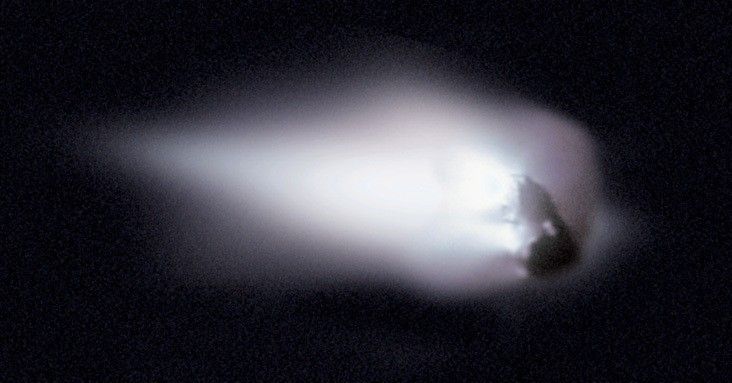
The comet’s appearance has often been breathtaking. During its 1910 passage, Earth briefly passed through part of its tail, creating worldwide excitement and, in some places, unnecessary panic. Although its 1986 return was less visually impressive because of its unfavorable position relative to Earth, spacecraft from several nations visited it for the first time, revealing a dark, icy nucleus releasing jets of gas and dust.
Halley’s Comet combines historical importance with enduring beauty, making it one of the greatest celestial icons in history.
2. Comet Hale-Bopp
When people think of spectacular modern comets, Hale-Bopp almost always comes to mind.
Discovered independently by Alan Hale and Thomas Bopp in July 1995, Comet Hale-Bopp became one of the brightest and longest-observed naked-eye comets of the twentieth century. It remained visible without optical aid for about 18 months, an extraordinarily long period that few comets have ever matched.
One of Hale-Bopp’s most striking features was its two distinct tails. The broad, curved dust tail glowed with reflected sunlight, while the narrower blue ion tail pointed directly away from the Sun under the influence of the solar wind. Together they created an unforgettable display stretching across the night sky.
Its enormous nucleus, estimated to be tens of kilometers across, produced tremendous amounts of gas and dust as it approached the Sun. Even observers in brightly lit cities could easily see the comet, while those under dark skies witnessed a magnificent object dominating the heavens.
For millions of people around the world, Hale-Bopp remains the most beautiful comet they have ever seen.
3. Comet NEOWISE
Comet C/2020 F3 (NEOWISE) arrived during a year when much of the world was coping with the COVID-19 pandemic. Amid uncertainty and isolation, this brilliant comet offered people a rare opportunity to reconnect with the night sky.
Discovered by NASA’s NEOWISE space telescope in March 2020, the comet survived its close passage around the Sun despite expectations that it might disintegrate. Instead, it emerged brighter than anticipated.
Its long golden dust tail and faint blue ion tail created spectacular photographs visible across the Northern Hemisphere. Even casual skywatchers with little astronomical experience were able to locate it shortly after sunset or before sunrise.
The comet became one of the brightest visible in the Northern Hemisphere in more than two decades. Social media filled with breathtaking images showing NEOWISE above mountains, forests, lakes, deserts, and famous landmarks, making it one of the most photographed comets in history.
4. The Great Comet of 1811
Long before photography existed, the Great Comet of 1811 amazed observers throughout Europe, Asia, Africa, and North America.
Officially known as C/1811 F1, this comet remained visible to the naked eye for approximately nine months. Such an extended display is exceptionally rare.
Its immense coma—the glowing cloud surrounding the nucleus—was among the largest ever recorded. The comet’s dust tail stretched across a significant portion of the sky, making it a magnificent sight for months.
Interestingly, the comet appeared during a year of exceptional grape harvests in parts of Europe. This coincidence led many wine enthusiasts to associate the “Comet Vintage” with unusually fine wines, although there is no scientific connection between the comet and agricultural success.
Astronomically, the Great Comet of 1811 remains one of history’s most memorable long-lasting celestial visitors.
5. Comet McNaught
Comet C/2006 P1 (McNaught) earned the title of the brightest comet observed in more than four decades.
Discovered by Australian astronomer Robert McNaught in August 2006, the comet reached extraordinary brilliance during January 2007. At its peak, it became visible even during daylight under suitable conditions.
Observers in the Southern Hemisphere witnessed perhaps its greatest display. The comet developed an enormous fan-shaped dust tail divided into numerous delicate streamers. These graceful ribbons of light spread across the sky in an appearance unlike almost any other comet ever photographed.
The intricate structure of its tail resulted from tiny dust particles released at different times as the comet approached the Sun. Sunlight illuminated these particles, creating one of the most stunning celestial scenes of the modern era.
Many astronomers regard McNaught as the finest comet since the Great Comet of 1965.
6. Comet Hyakutake
Comet C/1996 B2 (Hyakutake) appeared unexpectedly early in 1996 and rapidly became one of the most spectacular comets of the twentieth century.
Discovered by Japanese amateur astronomer Yuji Hyakutake only a few months before its closest approach, the comet passed unusually close to Earth—about 15 million kilometers away—in March 1996.
Its proximity made it appear exceptionally large in the night sky. Although its nucleus was relatively modest in size, the comet’s tail extended an astonishing distance through space.
Ultraviolet observations later revealed that Hyakutake possessed one of the longest known comet tails, stretching hundreds of millions of kilometers. While only part of this immense tail was visible to the naked eye, it created a breathtaking celestial arc spanning much of the sky.
For observers lucky enough to experience it under dark skies, Hyakutake became an unforgettable astronomical event.
7. The Great Comet of 1882
Among all known sungrazing comets, the Great Comet of 1882 stands out for its extraordinary brilliance.
Officially designated C/1882 R1, it belonged to the Kreutz family of sungrazing comets, whose members pass extremely close to the Sun.
As it approached perihelion, the comet became so bright that it could easily be seen in broad daylight. Even when located very close to the Sun in the sky, observers could detect it without telescopes.
The intense solar heat caused the nucleus to fragment into multiple pieces. Rather than diminishing its beauty, the fragmentation created a fascinating appearance as several bright fragments continued traveling together.
Astronomers studied the comet extensively, providing valuable insights into cometary behavior near the Sun.
8. Comet West
Comet C/1975 V1 (West) was one of the greatest disappointments—and greatest surprises—in modern astronomy.
Initially, astronomers expected only a moderately bright comet. Instead, as it approached the Sun in early 1976, it brightened dramatically.
Observers who ventured outside before sunrise witnessed an extraordinary spectacle. The comet developed a brilliant head and a long, luminous tail that dominated the morning sky.
Near perihelion, its nucleus split into several fragments. Despite this breakup, Comet West produced one of the most beautiful naked-eye displays of the twentieth century.
Unfortunately, many people in the Northern Hemisphere missed its peak because poor weather and unfavorable timing limited visibility. Those who saw it, however, often described it as one of the finest comets of their lives.
9. The Great Comet of 1577
The Great Comet of 1577 holds a unique place in both astronomy and history.
Visible across Europe, Asia, Africa, and the Americas, the comet remained in the sky for several months and attracted widespread attention.
Its greatest scientific significance came from the careful observations of Danish astronomer Tycho Brahe. By measuring its apparent position against background stars, Brahe demonstrated that the comet lay far beyond Earth’s atmosphere.
This discovery challenged the long-standing Aristotelian belief that the heavens were perfect and unchanging.
Visually, the comet displayed a bright nucleus and an elegant tail stretching high across the sky, inspiring artists, scholars, and ordinary observers alike.
Its beauty was matched by its profound influence on the development of modern astronomy.
10. Comet Ikeya-Seki
Comet C/1965 S1 (Ikeya-Seki) is often described as one of the greatest sungrazing comets ever observed.
Discovered independently by Japanese amateur astronomers Kaoru Ikeya and Tsutomu Seki in September 1965, the comet passed extraordinarily close to the Sun.
At its brightest, it became visible in daylight and rivaled the brilliance of the full Moon when viewed near the Sun under appropriate conditions.
The extreme solar heating caused the nucleus to break into multiple fragments, but not before producing a magnificent tail visible across much of the sky.
Its spectacular appearance attracted worldwide attention and provided astronomers with valuable opportunities to study how comets behave under intense solar conditions.
Even today, Ikeya-Seki is remembered as one of the brightest and most dramatic comets ever recorded.
Why Some Comets Become So Beautiful
Not every comet becomes a spectacular object. Most remain too faint to see without telescopes.
A comet’s beauty depends on several factors, including the size of its icy nucleus, the amount of gas and dust it releases, its distance from both the Sun and Earth, and the angle from which it is viewed. As sunlight warms the nucleus, frozen water, carbon dioxide, carbon monoxide, and other volatile substances sublimate directly into gas. This escaping material carries dust into space, forming the glowing coma and tails that make comets so visually striking.
The dust tail reflects sunlight and often appears white or golden, while the ion tail glows blue because ionized gases interact with the solar wind. Since these two tails form through different physical processes, they frequently point in slightly different directions, creating the elegant double-tail appearance seen in famous comets like Hale-Bopp and NEOWISE.
The Scientific Importance of Comets
Beyond their beauty, comets are invaluable scientific treasures.
They are often described as frozen time capsules because they preserve primitive material from the earliest stages of the Solar System. Many formed in the distant Kuiper Belt or the even more remote Oort Cloud, where they remained largely unchanged for billions of years.
By studying their composition, scientists gain insights into the conditions that existed when the planets were forming. Space missions such as the European Space Agency’s Rosetta mission, which successfully orbited and landed on Comet 67P/Churyumov–Gerasimenko, have revealed complex organic molecules and provided clues about the origins of water and the chemical ingredients necessary for life.
Although researchers continue to investigate how much comets contributed to Earth’s water and organic compounds, they remain among the most important objects for understanding the history of our Solar System.
A Timeless Wonder in the Night Sky
Every bright comet is a reminder that the Solar System is far from static. These icy travelers spend most of their existence in the darkness beyond the planets before making brief, spectacular visits to the inner Solar System. Some return every few decades, while others disappear for thousands or even millions of years before reappearing. A few pass the Sun only once and then leave forever on journeys into interstellar space.
For ancient civilizations, comets were mysterious signs written across the heavens. For modern scientists, they are relics of planetary formation and laboratories for studying the earliest building blocks of the Solar System. For everyone fortunate enough to witness a brilliant comet, however, they remain something even more profound—a breathtaking reminder that the universe still has the power to surprise, inspire, and fill us with wonder whenever we look up at the night sky.