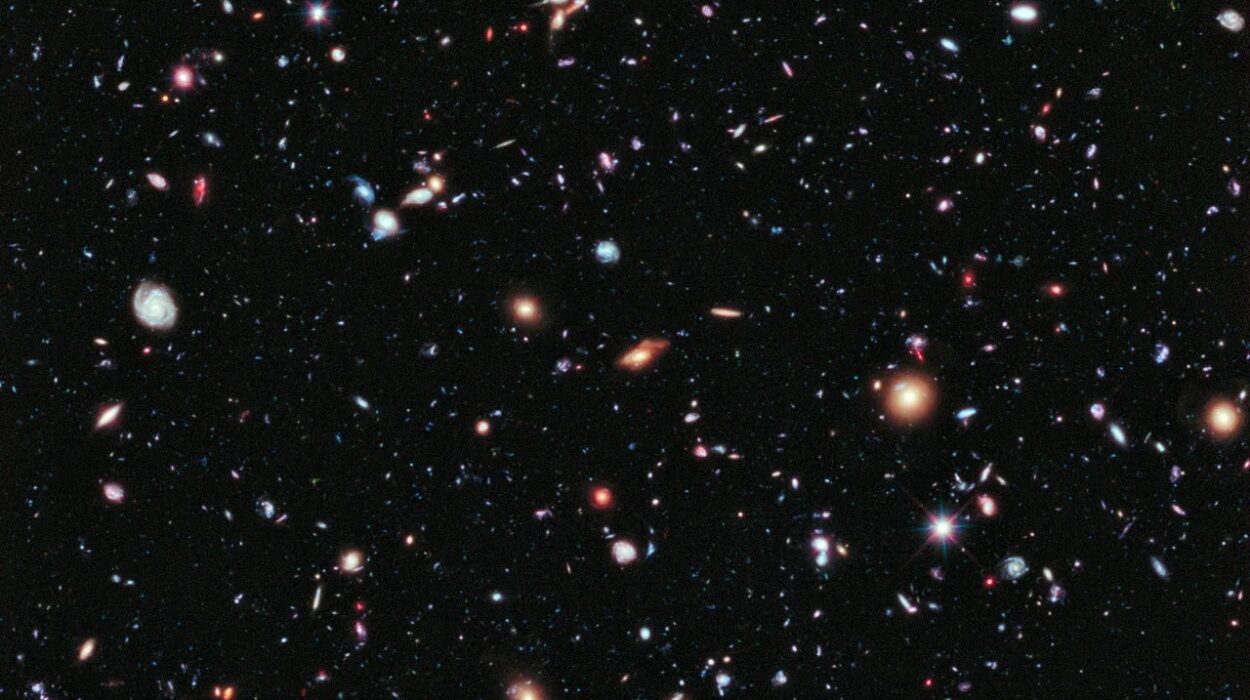
Galaxies come in several distinct shapes, from graceful spirals with sweeping arms to smooth, rounded collections of stars and chaotic systems with no recognizable structure. These differences are more than visual. A galaxy’s shape provides important clues about its stars, gas, dust, age distribution, star formation, and evolutionary history.
Astronomers commonly classify galaxies into three broad categories: spiral, elliptical, and irregular. Spiral galaxies have flattened disks with organized structures, often including prominent arms. Elliptical galaxies are generally rounded or elongated systems with smooth appearances and relatively little cold gas. Irregular galaxies lack the organized structures characteristic of the other two categories and often have uneven distributions of stars, gas, and dust.
The main differences arise from how galaxies formed, how their stars and gas move, how much material remains available to create new stars, and how interactions with other galaxies influence their structure. Although these categories describe distinct appearances, galaxies are not necessarily fixed in one form throughout their lifetimes.
How astronomers classify galaxies
A galaxy is a gravitationally bound system containing stars, stellar remnants, gas, dust, and dark matter. Dark matter is an invisible form of matter that does not emit or absorb light in the ordinary way but exerts gravitational influence. It contributes substantially to the mass of most galaxies and helps shape their formation and evolution.
Galaxies contain enormous numbers of stars, ranging from millions in some small systems to hundreds of billions or more in large ones. Their shapes depend on the distribution and movement of this material, particularly the balance between gravity, rotation, and the random motions of stars.
Astronomers classify galaxies primarily by observing their visible structures. The traditional classification system, developed by astronomer Edwin Hubble, organizes galaxies according to their shapes and structural features. It is commonly called the Hubble sequence.
This system distinguishes spiral galaxies, elliptical galaxies, and lenticular galaxies, with irregular galaxies forming another broad category. Lenticular galaxies have a disk and central bulge but lack the prominent spiral arms of typical spiral galaxies. They occupy an intermediate position in appearance between spirals and ellipticals.
The classification system is descriptive rather than a complete explanation of how galaxies evolve. A galaxy’s appearance does not reveal its entire history, and two galaxies that look similar may have formed through different processes.
Spiral galaxies have organized disks and winding arms
Spiral galaxies are among the most recognizable galaxy types. They typically have a flattened, rotating disk containing stars, gas, and dust, along with a brighter central region called the bulge. Many also have a surrounding halo containing older stars, globular clusters, and dark matter.
Their defining feature is a spiral pattern extending outward from the central region. These arms contain concentrations of stars, gas, and dust, often making them appear brighter and more prominent than the surrounding disk.
The Milky Way, the galaxy that contains our solar system, is a barred spiral galaxy. A barred spiral has an elongated structure of stars crossing its central region, with spiral arms extending outward from the ends of the bar. Our galaxy also contains a thin disk, a thicker disk, a central bulge, and a surrounding halo.
Another familiar example is the Andromeda Galaxy, a large spiral galaxy in the Local Group, the collection of galaxies that includes the Milky Way.
Why spiral arms form
Spiral arms are not simply permanent collections of stars moving together like the blades of a rotating fan. They are large-scale patterns in a rotating galactic disk.
The formation and maintenance of spiral patterns involve gravity, orbital motion, and the collective behavior of stars and gas. In many cases, spiral arms can be understood as regions where material becomes temporarily concentrated as it moves through a rotating disk.
A useful analogy is a traffic jam on a busy highway. Individual cars enter and leave the congested region, but the traffic jam itself can remain in roughly the same location. Similarly, stars and gas can move through a spiral pattern rather than remaining permanently attached to one arm.
However, this analogy is not a complete description. Spiral structure can arise through several mechanisms, including gravitational instabilities, interactions with neighboring galaxies, and the influence of a central bar. Different galaxies may sustain their spiral patterns in different ways.
As gas passes through regions of enhanced density, it can become compressed. Under suitable conditions, this compression helps trigger the formation of new stars. Massive, short-lived stars shine brightly and often illuminate the spiral arms, making them especially visible in images taken at wavelengths that reveal young stars and glowing gas.
This explains why spiral arms frequently appear blue and bright compared with the more yellowish or reddish central regions. Blue light often indicates the presence of hot, massive young stars, while older stellar populations contribute more strongly to yellow and red light.
Star formation in spiral galaxies
Spiral galaxies commonly contain substantial quantities of cold gas and dust, the raw materials needed to form stars. Star formation occurs when parts of a gas cloud become dense enough for gravity to overcome internal pressure and other forms of support, allowing the material to collapse.
The resulting dense regions can form clusters of young stars. Massive stars burn through their nuclear fuel relatively quickly, while smaller stars can survive for billions of years.
Spiral galaxies therefore often contain a mixture of stellar populations. Their central regions and halos can include very old stars, while their disks continue producing younger generations.
The availability of gas does not mean that star formation happens uniformly across the galaxy. It depends on local conditions, including gas density, temperature, turbulence, magnetic fields, and the influence of nearby stars and supernova explosions.
Spiral galaxies are particularly useful for studying how stars form because their disks preserve large-scale structures in which astronomers can examine the relationship between gas clouds, young stars, and spiral patterns.
Elliptical galaxies have smooth, rounded structures
Elliptical galaxies have a much smoother appearance than spiral galaxies. Instead of clearly defined spiral arms and flattened disks, they generally look like rounded or elongated collections of stars.
Their shapes range from nearly spherical to strongly elongated. Astronomers describe their apparent ellipticity using a classification system based on how much their projected shapes differ from a circle.
Unlike spiral galaxies, elliptical galaxies usually lack prominent cold gas and dust structures. Many contain predominantly older stars, and their current star formation rates are often low.
A large elliptical galaxy may contain hundreds of billions or even trillions of stars. Despite their smooth appearance, these systems can be among the most massive galaxies in the universe.
How stars move inside elliptical galaxies
One of the most important differences between elliptical and spiral galaxies is the way their stars move.
In a spiral galaxy, many stars follow relatively orderly orbits around the galactic center within a flattened disk. Their motion is strongly influenced by the galaxy’s overall rotation.
In an elliptical galaxy, stellar motion is generally more random. Stars travel along a wide range of orbital paths rather than following the organized circular motion characteristic of a spiral disk.
The galaxy remains gravitationally bound because the combined gravitational attraction of its stars, dark matter, and other material holds the system together.
A useful comparison is the difference between an organized rotating crowd and a large group of people moving in many directions within a space. Both groups can remain within the same area, but their individual movements follow different patterns. The comparison is limited because stellar orbits are governed by gravity and orbital mechanics, not deliberate movement.
The distribution of stellar velocities helps astronomers determine a galaxy’s mass and understand how it is structured. By measuring the Doppler shifts of starlight, researchers can estimate how quickly stars move toward or away from Earth along the line of sight. These measurements provide important evidence about the galaxy’s internal dynamics.
Why elliptical galaxies often have little star formation
Many elliptical galaxies contain relatively little cold gas, which limits their ability to form new stars. Their existing stars can continue shining for billions of years even when the galaxy produces few new ones.
The shortage of cold gas has several possible causes. Some elliptical galaxies may have used much of their original star-forming gas during earlier periods of intense star formation. Others may have lost gas through interactions with their surroundings or through powerful processes associated with their central supermassive black holes.
A supermassive black hole is an extremely massive object whose gravity is so strong that not even light can escape from within its event horizon. Many large galaxies contain one at their centers.
When gas falls toward a supermassive black hole, it can release enormous amounts of energy. This energy may heat surrounding gas or drive powerful outflows, making it more difficult for the gas to cool and form new stars.
The process through which a galaxy’s star formation becomes suppressed is often called quenching. Quenching can occur through several mechanisms, and astronomers continue to investigate their relative importance in different environments and stages of galaxy evolution.
Not every elliptical galaxy is completely inactive. Some contain gas, and a small number show evidence of ongoing or renewed star formation. Their properties vary with mass, environment, and evolutionary history.
Irregular galaxies lack a well-defined overall shape
Irregular galaxies do not have the organized structures that characterize typical spiral and elliptical galaxies. They may lack a clear central bulge, a symmetrical disk, or a smooth elliptical outline.
Their appearances can be uneven, clumpy, or distorted. Some contain bright regions of active star formation, while others have more diffuse distributions of stars and gas.
Two well-known examples are the Large Magellanic Cloud and the Small Magellanic Cloud. Both are satellite galaxies of the Milky Way, meaning they are smaller galaxies gravitationally associated with our own.
These neighboring systems contain stars, gas, and dust, but their structures differ from the orderly spiral pattern of the Milky Way.
Why irregular galaxies have unusual shapes
Several processes can produce irregular structures. Gravitational interactions between galaxies are particularly important.
When two galaxies pass near each other, their gravitational fields can disturb the motions of their stars and gas. These interactions may stretch parts of the galaxies, create tidal tails, distort disks, and trigger bursts of star formation.
A tidal tail is an elongated stream of stars and gas pulled outward by gravitational forces during an interaction. Such structures can extend far beyond a galaxy’s main body.
Close encounters do not always result in an immediate collision. Even when galaxies pass at considerable distances, their gravitational influence can alter their structures.
Irregular shapes can also result from interactions with multiple neighboring galaxies, the accretion of smaller systems, or internal gravitational disturbances. Some smaller galaxies have never developed the organized structures seen in large spiral systems.
Their lower masses can make them more susceptible to gravitational disturbances. They may also have less stable or less clearly defined internal structures.
Star formation in irregular galaxies
Many irregular galaxies contain significant amounts of gas and have active star formation. Their uneven structure can produce localized regions where gas becomes dense enough to collapse and form stars.
Some irregular galaxies experience intense episodes of star formation called starbursts. A starburst occurs when a galaxy forms stars at a rate substantially higher than its usual level.
Interactions and collisions can compress gas clouds, helping to initiate these episodes. However, not every irregular galaxy is undergoing a starburst, and not every starburst galaxy is irregular.
Irregular galaxies are important for understanding star formation under different conditions. Their gas distributions, chemical compositions, and gravitational environments can differ significantly from those of large spiral galaxies.
Many smaller irregular galaxies also contain relatively low concentrations of elements heavier than helium. Astronomers call these elements metals, following a convention in astronomy that includes elements such as carbon, oxygen, and iron.
The abundance of these elements provides clues about a galaxy’s history of star formation. Stars produce heavier elements through nuclear processes and distribute them into surrounding space through stellar winds and supernova explosions.
A galaxy with a low metal abundance may have experienced less chemical enrichment, although gas inflows, gas loss, and other processes also influence its composition.
The main differences between the three galaxy types
The most obvious difference among spiral, elliptical, and irregular galaxies is their overall shape. However, their structural differences are connected to broader differences in rotation, stellar motion, gas content, and star formation.
Spiral galaxies generally have flattened disks, organized spiral patterns, and substantial populations of both young and old stars. Their stars often move in relatively orderly orbits, and their gas supplies support ongoing star formation.
Elliptical galaxies have smooth, rounded or elongated shapes. Their stars generally move along more varied orbital paths, and many contain relatively little cold gas. They are commonly dominated by older stellar populations and have low rates of star formation.
Irregular galaxies lack a consistent overall structure. Their stars, gas, and dust may be distributed unevenly, and their internal motions and star formation activity vary considerably. Some contain abundant gas and actively produce new stars, while others are relatively quiet.
These distinctions are general patterns rather than absolute rules. Galaxy properties overlap, and individual galaxies do not always fit neatly into one category.
How galaxies acquire their shapes
Galaxy shapes develop over long periods through the combined effects of gravity, angular momentum, gas dynamics, star formation, and interactions with other galaxies.
Angular momentum is a measure of the rotational motion of a system. During galaxy formation, gas and dark matter gather under gravity. As the material collapses, angular momentum influences how it settles and moves.
When gas has sufficient angular momentum, it can settle into a rotating disk. As the gas cools, it can become concentrated within that disk and eventually form stars. This process helps explain why many spiral galaxies have flattened structures.
The dark matter surrounding a galaxy also plays an important role. A dark matter halo provides much of the gravitational framework within which ordinary matter gathers and evolves.
Elliptical galaxies can form through several evolutionary pathways. Major mergers, in which galaxies of comparable mass combine, can strongly disrupt their original structures. The gravitational interaction redistributes stellar orbits, often transforming organized disks into a more spheroidal system.
Such mergers can also drive gas toward central regions, where intense star formation may occur. Depending on the amount of gas involved and the energy released during subsequent evolution, the resulting galaxy may eventually become relatively gas-poor and develop a smooth elliptical appearance.
However, mergers are not the only possible route to an elliptical galaxy. Other processes, including repeated interactions and changes in gas supply, can contribute to the development of spheroidal systems.
Irregular galaxies may retain distorted structures because of ongoing interactions, incomplete structural development, or other disturbances. Some may eventually develop more organized forms, while others can remain irregular for extended periods.
Galaxy evolution is therefore not a simple sequence in which every irregular galaxy becomes a spiral and every spiral eventually becomes elliptical. The outcome depends on many factors, including mass, angular momentum, gas availability, environment, and merger history.
How astronomers determine a galaxy’s structure
Astronomers study galaxy shapes using telescopes that collect light across different parts of the electromagnetic spectrum. Visible-light observations reveal the distribution of stars and prominent structural features, while other wavelengths provide information about gas, dust, and energetic processes.
Images alone do not always reveal a galaxy’s true three-dimensional structure. A spiral galaxy viewed face-on may display its arms clearly, while the same galaxy viewed edge-on may appear as a narrow, flattened band.
This difference is caused by viewing angle rather than a fundamental change in the galaxy itself.
Astronomers account for perspective by studying the distribution of light, identifying structural features, and comparing observations across different wavelengths. Infrared observations can help reveal stars obscured by dust, while radio observations can map neutral hydrogen gas, an important component of the material from which stars form.
Spectroscopy provides another essential tool. It involves separating light into its component wavelengths to study the properties of astronomical objects.
By examining spectral features, astronomers can determine the chemical composition of stars and gas, estimate temperatures, and measure motion through the Doppler effect. These measurements help distinguish systems dominated by orderly rotation from those with more random stellar motion.
Computer simulations also contribute to understanding galaxy evolution. Researchers use models of gravity, gas dynamics, star formation, and feedback from stars and black holes to investigate how different galactic structures develop.
Simulations can test whether proposed evolutionary processes produce structures resembling those observed by telescopes. However, a successful simulation does not automatically prove that a particular galaxy followed exactly that evolutionary path. Astronomers must compare models with multiple independent observations.
Why the differences matter for understanding the universe
Classifying galaxies helps astronomers investigate how cosmic structures form and change over time. Each galaxy type provides information about different aspects of this process.
Spiral galaxies reveal how rotating disks maintain organized structures, how gas moves through them, and how new stars form. Because they often retain substantial cold gas, they are valuable laboratories for studying the ongoing relationship between interstellar material and stellar populations.
Elliptical galaxies help researchers understand gravitational interactions, mergers, stellar dynamics, and the processes that suppress star formation. Their smooth appearance can preserve evidence of earlier disturbances in the orbital motions of their stars.
Irregular galaxies offer opportunities to study gravitational disturbances, chemical enrichment, and star formation in systems with less organized structures. Their diversity also helps scientists understand how galaxy evolution depends on mass and environment.
The study of galaxy populations across different distances provides an additional perspective. Because light takes time to travel, distant galaxies are observed as they existed in the past. Looking at galaxies at different distances therefore allows astronomers to investigate how galaxy populations and structures have changed throughout cosmic history.
These observations show that galaxies have evolved substantially over billions of years. The relative abundance of different galaxy types, their gas supplies, and their star formation activity provide clues about the changing conditions of the universe.
Galaxy shapes are clues, not permanent labels
The distinction between spiral, elliptical, and irregular galaxies is a useful starting point for understanding the diversity of the universe. Spiral galaxies have organized rotating disks and often prominent arms. Elliptical galaxies have smooth, spheroidal structures dominated by varied stellar orbits. Irregular galaxies lack a clearly defined overall shape and often display uneven distributions of stars and gas.
Yet these categories describe appearances and broad physical tendencies, not unchanging identities. Galaxies can be disturbed by interactions, lose or acquire gas, merge with neighbors, and experience changes in their star formation activity.
A galaxy’s present-day shape is therefore both a description of its current structure and a record of the physical processes that have influenced it. By studying these differences alongside stellar motion, gas content, chemical composition, and surrounding environment, astronomers can reconstruct how galaxies form, evolve, and contribute to the large-scale structure of the universe.