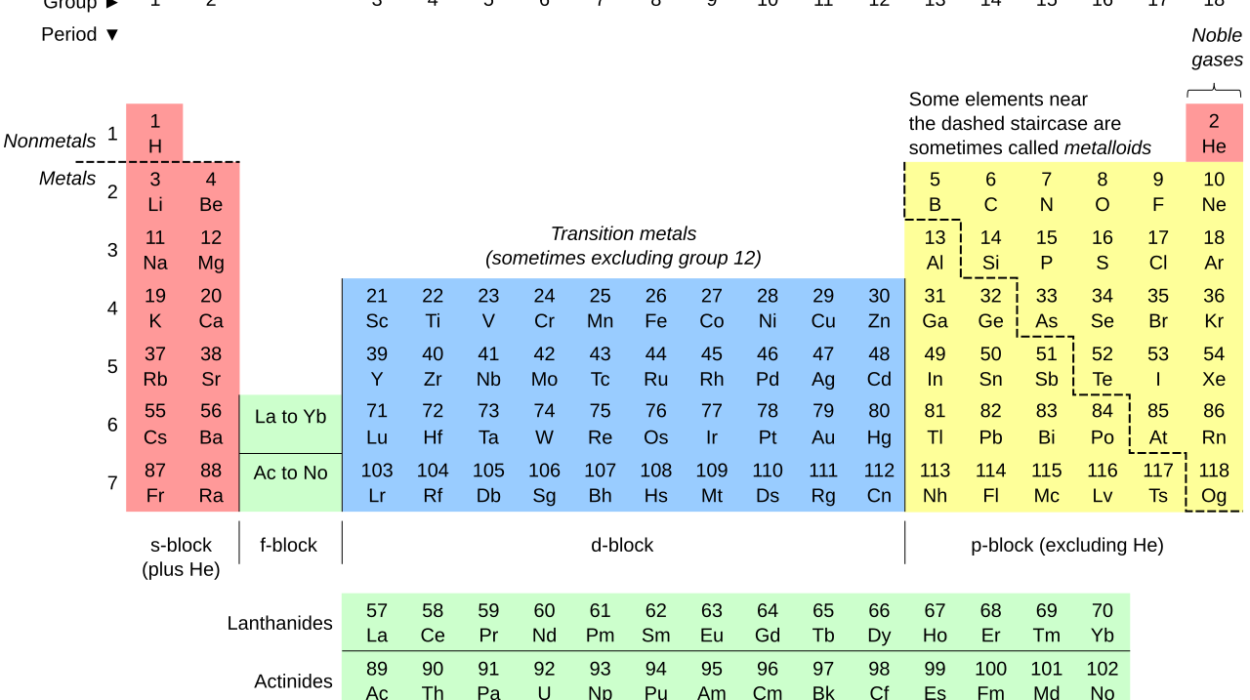
The periodic table is more than a chart of chemical elements. Every box contains information about an element’s identity, atomic structure, and behavior. The numbers and symbols tell you which element you are looking at, how its atoms are built, and how it may interact with other substances.
Most periodic tables display an element’s atomic number, chemical symbol, name, and atomic mass. Some also include information about electron arrangements, oxidation states, or physical properties. Once you understand the meaning of these details, the table becomes a practical tool for predicting how matter behaves rather than simply a collection of unfamiliar abbreviations.
The atomic number identifies the element
The atomic number is usually the whole number displayed near the top of an element’s box. It tells you how many protons are in the nucleus, or central core, of each atom of that element.
This number is the defining feature of an element. Every hydrogen atom has one proton, every carbon atom has six, and every oxygen atom has eight. If the number of protons changes, the atom becomes a different element.
For example, carbon has an atomic number of 6, while nitrogen has an atomic number of 7. The difference is just one proton, but that difference changes the element’s electron structure and chemical properties.
In an electrically neutral atom, the number of electrons equals the number of protons. Carbon therefore has six electrons when neutral, and oxygen has eight. Because electrons determine how atoms form chemical bonds and interact with one another, the atomic number helps explain much of an element’s chemistry.
The elements in the periodic table are arranged in increasing atomic number, beginning with hydrogen. This arrangement reveals recurring patterns in their properties and provides the foundation for the table’s structure.
The chemical symbol is an element’s abbreviation
Each element has a chemical symbol consisting of one or two letters, although some elements with atomic numbers above 100 have three-letter temporary systematic symbols in certain contexts. Symbols are standardized internationally, allowing scientists to communicate about elements regardless of their native language.
The first letter of a chemical symbol is always uppercase, and the second, when present, is lowercase. For example, H represents hydrogen, He represents helium, and Mg represents magnesium. The capitalization matters: Co is cobalt, while CO represents a compound containing carbon and oxygen, with one carbon atom and one oxygen atom in its simplest formula unit.
Some symbols closely resemble the element’s English name. Others come from Latin or historical names. Sodium, for instance, has the symbol Na, derived from natrium, while iron is represented by Fe, from ferrum. Gold has the symbol Au, derived from aurum.
These abbreviations also appear in chemical formulas and equations. H₂O represents water, with two hydrogen atoms for every oxygen atom in a molecule. CO₂ represents carbon dioxide, with one carbon atom and two oxygen atoms. The symbol identifies the element, while any subscript indicates how many atoms of that element are present in the formula.
The atomic mass describes an element’s atoms
A number often printed below an element’s name or symbol is its atomic mass or relative atomic mass. On many periodic tables, this number is a decimal rather than a whole number.
Atomic mass reflects the mass of an atom, which comes primarily from the protons and neutrons in its nucleus. Electrons contribute very little to an atom’s total mass. Because protons and neutrons each have a mass close to one atomic mass unit, elements with more of these particles generally have heavier atoms.
One atomic mass unit, abbreviated u, is defined as one-twelfth of the mass of a carbon-12 atom. This unit makes it possible to compare the masses of individual atoms on a convenient scale.
The decimal values on most periodic tables arise because many elements occur naturally as mixtures of isotopes. Isotopes are forms of the same element that have the same number of protons but different numbers of neutrons. They share the same atomic number but have different masses.
Chlorine provides a useful example. Naturally occurring chlorine consists primarily of chlorine-35 and chlorine-37, two isotopes with different numbers of neutrons. The atomic mass shown on a typical periodic table is about 35.45 u, reflecting the weighted average of the masses of naturally occurring chlorine isotopes. It is not the mass number of a single chlorine atom.
The mass number, by contrast, is a whole number equal to the total number of protons and neutrons in one particular atom. A chlorine-35 atom has 17 protons and 18 neutrons, giving it a mass number of 35.
Not every periodic table uses the same format. Some list a relative atomic mass, while others show a standard atomic weight or an interval when natural isotopic composition varies significantly among samples. For radioactive elements without a representative standard atomic weight, a table may display the mass number of a selected isotope in brackets. The legend or notes accompanying the table explain the convention being used.
The element’s name tells you what substance it represents
The name printed in each box identifies the element in words. Names may reflect historical figures, geographic locations, astronomical objects, minerals, or distinctive properties.
For example, helium takes its name from the Greek word for the Sun because it was identified through observations of sunlight before it was isolated on Earth. Curium honors scientists Marie and Pierre Curie, while einsteinium honors Albert Einstein.
An element’s name is useful for communication, but its chemical symbol is more compact and particularly convenient for writing formulas and equations. Together, the name and symbol make it easy to identify an element without confusion between languages.
The name alone does not tell you everything about an element’s behavior. For that, its position in the periodic table and its atomic structure are more informative.
Rows and columns reveal patterns in chemical behavior
The periodic table is arranged in horizontal rows called periods and vertical columns called groups. These positions are meaningful because elements with related electron arrangements often share similar chemical properties.
A period runs from left to right as atomic number increases. Moving across a period generally adds one proton to the nucleus and one electron to the neutral atom. The added electrons fill available regions of electron structure in a recurring pattern.
A group runs from top to bottom. Elements in the same group often have similar numbers of electrons in their outermost occupied shell, particularly among the main-group elements. These outer electrons, called valence electrons, are especially important because they participate in chemical bonding.
For example, lithium, sodium, and potassium belong to Group 1. Each has one valence electron and tends to lose that electron during many chemical reactions, forming a positively charged ion. Their shared electron pattern helps explain why they have similar chemical behavior, although they differ in reactivity and other properties.
Fluorine, chlorine, and the other halogens occupy Group 17. They generally need one additional electron to complete their outer electron shell and often form negatively charged ions or participate in covalent bonds.
Group 18 contains the noble gases, such as helium, neon, and argon. Their outer electron shells are generally filled, making them relatively unreactive under ordinary conditions. Helium is an exception to the idea of a full shell requiring eight electrons: its first and only occupied shell is complete with two.
These patterns are not absolute rules for every element or every chemical reaction. Transition metals, for example, can form ions with different charges, and many elements can participate in several kinds of bonds. Nevertheless, the table’s rows and columns provide a powerful starting point for understanding chemical behavior.
Electron arrangements explain the table’s structure
Electrons occupy regions around the nucleus known as orbitals. These orbitals are organized into energy levels and sublevels, and the way electrons fill them helps explain why the periodic table has its characteristic shape.
The first period contains only hydrogen and helium because the first energy level accommodates just two electrons. The second and third periods each contain eight elements in the familiar layout because the relevant s and p sublevels accommodate a total of eight electrons.
The longer fourth and fifth periods each contain 18 elements, while the sixth and seventh periods can contain up to 32. These longer rows include elements in which d and f sublevels are being filled.
This structure produces the table’s broad regions, often called blocks. The s-block occupies the left side, the p-block the right, the d-block the middle, and the f-block the two rows commonly printed beneath the main table.
These blocks reflect which type of orbital is being filled as atomic number increases. They also help explain why certain elements share characteristics and why the transition metals and inner transition metals occupy their distinctive positions.
Some periodic tables include electron configurations, which are compact descriptions of how an atom’s electrons are distributed among orbitals. A configuration such as 1s² 2s² 2p² describes a neutral carbon atom. The superscript numbers indicate how many electrons occupy each listed sublevel, adding up to six.
Electron configurations provide a more detailed picture of atomic structure than the atomic number alone. They help explain bonding, ion formation, and recurring chemical patterns, although accurate configurations can require special treatment for certain elements.
Additional symbols and numbers provide specialized information
Beyond the atomic number, symbol, name, and atomic mass, many periodic tables include extra information. What appears depends on the table’s intended audience and level of detail.
Some tables show oxidation states, commonly written with plus or minus signs. An oxidation state is a bookkeeping value used to describe how electrons are assigned when analyzing chemical compounds and reactions. It helps chemists track electron transfer and understand chemical formulas. It is not always the same as an atom’s actual electrical charge.
Iron, for example, commonly forms ions with charges of +2 and +3, often written Fe²⁺ and Fe³⁺. A periodic table that lists common oxidation states may show both values. This indicates that iron can participate in different chemical compounds with different electron arrangements.
Other tables include electronegativity, a measure of how strongly an atom attracts shared electrons in a chemical bond. Electronegativity generally increases from left to right across a period and decreases down many groups, although the trend has exceptions. These differences help explain whether bonds tend to share electrons relatively evenly or draw them more strongly toward one atom.
A table may also list an element’s electron configuration, density, melting point, boiling point, or physical state at a specified temperature. Such details help distinguish elements with similar atomic structures or identify their behavior under particular conditions.
Color coding is another common feature. A legend might use different colors to distinguish metals, nonmetals, and metalloids, or to separate categories such as alkali metals, halogens, and noble gases. These colors are visual aids rather than universal chemical symbols. Their meaning depends on the particular chart, so the legend should always be checked.
Some tables also distinguish naturally occurring elements from synthetic ones, or stable elements from those that are radioactive. Such classifications provide useful context but do not change the meaning of the element’s atomic number or symbol.
Metals, nonmetals, and metalloids occupy different regions
The periodic table’s layout also highlights broad differences in physical and chemical properties. Most elements are metals, which generally conduct heat and electricity well and tend to be malleable, meaning they can be shaped without breaking easily.
Metals occupy most of the left side and center of the table. Examples include aluminum, copper, iron, and silver. Their atoms often form metallic bonds, in which electrons are shared across many atoms rather than confined to individual pairs of atoms.
Nonmetals are concentrated on the upper-right side, with hydrogen positioned separately at the upper left. Many nonmetals are poor electrical conductors, and their chemical behavior differs substantially from that of metals. Carbon, oxygen, sulfur, and chlorine are examples. Nonmetals can form covalent bonds by sharing electrons and can also form ions under suitable conditions.
Metalloids lie near the boundary between the metals and nonmetals. Elements commonly classified as metalloids include silicon, boron, and germanium, although the precise classification varies by convention. They exhibit a mixture of metallic and nonmetallic characteristics. Silicon’s electrical properties, for example, make it useful in semiconductors, materials whose ability to conduct electricity can be controlled.
These categories are helpful generalizations rather than rigid laws. An element’s actual properties depend on its atomic structure, physical form, temperature, pressure, and chemical environment.
Isotopes and ions change an atom without changing its element
Two important concepts help explain why the numbers associated with an element do not always describe every individual atom equally well: isotopes and ions.
Isotopes differ in neutron number. Carbon-12 has six protons and six neutrons, while carbon-14 has six protons and eight neutrons. Both remain carbon because both contain six protons. However, their masses differ, and carbon-14 is radioactive while carbon-12 is stable.
The atomic number remains six for both isotopes, but their mass numbers are 12 and 14, respectively. The atomic mass on a typical periodic table reflects the naturally occurring isotopic mixture rather than describing every carbon atom individually.
Ions differ in electron number. When an atom loses electrons, it becomes positively charged; when it gains electrons, it becomes negatively charged. A sodium atom has 11 protons and 11 electrons when neutral. If it loses one electron, it becomes a sodium ion, Na⁺, with 11 protons and 10 electrons.
Its atomic number remains 11 because the number of protons has not changed. Its mass changes only very slightly because electrons have so little mass compared with protons and neutrons.
This distinction matters in chemistry. The periodic table identifies the element, while isotope notation and ion symbols provide additional information about a particular atom or ion.
How to read an element’s box in practice
Consider a typical box for oxygen. It may show the atomic number 8, the symbol O, the name oxygen, and an atomic mass close to 16.00 u.
From the atomic number, you know that every oxygen atom contains eight protons. A neutral oxygen atom has eight electrons. Its position in Group 16 indicates that it has six valence electrons, which helps explain why oxygen commonly forms two covalent bonds in many familiar compounds or forms an oxide ion with a charge of −2 in suitable ionic compounds.
The atomic mass tells you that naturally occurring oxygen atoms have an average mass close to 16 atomic mass units, primarily because oxygen-16 is by far the most abundant naturally occurring isotope. It does not mean that every oxygen atom has exactly that mass.
Its group and period offer additional clues about its chemistry, while any supplementary entries on the chart may provide information about oxidation states, electronegativity, or other properties.
The same approach works for any element: identify the atomic number first, use the symbol and name to establish the element’s identity, interpret the atomic mass correctly, and then use the element’s position to explore its electron structure and likely behavior.
The numbers and symbols on the periodic table are therefore connected pieces of information. The atomic number establishes identity, the chemical symbol provides a universal shorthand, the atomic mass describes mass on an atomic scale, and the arrangement of elements reveals recurring relationships in their structure and chemistry. Together, they turn the periodic table into a compact guide to the building blocks of matter.