Muonium atoms are emerging from a film of superfluid helium as a tightly directed beam, with a narrow spread of speeds that could make the exotic atoms far easier to use in precision experiments. In a new experiment, researchers extracted muonium from helium cooled below 1 kelvin and measured a mean beam velocity of about 2,180 meters per second, while the velocity spread was constrained to less than 150 meters per second. The result provides a high-brightness source that the researchers say can support proposed experiments measuring how muonium responds to gravity and probing its spectrum with much higher precision.
Muonium is a short-lived, hydrogen-like atom made from a positively charged antimuon bound to an electron. Unlike ordinary hydrogen, it contains no proton. Because its mass is dominated by the antimuon, muonium provides a way to study a purely leptonic atomic system and to probe properties associated with the muon.
That makes muonium attractive for precision measurements, but producing a beam suitable for those experiments has been difficult.
Conventional muonium sources generally produce atoms with broad distributions of velocities and directions. Cooling such sources can reduce the spread in momentum, but the number of atoms that reach the vacuum falls sharply. At temperatures below about 100 kelvin, essentially no muonium diffuses out into vacuum from those conventional systems.
The experiment reported here takes a different approach. Instead of trying to cool an already emitted beam, the researchers use superfluid helium, or He II, as the environment in which muonium is formed and transported toward the surface.
The underlying idea depends on how muonium behaves inside superfluid helium. Muonium is expected to have a positive chemical potential in the liquid. Under those conditions, atoms reaching the liquid surface can be ejected preferentially in the direction normal to the surface, producing what the researchers describe as a “superthermal” beam.
Before the experiment, however, several parts of that picture were uncertain. It was not known precisely how muonium would form at temperatures below 0.7 kelvin, what its chemical potential in the liquid would be, or how efficiently it would move through the helium before the muon decayed.
The last question is especially important because the positive muon at the heart of muonium survives for only a few microseconds.
Muonium has to escape before the muon decays
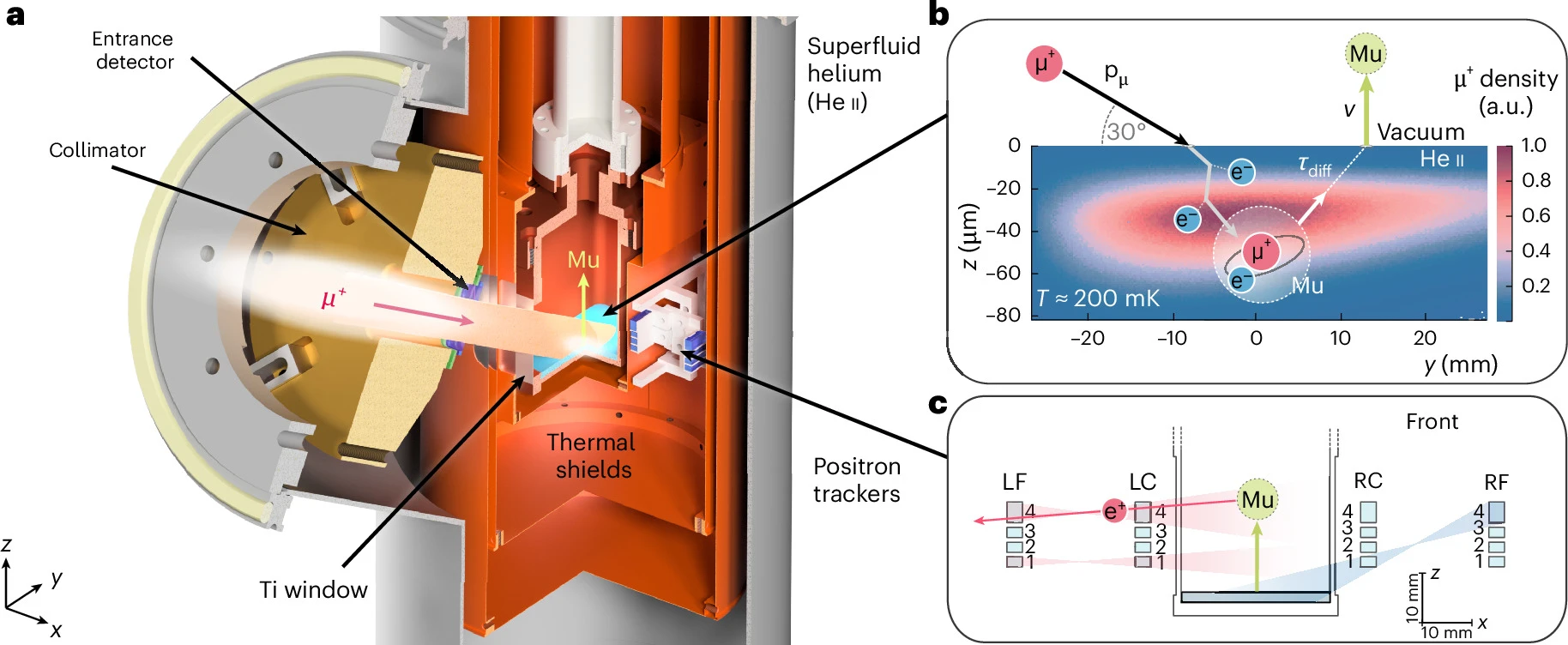
In the experiment, positive muons were directed into a cryogenic target containing superfluid helium. For the muon momenta used in the experiment, the muons normally stop more than 30 micrometers below the helium surface.
A stopped muon must first form muonium and then move through the helium before the atom can emerge into vacuum. If that diffusion were too slow, most muons would decay before their muonium atoms reached the surface.
The researchers therefore looked for direct evidence that muonium was actually forming and moving through the superfluid.
They observed the precession of the muonium triplet state in the helium target. The Larmor precession signal in coincidence measurements demonstrated that stopped positive muons were forming muonium inside the superfluid. The early onset of the signal indicated that formation occurred on a timescale of roughly 100 nanoseconds.
That left the crucial question of how quickly the newly formed atoms could travel to the surface.
The arrival times reveal the beam
The researchers measured when muonium atoms arrived at detectors positioned at different distances from the target. The raw timing distribution was dominated by the ordinary exponential decay of positive muons, so the decay behavior had to be separated from the much smaller signal associated with atoms escaping into vacuum.
After compensating for the muon lifetime and subtracting the background, the researchers isolated a peak associated with muonium emission.
Changing the detector position changed the mean arrival time. The relationship between distance and arrival time provided a direct way to determine the propagation velocity of the emitted atoms while also constraining how long they spent diffusing through the helium.
The measurements were consistent with a directed beam rather than an ordinary thermal distribution.
In the model used to describe the experiment, muonium atoms first undergo diffusion through the superfluid. Each atom was assigned a diffusion speed and an isotropically distributed direction from its stopping point. Once an atom reached the surface, the superthermal model added a directed velocity component normal to the surface.
The fit gave a diffusion velocity of
26^{+6}_{−4} meters per second
and a vacuum ejection velocity of
2,180^{+160}_{−130} meters per second
with the quoted uncertainties corresponding to the paper’s 90% confidence region.
The result indicates that the atoms move comparatively slowly while diffusing through the helium but leave the surface at a much higher and much more uniform velocity.
A beam with a narrow velocity spread
The researchers also tested how broad the velocity distribution could be without contradicting the measured arrival-time distributions.
They compared the measured rising edges with simulated distributions generated using different velocity spreads. Spreads of about 80 to 150 meters per second were consistent with the measurements at the 90% confidence level, with approximately 100 meters per second giving the best agreement.
For subsequent estimates, the researchers conservatively used an upper limit of
σv < 150 meters per second.
They assumed the velocity spread to be isotropic in those calculations.
At a mean velocity of about 2,180 meters per second, this corresponds to a substantially narrower distribution than would be expected from a conventional thermal source. The nearly normal emission from the helium surface also gives the beam a much smaller angular divergence.
That combination of direction and velocity is central to the proposed applications.
The source produces a substantial fraction of its muonium in vacuum
The experiment also allowed the researchers to estimate how efficiently the incoming muons were converted into muonium.
They introduced a muonium formation efficiency as a free parameter in the beam model. The best-fit formation efficiency was
60^{+6}_{−8}%.
Not every formed atom can become part of the vacuum beam, however. Some muonium atoms decay while diffusing through the helium, and only roughly half of the atoms are directed toward the surface.
After accounting for those losses, the estimated vacuum muonium efficiency was
(8.2^{+0.8}_{−1.1})%.
The researchers found that this value agreed with independent, model-independent estimates based on the measured time distributions.
The resulting vacuum yield is comparable to the highest-intensity diffuse muonium sources, according to the paper, but the new source adds a property those diffuse sources lack: a substantially more directed and narrowly distributed beam.
The beam could be used to measure muonium in gravity
One proposed use is a gravity experiment based on muonium interferometry.
The basic interferometer considered by the researchers uses three gratings with a pitch of about 100 nanometers. Muonium atoms pass through the grating structure and form an interference pattern. Gravity shifts that pattern because the atoms fall while traveling between the gratings.
For atoms moving at velocity , the interaction time over a grating separation is
The gravitational displacement is then
The longer the atoms spend traveling through the interferometer, the larger the gravitational displacement becomes. But muonium is unstable, so increasing the interaction time also increases the number of atoms lost through muon decay.
The calculations therefore produce an optimum rather than simply favoring the longest possible interferometer.
For the beam considered in the paper, the optimum interaction time is about 4.5 microseconds, corresponding to a grating spacing of about 9.6 millimeters.
The predicted sensitivity also depends on the number of detectable atoms, the grating transmission, the detector efficiency and the contrast of the interference pattern. The researchers used a conservative wave-optics treatment to account for the partial coherence of the source.
Their calculations predict that the interference contrast can remain above 0.35 across an extended region of roughly 1 micrometer along the optical axis.
Directional emission reduces aperture losses
The narrow angular distribution of the superthermal source has another important consequence for the proposed interferometer.
The researchers compared the new beam with a thermal source whose atoms would emerge with an approximately cosine angular distribution. For a thermal beam with a characteristic velocity of about 6,600 meters per second, the optimum interaction time considered in the calculation corresponds to a grating separation of about 29 millimeters.
The fraction of atoms accepted through the modeled apertures was about 0.07 for the thermal beam.
For the superthermal beam, the corresponding acceptance was about 0.95.
The calculations used 1-square-centimeter apertures, a single-grating transmission of about 0.35 and a detector efficiency of about 0.75. They also took into account muonium decay during the interferometer transit.
The difference arises from the beam geometry. A nearly normal-emission beam wastes far fewer atoms at the apertures than a diffuse beam whose atoms leave over a broad range of angles.
The researchers note that the actual gravity measurement would require a horizontal beam geometry. One possible arrangement would use a mirror coated with superfluid helium, although that configuration would introduce lifetime losses. Their ongoing approach instead considers nanofabricated silicon structures that can support vertical layers of superfluid helium through capillary forces and directly produce horizontal beams.
The atoms are slow enough for a useful de Broglie wavelength
The beam’s relatively low velocity also gives the muonium atoms a de Broglie wavelength of about 1.5 nanometers.
For grating pitches near 100 nanometers, the associated Talbot length is about 14 micrometers. These scales enter the wave-optics calculations used to determine whether the partially coherent source can produce a measurable interference pattern.
The source itself is about 10 millimeters wide in the modeled configuration. The researchers estimate a conservative transverse coherence width of about 22 nanometers, based on an upper angular divergence of roughly 70 milliradians.
Because the source is mainly incoherent, with the estimated coherence width around one-quarter of the grating pitch, the calculations do not assume an ideal fully coherent beam. Instead, they examine how the interference contrast changes through the relevant optical region.
The calculations also consider the grating open fraction. An open fraction near 0.45 gives a calculated contrast of about 0.5 in the modeled configuration.
Together, these calculations establish the beam parameters that the researchers say are needed for a practical muonium interferometer.
The same source could improve laser spectroscopy
The beam’s intensity is also important for a different kind of precision experiment.
Muonium spectroscopy can be used to determine properties of the muon and to test bound-state quantum electrodynamics. In particular, the researchers identify the 1S–2S transition as a target for high-precision laser spectroscopy.
The challenge is the number of muonium atoms that can be delivered to the region where the laser interacts with them.
For subsurface muons, the PSI πE5 beamline can deliver about 1.5 × 10^8 positive muons per second at a momentum of 28 MeV/c to a spot with horizontal and vertical widths of about 10 millimeters. The paper notes that this rate follows approximately a dependence on muon momentum.
At much lower energy, the low-energy muon beamline can provide about 3 × 10^3 positive muons per second at a kinetic energy of 5 keV, corresponding to a momentum of about 1 MeV/c, with a beam size of roughly 7 millimeters in each transverse direction.
The source calculations account for these beam rates and for the efficiency with which incoming muons ultimately produce vacuum muonium.
For continuous-wave laser spectroscopy, the researchers define the laser-addressable flux using two 1-by-1-millimeter-square planes separated by 1 millimeter. They calculate the number of atoms passing through those planes at different distances from the helium target.
Under those conditions, the He II source produces about 800 times more laser-addressable muonium atoms than the cryogenic silicon-dioxide source considered for comparison in the paper.
The authors say the resulting brightness opens the possibility of sub-kilohertz 1S–2S spectroscopy.
Several parts of the source physics were still being tested
The beam measurements establish the observed timing and velocity behavior, but the researchers distinguish those observations from the physical interpretation used to describe them.
Their model treats muonium diffusion through the superfluid as ballistic propagation with an upper velocity limit. The atoms are assigned diffusion speeds drawn from a flat distribution between zero and twice the fitted diffusion velocity, with isotropic directions.
The surface emission is then modeled in two different ways. In the superthermal case, the atom receives a directed surface-normal velocity. In the thermal case, emission follows a Maxwell-Boltzmann distribution with random emission angles weighted by the appropriate angular distribution.
The measured timing data favor the directed-beam description used in the analysis.
The experiment also addresses an earlier uncertainty about whether muonium could move through superfluid helium rapidly enough to escape before muon decay. The fitted diffusion velocity provides evidence for rapid transport on the relevant scale, while the observed muonium formation signal establishes that muonium is indeed produced in the superfluid.
The paper does not treat every underlying property of muonium in He II as independently measured. The chemical potential and microscopic behavior that motivate the superthermal emission model remain part of the physical framework used to interpret the observations.
From a cryogenic surface to precision measurements
The experiment therefore connects several stages that had previously posed separate challenges: muonium formation inside superfluid helium, rapid transport to the surface, efficient emission into vacuum, and the production of a beam with relatively narrow velocity and angular distributions.
The measured mean emission velocity is about 2,180 meters per second, while the conservative velocity-spread limit is below 150 meters per second. The estimated vacuum efficiency is about 8.2%, and the modeled beam acceptance for the proposed interferometer is close to 95%.
Those measured and calculated properties form the basis for the proposed gravity and spectroscopy experiments. The gravity calculations use the beam to obtain sufficient interaction time while retaining enough atoms before muon decay, while the spectroscopy calculations use the increased brightness to increase the number of muonium atoms accessible to a laser.
The researchers conclude that the high-brightness superthermal source provides the beam characteristics needed for muonium interferometry and could enable a percent-level measurement of muonium’s gravitational acceleration. They also identify its brightness as a route toward sub-kilohertz 1S–2S spectroscopy for precise muon-mass determination and tests of bound-state quantum electrodynamics.
The study was published in Nature Physics.