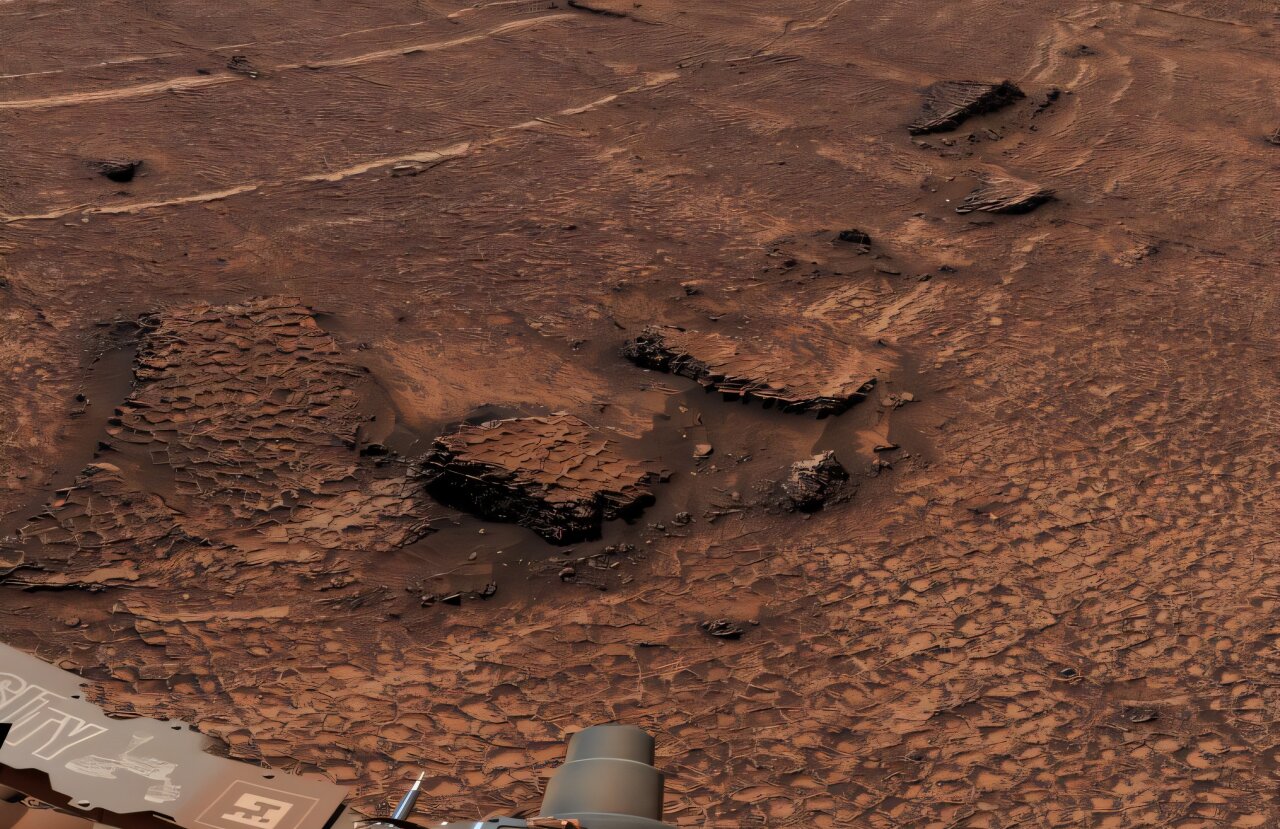
NASA’s Curiosity rover has photographed a broad field of polygon-shaped features on Mars that may preserve evidence of ancient wet and dry conditions. The shapes are only a few centimeters across, and scientists are now examining their chemistry and geometry to better understand how they formed.
Curiosity sees the polygons up close
Mars has preserved much of its ancient surface because it lacks several processes that continually reshape Earth, including plate tectonics, volcanism and flowing water. Dust storms occur on Mars, but they have done little to substantially alter the surface over billions of years.
That makes the planet’s exposed landscapes useful for studying its distant past. Curiosity’s latest images add another example.
The car-sized rover recently encountered polygon-like features that had been seen elsewhere on Mars but had not previously been observed by Curiosity at ground level. The features measure roughly 4 to 8 centimeters, or about 1.5 to 3 inches, across.
Ashwin Vasavada, a Curiosity rover mission scientist at NASA’s Jet Propulsion Laboratory, said the team carefully measured the shapes and their chemistry while looking for clues about their origin.
The shapes may be ancient mud cracks
The leading idea is that these particular polygons formed when mud dried and cracked.
A 2023 study in Nature proposed that similar features observed by Curiosity inside Gale Crater could have developed through repeated wetting and drying. That work placed their possible formation around the Noachian-Hesperian transition, roughly 3.8 to 3.6 billion years ago, a period researchers have hypothesized may have included a more Earth-like climate on Mars.
The newly observed polygons are also hypothesized to be mud cracks, but their exact formation process is not yet established. The researchers studying them say additional work is needed to determine how the features formed.
Not every polygonal surface on Mars necessarily has the same origin. Some have been hypothesized to result from freeze-thaw cycles, while others may have formed through tectonic or volcanic stress.
Mars has polygons of very different sizes
Polygonal surfaces have been observed from orbit as well as from the ground.
NASA’s High Resolution Imaging Science Experiment, or HiRISE, has been orbiting Mars since 2006 and has photographed much larger polygonal features. Orbital observations show polygons ranging from about 15 meters to more than 350 meters across, or roughly 50 feet to more than 1,000 feet.
The polygons Curiosity has observed at ground level are much smaller, closer in size to the newly photographed features.
Some of the larger examples occur in regions known as crater floor polygons, or CFPs. These cracked surfaces have been considered potentially indicative of ancient standing water. Examples occur in Hellas Planitia, Noachis Terra and Margaritifer Terra.
Hellas Planitia is the largest impact basin on Mars. It is about 2,300 kilometers, or 1,400 miles, across and extends just over 7,000 meters, or 23,000 feet, below the Martian datum, the planet’s reference elevation.
The ancient surface preserves different clues
Mars today is cold and dry, but its surface contains features that may record processes from much earlier periods in the planet’s history.
The Pre-Noachian, Noachian and possibly Hesperian periods are estimated to have collectively lasted from about 4.5 billion to 3.0 billion years ago. The present-day Martian period is known as the Amazonian.
The new polygons add another ground-level observation to the collection of surface features scientists are using to examine that ancient history. Their shapes and chemistry are now being studied for clues about how they formed.