Yes, alien life could exist on other planets, and scientists consider the possibility a serious question in astronomy, biology, and planetary science. Earth is the only world known to support life, but the discovery of thousands of planets beyond our solar system has revealed that planets are common throughout the galaxy. Some may have conditions suitable for living organisms, although scientists have not yet confirmed life beyond Earth.
The question is not simply whether another planet resembles Earth. It is whether life can emerge under different conditions, what environments can sustain it, and how scientists might recognize it from across the enormous distances between stars. Answering these questions requires understanding the basic requirements of life, the diversity of planets, and the limits of current scientific knowledge.
Why scientists consider extraterrestrial life possible
Earth provides the only confirmed example of life, but it also demonstrates how adaptable living organisms can be. Life exists in environments once considered too extreme to support it, including deep-sea hydrothermal vents, acidic waters, frozen landscapes, and places with little sunlight. Some microorganisms survive intense radiation, high pressures, or severe shortages of nutrients.
These organisms are called extremophiles because they tolerate conditions that would be hostile to many other forms of life. Their existence has broadened scientists’ understanding of where life might survive elsewhere.
For example, some microbes obtain energy from chemical reactions rather than sunlight. Others survive in very cold environments or remain dormant when water is unavailable. These abilities suggest that extraterrestrial life would not necessarily need a warm surface, a breathable atmosphere, or a steady supply of sunlight.
However, the limits of life on Earth should not be confused with proof that life can survive anywhere. All known organisms depend on particular chemical processes and environmental conditions. Extreme adaptability expands the range of plausible habitats, but it does not eliminate the fundamental challenges living systems face.
The sheer number of planets also makes the question compelling. Our galaxy contains an enormous population of stars, many of which host planets. Even if only a small fraction of these worlds have suitable conditions, there could be many environments worth investigating. Whether any actually contain life remains unknown.
What conditions does life need?
Scientists generally begin the search by looking for environments that could support life as we understand it. Earth-based life requires liquid water, chemical elements that can form complex molecules, and a source of energy. It also relies on intricate chemical reactions that maintain and reproduce living systems.
These requirements provide a practical starting point, although they do not prove that every possible form of life must follow precisely the same pattern.
Liquid water and the chemistry of life
Water is important because it dissolves many substances and allows molecules to interact. It also supports the chemical reactions that take place inside cells. On Earth, water helps transport nutrients, remove waste, and regulate temperature.
For these reasons, scientists pay close attention to places where liquid water could exist. A planet with the right surface temperature and atmospheric pressure might maintain oceans or lakes. Water can also remain liquid beneath ice, where internal heat and dissolved salts create conditions different from those at the surface.
Yet the presence of water alone does not establish that a world is inhabited. Water must be available in a suitable environment, and life also requires the right chemical ingredients and energy sources. A planet could have extensive oceans without ever developing living organisms.
The chemical ingredients of living organisms
Earth life is built primarily from carbon, hydrogen, oxygen, nitrogen, phosphorus, and sulfur, along with other elements needed for particular biological functions. Carbon is especially useful because it can form stable bonds with several atoms at once, allowing the creation of complex molecules.
Proteins, fats, carbohydrates, and genetic material all depend on elaborate chemical structures. Before life can exist, a suitable environment must support the formation and persistence of molecules capable of participating in increasingly complex chemical systems.
Many of the elements used by life on Earth are found throughout the universe. They are produced through cosmic processes and incorporated into stars, planets, and other celestial objects. This widespread availability makes the chemistry of life plausible beyond Earth.
Still, having the ingredients is not the same as assembling them into a living system. Scientists do not yet know exactly how nonliving chemistry first produced life on our planet, much less how frequently that transition occurs elsewhere.
A reliable source of energy
Living organisms need energy to grow, repair themselves, maintain internal conditions, and reproduce. On Earth, sunlight drives photosynthesis, which supports much of the food web. But sunlight is not the only possible source of biological energy.
Some microorganisms use chemical reactions involving substances such as hydrogen, sulfur compounds, or iron to obtain energy. Similar processes could potentially sustain life in environments where sunlight is weak or absent.
A planet or moon with internal geological activity might provide heat and chemical gradients, meaning differences in chemical conditions that can drive reactions. Such environments could support microbial ecosystems even beneath thick layers of ice or far below a world’s surface.
Energy availability is therefore a central part of the search. Scientists want to know not only whether a world contains water and useful chemicals, but also whether those ingredients can interact in ways that provide enough usable energy for life.
Could life exist on planets beyond our solar system?
Planets orbiting stars other than the Sun are called exoplanets. Their discovery has transformed the search for extraterrestrial life because it has shown that planetary systems are widespread and remarkably diverse.
Some exoplanets are rocky, some are dominated by gas, and others may contain deep layers of water or atmospheres unlike anything found on Earth. Their sizes, temperatures, orbits, and atmospheric compositions vary considerably.
This diversity matters because life may not be restricted to planets that look exactly like our own. A world could potentially support an ocean beneath ice, for example, without having blue skies, continents, or a temperate surface.
The habitable zone
One useful concept in the search for life is the habitable zone, sometimes called the Goldilocks zone. It describes the region around a star where a planet with suitable atmospheric conditions could maintain liquid water on its surface.
A planet too close to its star may become extremely hot, while one too far away may become too cold for surface water to remain liquid. The habitable zone identifies the range between these extremes, but its boundaries depend on factors such as the star’s brightness and the planet’s atmosphere.
The concept has important limitations. Being in the habitable zone does not guarantee that a planet has liquid water, a suitable atmosphere, or life. A planet might have lost its atmosphere, developed a runaway greenhouse effect, or become frozen under conditions that prevent surface oceans from existing.
Conversely, a world outside the conventional habitable zone might still contain environments suitable for life. Internal heating, tidal forces, or the insulating effects of ice and atmosphere could allow liquid water to persist beneath the surface.
The habitable zone is therefore a useful guide for choosing targets, not a definitive boundary between living and lifeless worlds.
The importance of a planet’s atmosphere
An atmosphere can influence a planet’s temperature, protect its surface from some forms of radiation, and affect whether liquid water can remain stable. Greenhouse gases, including carbon dioxide and water vapor, absorb and reemit heat, helping determine a planet’s climate.
Scientists can sometimes study an exoplanet’s atmosphere by analyzing starlight that passes through it as the planet moves in front of its star. Different gases absorb light at characteristic wavelengths, leaving patterns that can reveal atmospheric composition.
Finding water vapor, carbon dioxide, methane, or other compounds could help scientists assess whether a planet has potentially habitable conditions. But no single gas automatically demonstrates the presence of life.
Atmospheres also evolve through geological processes, sunlight-driven chemistry, volcanic activity, and interactions between a planet’s surface and interior. Understanding these processes is essential because the same atmospheric substance can have biological or nonbiological origins.
Could life exist elsewhere in our solar system?
Although distant exoplanets offer an enormous field of possibilities, nearby worlds may provide better opportunities to investigate extraterrestrial life directly. Spacecraft can examine some of these environments, analyze samples, and search for chemical or geological evidence that telescopes cannot easily obtain from distant planets.
Several places in our solar system are especially interesting because they may contain liquid water or preserve evidence of environments that once supported it.
Mars and the possibility of ancient life
Mars is a leading target in the search for past extraterrestrial life. Its surface contains geological features associated with ancient rivers, lakes, and other environments shaped by liquid water. The planet was warmer and wetter in its distant past, although scientists are still investigating how its climate changed.
If life developed on early Mars, traces of it might survive in ancient rocks or sediments. Microbial life could potentially have existed in environments where water persisted long enough for chemical processes to develop.
Today, Mars has a cold, dry surface and a thin atmosphere. Liquid water is difficult to maintain under present surface conditions, although the possibility of water or other habitable environments underground remains an area of scientific investigation.
Finding organic molecules on Mars would be valuable because organic molecules contain carbon and can participate in the chemistry associated with life. However, they can also form through nonbiological processes. Convincing evidence of past life would require multiple lines of evidence that could not be adequately explained by geology or chemistry alone.
Europa and Enceladus: oceans beneath ice
Some of the most intriguing potential habitats in the solar system are not planets but moons. Europa, which orbits Jupiter, and Enceladus, which orbits Saturn, are believed to contain subsurface oceans beneath icy crusts.
Their significance comes from the possibility that liquid water, chemical ingredients, and energy sources coexist below the surface. Tidal forces caused by their host planets and neighboring moons can flex their interiors, generating heat that helps maintain liquid water.
Enceladus also releases plumes of material into space from fractures in its icy surface. Studying this material has revealed evidence of ingredients and chemical processes relevant to habitability. Such findings make the moon an important target for future investigations.
Europa is similarly compelling because its hidden ocean may have contact with rock beneath the ice, potentially allowing chemical reactions that provide energy. However, the extent of these interactions and their ability to sustain life remain uncertain.
Neither moon has yielded confirmed evidence of extraterrestrial organisms. Their oceans are promising because they may offer environments in which life could survive, not because scientists know that life exists there.
Venus and other unusual environments
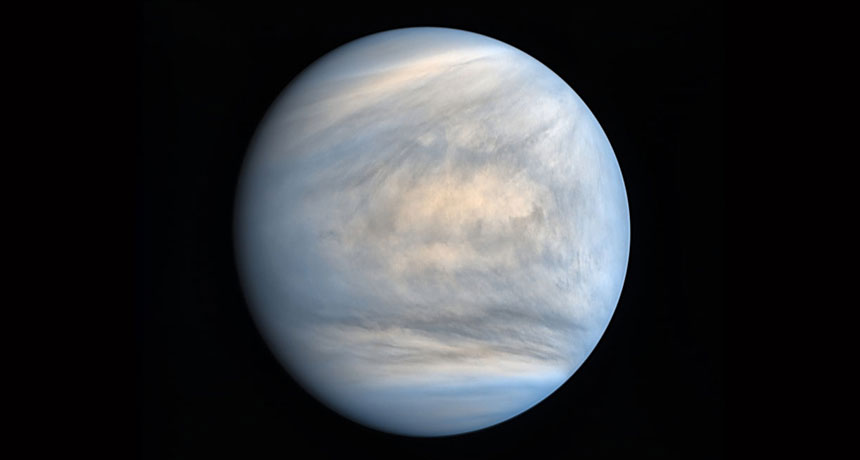
Venus has a surface hot enough to melt lead, with crushing atmospheric pressure and clouds containing corrosive sulfuric acid. These conditions make its surface highly hostile to known life.
Scientists have nevertheless considered whether some cloud layers might offer more moderate temperatures and pressures. The chemistry of those clouds is extremely challenging for Earth-like organisms, and the possibility of life there remains speculative.
Other environments, including the interiors of icy moons and the atmospheres of certain planets, also invite scientific questions about how far the requirements of life can extend. Such possibilities are worth distinguishing from established findings: an environment may be scientifically interesting without being demonstrably habitable, and habitability itself does not establish that organisms are present.
How could scientists detect alien life?
Finding extraterrestrial life is more difficult than identifying a planet with potentially suitable conditions. Scientists need evidence that distinguishes biological activity from the many nonliving processes that can produce similar chemical or physical signals.
The search uses several complementary approaches, from examining nearby planetary surfaces to studying the atmospheres of distant worlds.
Searching for biosignatures
A biosignature is a substance, pattern, or other observable feature that could provide evidence of life. Possible examples include particular atmospheric gases, organic compounds, distinctive mineral patterns, or chemical relationships that are difficult to explain without biological activity.
On Earth, life has dramatically altered the atmosphere. Photosynthetic organisms release oxygen, and biological processes contribute to the cycling of carbon and other elements. If scientists detected an unusual combination of gases in an exoplanet’s atmosphere, they might investigate whether living organisms could explain it.
Oxygen can be an especially interesting clue because large amounts of it can accumulate through biological activity. Yet oxygen can also arise through nonbiological processes, depending on the planet’s environment and history. Methane may likewise have biological or geological origins.
The interpretation of a possible biosignature therefore requires context. Scientists must examine the planet’s star, atmospheric composition, geological activity, and other processes that could create or destroy the observed substances.
A strong case for life would ideally involve multiple independent observations that fit a biological explanation better than plausible alternatives. This cautious approach helps prevent an intriguing chemical discovery from being mistaken for proof.
Examining rocks, soils, and subsurface environments
For nearby worlds, direct investigation may offer stronger evidence than remote observations alone. Robotic spacecraft can photograph geological features, measure environmental conditions, and analyze material collected from planetary surfaces or atmospheres.
Future missions could investigate ancient Martian sediments, sample material from the plumes of icy moons, or examine the chemistry of subsurface environments. Instruments may look for complex organic molecules, patterns in molecular structures, or other signs of biological organization.
Even these measurements can be difficult to interpret. Ancient rocks may have been altered by heat, water, radiation, or geological activity. Such changes can erase evidence of past life or create patterns that resemble biological signatures.
Scientists must also consider contamination. Earth organisms or biological material carried by spacecraft could interfere with a search for native life. Planetary protection procedures aim to reduce this risk and preserve the scientific value of investigations.
Listening for technological signals
Another approach is the search for extraterrestrial intelligence, often abbreviated as SETI. Rather than looking for microorganisms, this effort seeks possible signs of technologically advanced civilizations.
Scientists can search for unusual radio signals or other emissions that might indicate deliberate communication or technological activity. Radio waves can travel across interstellar distances, making them a possible means of communication between civilizations separated by enormous stretches of space.
However, the search faces significant challenges. Researchers do not know whether extraterrestrial civilizations exist, what technologies they might use, how long they might remain detectable, or whether they would transmit signals in ways humans can recognize.
A signal would also need careful verification. Natural astronomical phenomena and human-made interference can produce confusing observations, so researchers must rule out ordinary explanations before considering an extraterrestrial origin.
The absence of a confirmed signal does not demonstrate that intelligent life is nonexistent. It means only that the searches conducted so far have not established a verified detection.
Why finding life elsewhere would be difficult
The greatest challenge is not simply the distance between stars. It is the uncertainty surrounding how life begins, how it survives, and how often it develops.
Scientists understand many of the chemical reactions that occur in living organisms, but they do not yet have a complete explanation for how nonliving matter first became a self-sustaining living system on Earth. This question, known as the origin of life, remains an active area of research.
One possibility is that life emerges relatively readily when suitable conditions persist. Another is that the transition from chemistry to biology requires a rare combination of circumstances. Earth’s single confirmed example cannot establish how common either possibility is.
There is also a distinction between the emergence of life and the evolution of complex organisms. Simple microbial life might be much more common than large, multicellular organisms. Intelligent life capable of developing technology could be rarer still, because it would require a long sequence of evolutionary and environmental developments.
Even if life exists on many worlds, detecting it may be difficult. Microorganisms buried beneath ice or rock could leave little evidence visible from space. Distant planets may be too faint for scientists to measure their atmospheres precisely, and biological signals could be obscured by clouds or confused with nonbiological chemistry.
Time adds another complication. A planet might have supported life millions or billions of years ago but be lifeless today. A technological civilization could have existed long before humans appeared, or it might emerge long after humanity is gone. Two forms of intelligent life could exist in the same galaxy without overlapping in time or ever detecting one another.
These limitations mean that the search for extraterrestrial life requires patience, improved instruments, and careful interpretation rather than assumptions about what scientists ought to find.
What would the discovery of alien life mean?
The discovery of life beyond Earth would be one of the most consequential scientific findings in human history. Its significance would depend partly on what kind of life was found and how clearly its origin could be established.
If scientists discovered independent microbial life on Mars or an icy moon, they could compare its chemistry and biological organization with Earth’s organisms. A fundamentally different biological system would suggest that life can arise through more than one pathway, strengthening the case that life is not unique to our planet.
If the organisms were closely related to Earth life, scientists would need to investigate whether the two forms of life shared an ancient origin. Material can move between planetary bodies through impacts that eject rocks into space, creating a possible route for microorganisms or their precursors to travel between worlds. Such transfer, sometimes called panspermia when referring to the spread of life, is a possibility rather than an established explanation for life’s origin.
A discovery on a distant exoplanet could provide a different kind of insight. Atmospheric evidence consistent with biological activity might reveal that life can influence the environment of another planet, even if researchers could not directly observe the organisms responsible.
Confirming intelligent extraterrestrial life would raise additional questions about the development of technology, the longevity of civilizations, and the possibility of communication across interstellar distances. Yet finding microbial life would be scientifically transformative even without any evidence of intelligence.
In every case, scientists would need to establish that the evidence was genuine, reproducible, and best explained by life rather than by an unknown nonbiological process.
How scientists assess the odds of life in the universe
The number of planets in the universe makes extraterrestrial life plausible, but counting planets is only the beginning of estimating its likelihood. Scientists must also consider how often planets develop suitable environments, how frequently life begins in those environments, and how long living systems survive.
The Drake equation is a framework developed to organize questions about the possible number of detectable technological civilizations in the Milky Way. It considers factors such as the rate of star formation, the fraction of stars with planets, the number of potentially suitable worlds, and the likelihood that life, intelligence, and detectable technology emerge.
The equation is useful because it identifies the assumptions that influence estimates. However, several of its terms remain highly uncertain, and it does not provide a reliable numerical answer without assumptions about those unknown quantities. It also addresses detectable technological civilizations, not all forms of life.
The probability that life exists somewhere is different from the probability that humans will discover it. A planet might contain organisms yet remain inaccessible to current instruments. A civilization might emit detectable signals for only a brief period. Conversely, evidence of simple life could be discovered relatively close to Earth if a suitable environment exists within our solar system.
As observations improve, scientists can better estimate how common different types of planets are and determine which environments deserve further study. But the frequency with which life begins remains one of the largest unanswered questions.
What scientists can conclude today
The scientific evidence supports a clear distinction between possibility and confirmation. Planets are widespread, the chemical elements associated with life are found throughout the universe, and Earth demonstrates that life can survive in a broader range of environments than once expected. Several worlds in our solar system may contain conditions suitable for microbial organisms, while some distant exoplanets have characteristics worth investigating.
None of these facts establishes that extraterrestrial life has been found. Scientists have not confirmed organisms beyond Earth, identified a universally accepted biological signature on another planet, or verified a signal from an extraterrestrial civilization.
The strongest conclusion is that alien life is scientifically plausible but remains unproven. The universe offers many environments in which researchers can test ideas about habitability, chemistry, and the origin of living systems. Each discovery can narrow the possibilities, reveal new questions, or change how scientists understand the conditions required for life.
Whether life exists beyond Earth is still an open question. Answering it will require combining planetary exploration, astronomy, chemistry, biology, and rigorous tests of competing explanations. The search is valuable not only because it may reveal life elsewhere, but also because it can deepen our understanding of how life began on Earth and what makes a world capable of sustaining it.