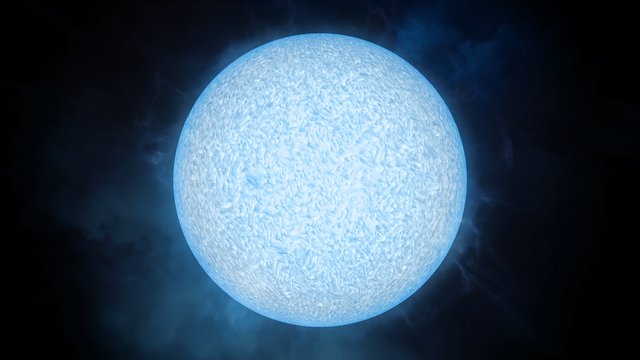
Black holes and neutron stars are among the most extreme objects in the universe. Both can form when massive stars reach the end of their lives and collapse under gravity. Both pack enormous amounts of mass into remarkably small spaces, producing gravitational fields far stronger than those found around ordinary stars. Yet they represent two fundamentally different outcomes of stellar evolution.
The essential difference is that a neutron star is an extremely dense stellar remnant with a physical surface, while a black hole is a region of spacetime enclosed by an event horizon, a boundary beyond which nothing can escape to the outside universe, not even light. Neutron stars are supported against further gravitational collapse primarily by the quantum properties of matter. Black holes form when gravity overwhelms the available pressure and support mechanisms, causing collapse beyond the point at which a stable neutron-star configuration can exist.
Understanding these objects requires looking at how stars live and die, what happens to matter under extreme compression, and how gravity behaves in the strongest conditions known to science.
How massive stars produce these extreme objects
Stars spend most of their lives balancing two competing influences. Gravity pulls their material inward, while pressure generated within the star pushes outward. Much of this pressure comes from the energy released through nuclear fusion, the process in which lighter atomic nuclei combine to form heavier nuclei.
During much of a star’s lifetime, hydrogen fusion in its core produces helium and releases energy. As the hydrogen supply decreases, the star’s internal structure changes. Depending on its initial mass, it may begin fusing progressively heavier elements.
In sufficiently massive stars, this process can eventually produce an iron-rich core. Iron is particularly important because fusing iron-group nuclei does not release energy in the same way that fusion of lighter elements does. Instead, further fusion generally requires an energy input.
As the core loses its ability to generate sufficient pressure, gravity causes it to collapse. Under these conditions, electrons can combine with protons to produce neutrons and neutrinos. This process, known as electron capture, reduces the number of electrons available to resist compression and changes the composition of the core.
The collapse can become extremely rapid. In many cases, the outer layers of the star are expelled in a supernova, an enormous stellar explosion. The remaining core may become a neutron star if the mass and physical conditions allow it to reach a stable configuration.
If the collapsing core is too massive to be supported, it can continue contracting and form a black hole.
Not every black hole or neutron star forms through precisely the same pathway. Stellar evolution depends on factors such as initial mass, chemical composition, rotation, and interactions with companion stars. Some black holes can also grow through mergers or other processes. Nevertheless, the collapse of a massive stellar core provides the clearest explanation of how these two objects are related.
Neutron stars: Matter compressed to extraordinary densities
A neutron star is the collapsed core of a massive star, compressed until its matter reaches densities comparable to or greater than those inside atomic nuclei.
A typical neutron star contains more mass than the Sun within a sphere only about 20 to 25 kilometers across. Its average density is therefore extraordinarily high. A small volume of neutron-star material would contain an enormous amount of mass compared with an equivalent volume of ordinary matter.
The reason a neutron star can resist further collapse lies in quantum mechanics.
Electrons, protons, and neutrons are particles called fermions. Fermions obey the Pauli exclusion principle, a fundamental rule stating that identical fermions cannot occupy exactly the same quantum state simultaneously.
When matter is compressed sufficiently, this restriction becomes important. Neutrons are forced into increasingly energetic quantum states as available lower-energy states become occupied. The resulting resistance to further compression contributes to what physicists call neutron degeneracy pressure.
This is not ordinary pressure produced by heating a gas. It arises from the quantum properties of matter and can remain important even when thermal pressure is relatively small.
Neutron stars are also supported by interactions between their constituent particles. The strong nuclear interaction, which governs the behavior of particles inside atomic nuclei, contributes significantly to the pressure of matter at these extreme densities.
The precise balance between gravity, quantum effects, and nuclear interactions determines whether a neutron star can remain stable.
Despite their name, neutron stars are not necessarily composed entirely of neutrons. Their interiors may contain protons, electrons, and other particles. Scientists also investigate whether exotic forms of matter, such as hyperons or deconfined quark matter, can exist in their deepest regions. The exact composition of the central core remains an important open question in nuclear astrophysics.
A neutron star has a physical surface, although its surface is nothing like the solid ground found on Earth. It is an extremely dense boundary where the properties of matter change rapidly. Above it, a thin atmosphere may exist, and the surrounding environment can contain powerful magnetic fields and energetic particles.
Black holes: When gravity overwhelms matter
A black hole forms when a sufficient amount of mass becomes concentrated within a sufficiently small region that an event horizon develops.
An event horizon is a boundary in spacetime beyond which no signal can reach distant observers. Once matter or light crosses this boundary, it cannot escape to the outside universe.
The event horizon is not a solid surface. It is not a physical shell that objects strike. Instead, it marks a fundamental boundary in the geometry of spacetime.
Einstein’s general theory of relativity explains gravity as the curvature of spacetime caused by mass and energy. In this description, objects move through curved spacetime rather than being pulled by a conventional force acting across an otherwise flat background.
A black hole represents an extreme case of this curvature. Its gravitational influence becomes so strong near the event horizon that every possible future-directed path for an object or signal inside the horizon leads farther inward.
For a nonrotating black hole, the event horizon has a radius determined by its mass, commonly called the Schwarzschild radius. Increasing the black hole’s mass increases this radius.
Unlike a neutron star, a black hole has no known material surface that supports its weight. The pressure mechanisms that can stabilize ordinary matter and neutron-star matter cannot prevent the formation of an event horizon once gravitational collapse proceeds sufficiently far.
Classical general relativity predicts that matter collapsing into a black hole ultimately reaches a singularity, a region where the theory predicts quantities such as spacetime curvature to become infinite. However, this prediction also signals a limitation of the theory. Physicists expect a complete description of the deepest interior to require a theory of quantum gravity, which has not yet been established.
Consequently, the singularity should not be treated as a fully understood physical object. It represents a point at which our current theories are no longer sufficient to describe the conditions reliably.
The most important differences between black holes and neutron stars
Although both objects can originate from collapsing stellar cores, their structures and physical properties differ substantially.
The first major difference is the presence of a surface. A neutron star has a physical material surface, whereas a black hole has an event horizon rather than a conventional surface. Matter falling onto a neutron star can collide with its surface and release energy. Matter crossing a black hole’s event horizon passes beyond the boundary from which it can communicate with distant observers.
Their sizes also differ. A neutron star typically measures only a few tens of kilometers across. A stellar-mass black hole can have an event horizon with a radius of several kilometers, depending on its mass. The event horizon of a black hole is not necessarily larger than a neutron star’s diameter; the two objects can have comparable characteristic dimensions while having fundamentally different internal structures.
Their densities require a more careful comparison. Neutron stars have well-defined material interiors, allowing scientists to discuss their average and internal matter densities. Black holes do not have an ordinary material surface or a well-defined volume of matter in the same sense. Assigning them a conventional average density can therefore be misleading, particularly for very massive black holes.
Their gravitational effects also differ. Both can produce powerful gravitational fields, but the event horizon gives a black hole a distinctive causal boundary. A neutron star’s gravity can be extremely strong, yet its surface remains accessible to light and matter outside the star.
Another important distinction concerns the mechanisms that prevent collapse. Neutron stars are supported by quantum degeneracy pressure and nuclear interactions. A black hole forms when no stable configuration of matter can prevent gravitational collapse from proceeding far enough to create an event horizon.
These differences explain why black holes and neutron stars are not simply larger and smaller versions of the same object. They represent distinct physical states of collapsed matter and spacetime.
Gravity, density, and the behavior of light
Both neutron stars and black holes produce gravitational effects far beyond those associated with ordinary stars.
A neutron star’s surface gravity can be hundreds of billions of times stronger than Earth’s gravity. An object near its surface experiences an intense gravitational field, and the escape velocity can approach a substantial fraction of the speed of light.
The escape velocity is the minimum speed an object would need to escape a gravitational field without further propulsion, under a simplified Newtonian description. Near a neutron star, relativistic effects become important, so general relativity provides the more accurate explanation.
One consequence of a neutron star’s strong gravity is gravitational redshift. Light traveling away from the star loses energy as measured by a distant observer, causing its wavelength to increase and its frequency to decrease.
This effect provides scientists with a way to investigate the gravitational field near a neutron star.
Black holes produce an even more distinctive effect on escaping light. As light approaches the event horizon from outside, its frequency, as measured by a distant observer, becomes increasingly redshifted. Light emitted at or inside the event horizon cannot reach distant observers.
This does not mean that a distant observer simply watches an object freeze permanently at the horizon in every physical sense. The appearance depends on how the observer describes the event and what signals can actually be received. An object falling through the horizon crosses it in a finite amount of its own proper time, even though distant descriptions of its approach can exhibit increasingly delayed and redshifted signals.
A common misconception is that black holes automatically suck in everything around them. In reality, their gravitational influence at a given distance depends on their mass, just as it does for other objects.
If the Sun were hypothetically replaced by a black hole with exactly the same mass, Earth’s orbit would remain approximately the same, provided the replacement did not otherwise disturb the solar system. Earth would lose sunlight and heat, but it would not suddenly be pulled into the black hole.
The extraordinary danger of a black hole comes from its ability to bring matter within an event horizon, not from an unlimited gravitational attraction extending across the universe.
Rotation and magnetic fields create different environments
Neutron stars and black holes can both rotate, sometimes extremely rapidly.
A neutron star’s rotation can be inherited from its parent star. As the stellar core collapses, its radius decreases dramatically. Conservation of angular momentum causes its rotation rate to increase, much as a spinning figure skater rotates faster when drawing their arms inward.
Some neutron stars complete hundreds of rotations per second.
Many neutron stars also possess extraordinarily strong magnetic fields. Their magnetic fields can influence charged particles, generate radiation, and shape the environment around the star.
When a rotating neutron star emits beams of electromagnetic radiation from regions near its magnetic poles, those beams can sweep across space. If one crosses Earth’s line of sight repeatedly, astronomers observe regular pulses of radiation. Such an object is called a pulsar.
Pulsars can act as exceptionally precise cosmic clocks. Their pulse timing allows researchers to study stellar rotation, magnetic-field evolution, gravitational interactions, and the behavior of matter under extreme conditions.
Some neutron stars have particularly intense magnetic fields and are known as magnetars. Their magnetic energy can produce powerful bursts of X-rays and gamma rays. Magnetars demonstrate how extreme magnetic fields can influence the behavior of matter and radiation.
Black holes can rotate as well. A rotating black hole is described by the Kerr solution of general relativity. Its rotation changes the geometry of spacetime around it and creates a region called the ergosphere, where spacetime is dragged around by the black hole’s rotation.
This effect is known as frame dragging. It is a prediction of general relativity and means that objects near a rotating black hole cannot remain stationary relative to distant observers within the ergosphere.
Although a black hole does not have a magnetic field generated by a solid material surface in the way a neutron star does, magnetic fields can exist in the plasma surrounding it. Plasma is a gas containing electrically charged particles. Magnetic fields in this environment can help transport angular momentum and power energetic outflows.
Thus, rotation and magnetism influence both kinds of objects, but their physical origins and observable effects are not identical.
Accretion disks reveal what happens around compact objects
Black holes and neutron stars can both become surrounded by accretion disks.
An accretion disk is a rotating structure of gas and other material that gradually moves inward toward a compact object. The material may come from a companion star, a surrounding cloud, or another source of gas.
As the material spirals inward, particles collide and interact, converting gravitational potential energy into heat and radiation. The disk can become extremely hot, producing X-rays and other high-energy radiation.
This process makes otherwise difficult-to-observe compact objects detectable.
In a binary star system, a neutron star or black hole can draw gas from a companion star. The transferred material may form an accretion disk and produce intense X-ray emission.
The physical surface of a neutron star creates an important difference. Material falling onto it can release additional energy when it strikes the surface. This energy can produce radiation that carries information about the star’s surface and interior.
A black hole has no comparable material surface. Material that crosses the event horizon disappears from the view of distant observers. Radiation can be emitted by the surrounding disk and other regions outside the horizon, but the event horizon itself does not shine.
Both types of compact objects can also launch powerful jets. These are narrow streams of energetic particles traveling outward at speeds that can approach the speed of light. Jets are associated with magnetic fields and the complex dynamics of material near the compact object.
In black-hole systems, the rotational energy of the black hole may contribute to powering jets through interactions involving magnetic fields. However, not every black hole produces a powerful jet, and the precise mechanisms depend on the surrounding environment.
The presence of an accretion disk or energetic jet alone does not establish whether the central object is a neutron star or a black hole. Astronomers must examine additional evidence.
How scientists distinguish black holes from neutron stars
Neither black holes nor neutron stars can generally be identified simply by looking at them through an ordinary telescope. Scientists instead study their gravitational effects, radiation, motion, and interactions with surrounding matter.
One important method is measuring the mass of a compact object in a binary system.
A binary system consists of two objects orbiting a common center of mass. By observing the motion of a visible companion star, astronomers can estimate the mass of its unseen partner.
If the compact object is too massive to be supported as a stable neutron star under known physical constraints, a black-hole interpretation becomes compelling.
Neutron stars also reveal themselves through radiation emitted by their surfaces, magnetic fields, and surrounding environments. Pulsations, thermally emitted X-rays, and thermonuclear bursts can provide evidence for a material surface.
Thermonuclear bursts can occur when matter transferred from a companion star accumulates on a neutron star’s surface and undergoes rapid nuclear burning. These events are an important clue because they involve physical processes occurring on a material surface.
Black holes do not produce comparable surface bursts because they lack a conventional material surface.
However, the absence of observed pulsations or surface bursts does not by itself prove that an object is a black hole. Observational geometry, magnetic-field properties, accretion conditions, and other factors can affect whether particular signals are detectable.
Scientists also study gravitational waves, which are ripples in spacetime produced by accelerating masses. These waves can carry information about collisions and mergers involving compact objects.
When two black holes merge, they produce a characteristic gravitational-wave signal. When neutron stars merge, their material structure can influence the signal, particularly during the final stages of the collision.
A neutron-star merger may also produce electromagnetic radiation, including a kilonova. A kilonova is a transient astronomical event powered partly by radioactive decay in material expelled during a merger. Such events can help scientists investigate the formation of heavy elements, including some of the heaviest elements found in nature.
The combination of gravitational-wave measurements and electromagnetic observations is called multimessenger astronomy. It allows researchers to study compact objects through different forms of information rather than relying on light alone.
What happens when neutron stars and black holes merge
The merger of two neutron stars or a neutron star and a black hole provides a particularly valuable opportunity to test our understanding of gravity and matter.
When two neutron stars orbit each other, they gradually lose orbital energy through gravitational-wave emission. As their separation decreases, they orbit faster and eventually collide.
Depending on their combined mass, the merger may produce a massive neutron-star remnant that survives temporarily, a more stable neutron star in some circumstances, or a black hole.
The collision can eject neutron-rich material into space. As unstable atomic nuclei form and undergo radioactive decay, they release energy that powers a kilonova.
These events are scientifically important because many heavy elements can be produced through rapid neutron capture, a process in which atomic nuclei absorb neutrons faster than they can undergo certain radioactive transformations.
A neutron-star merger therefore provides an important environment for studying how some heavy elements are created and distributed through the universe.
A neutron star merging with a black hole produces a different set of possibilities.
The black hole’s gravity may disrupt the neutron star before it crosses the event horizon, tearing it apart and ejecting material into space. This can produce electromagnetic radiation and potentially a kilonova.
Alternatively, the neutron star may be swallowed largely intact, leaving little material outside the black hole to generate a bright electromagnetic signal.
Which outcome occurs depends on factors such as the black hole’s mass, rotation, and the relative sizes and orbital properties of the two objects.
These mergers are particularly useful for understanding the maximum mass of neutron stars and the behavior of matter at densities that cannot be reproduced in terrestrial laboratories.
What remains unknown about these extreme objects
Despite major advances in astronomy and theoretical physics, important questions remain unanswered.
One of the most significant concerns the maximum mass of a neutron star. The balance between gravity and internal pressure determines how massive a neutron star can become before collapsing into a black hole.
The exact limit depends on the equation of state of dense matter. An equation of state describes how pressure, density, temperature, and other physical properties are related within a material.
At ordinary densities, scientists can study matter through laboratory experiments. But neutron-star interiors reach conditions far beyond those normally accessible on Earth.
Researchers use nuclear physics, observations of neutron-star masses, measurements of their sizes, and gravitational-wave signals to constrain the possible equation of state.
Another unresolved question concerns the composition of neutron-star cores. Some theoretical models predict that the deepest regions may contain unusual particles or phases of matter not found in ordinary atomic nuclei.
Observations can help eliminate some possibilities, but the internal composition has not yet been established conclusively.
Black holes present a different fundamental challenge. General relativity describes their large-scale gravitational behavior with remarkable success, but it does not provide a complete explanation of what happens at the deepest interior scales.
Combining general relativity with quantum mechanics remains one of the major goals of theoretical physics. A successful theory of quantum gravity may eventually explain the internal structure of black holes and clarify the nature of the singularity predicted by classical relativity.
Black holes also raise questions about information. Quantum mechanics suggests that physical information cannot simply disappear, yet the apparent loss of information associated with matter entering a black hole creates a deep theoretical problem. Hawking radiation, a theoretical prediction that black holes can emit thermal radiation because of quantum effects near their horizons, plays a central role in this discussion.
For astrophysical black holes, this radiation is expected to be extraordinarily weak and has not been directly detected from an individual black hole. Its implications for quantum theory and gravity nevertheless remain important.
Why the distinction matters for understanding the universe
Black holes and neutron stars offer two different laboratories for studying the most extreme consequences of gravity.
Neutron stars allow scientists to investigate how matter behaves when compressed beyond ordinary nuclear conditions. Their masses, sizes, magnetic fields, rotation rates, and radiation reveal information about nuclear interactions and the limits of matter’s ability to resist gravity.
Black holes provide opportunities to test general relativity in environments where spacetime curvature becomes exceptionally strong. Their mergers generate gravitational waves, while their surrounding accretion disks and jets reveal how gravity, magnetic fields, and energetic plasma interact.
Together, these objects help researchers investigate stellar evolution, the formation of heavy elements, the behavior of matter at extreme densities, and the fundamental relationship between gravity and quantum physics.
The central distinction remains straightforward: a neutron star is an extraordinarily dense object made of matter that still resists gravitational collapse, while a black hole is a region of spacetime whose event horizon marks the boundary beyond which escape is impossible.
Both emerge from the struggle between gravity and the physical properties of matter. Their different outcomes reveal just how dramatically the universe can change when gravity reaches its most extreme limits.