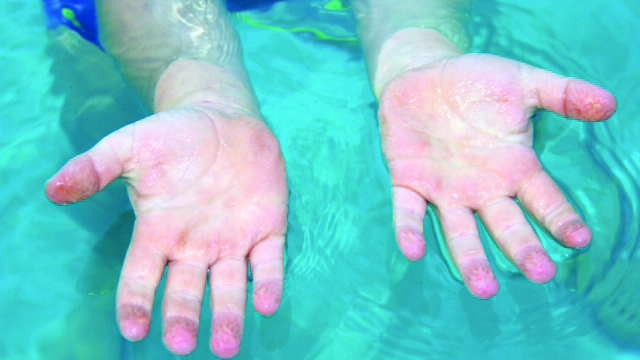
If you’ve ever spent too long in a bath, gone swimming, or washed dishes without gloves, you’ve probably noticed the same strange transformation: your fingertips become covered in deep, ridged wrinkles. The skin may look shriveled, almost as though it has absorbed a huge amount of water.
For a long time, the simplest explanation was that water seeped into the outer layer of the skin and caused it to swell. That explanation is partly true, but it doesn’t tell the whole story. The distinctive wrinkling of the fingers and toes is also controlled by the nervous system and changes in blood flow beneath the skin.
In other words, your wrinkled fingertips are not simply waterlogged skin. They are the visible result of a physiological response.
What actually happens when your fingers get wet?
The outermost part of your skin, called the stratum corneum, is made largely of dead, flattened skin cells. It contains keratin, a tough structural protein that also occurs in hair and nails. The stratum corneum acts as an important barrier, helping limit the movement of water into and out of the body.
When your hands are immersed in water for several minutes, some water interacts with and enters the outer layers of the skin. This can make the outer skin layer swell somewhat.
But simple swelling cannot fully explain the characteristic wrinkles on your fingertips.
If water absorption were the only mechanism, you would expect all of the exposed skin to wrinkle in roughly the same way. Instead, pronounced water wrinkling is especially noticeable on the palms of the hands and the soles of the feet. These areas have a distinctive pattern of ridges and a high density of eccrine sweat glands, and their response to prolonged immersion involves changes in the tissue beneath the skin.
The result is that the surface of the skin develops grooves and ridges that become much more obvious when the fingers have been underwater for a while.
Your nervous system plays a major role
One of the most important discoveries about water-induced wrinkling is that it is an active physiological process rather than merely passive water absorption.
The autonomic nervous system, which automatically regulates many functions you don’t consciously control, influences blood vessels in the skin. During prolonged immersion, nerves can cause blood vessels in the fingers to constrict, or narrow.
As those blood vessels become narrower, the volume of blood in the tissues beneath the skin decreases. This causes the underlying tissue to contract slightly. The skin on top consequently becomes less tightly stretched over the tissue, producing the familiar wrinkles.
This helps explain a particularly interesting observation: people whose sympathetic nerves to a finger have been damaged may show reduced or absent water-induced wrinkling in that finger.
That finding is difficult to explain if wrinkling were simply a matter of the skin absorbing water. It makes much more sense if the nervous system is involved.
Why doesn’t all of your skin wrinkle equally?
The palms of your hands and the soles of your feet behave differently from most other areas of your skin.
Their surfaces contain specialized thick skin with prominent dermatoglyphs—the permanent ridge patterns that form fingerprints and footprints. These regions also contain many eccrine sweat glands but lack hair follicles.
When immersed in water, the skin of these areas develops the pronounced wrinkling that most people associate with a long bath or swim.
Other parts of the body can become softened or somewhat swollen after prolonged exposure to water, but they generally don’t develop the same dramatic pattern of wrinkles.
The anatomy of the palms and soles therefore matters. The effect isn’t simply a universal property of human skin.
Why do the wrinkles form patterns?
The wrinkles on wet fingers aren’t random creases. They often form branching, roughly parallel grooves across the fingertips and palms.
That pattern is influenced by the underlying anatomy and the preexisting structure of the skin.
Your fingertips already contain ridges that create fingerprints. When the underlying tissues change volume during water immersion, the overlying skin deforms around this existing structure. The resulting grooves can therefore follow recognizable patterns.
The exact appearance varies from person to person because everyone’s fingerprints and skin structure are different.
Is the skin really absorbing water?
Yes, but the amount and mechanism matter.
The outer layer of skin is not a completely impermeable shell. Water can interact with the stratum corneum, and prolonged exposure causes changes in its hydration. This is why skin that has been submerged for a long time can become pale, soft, and swollen.
The outer skin cells contain substances that interact with water, and prolonged exposure changes the physical properties of the stratum corneum.
However, the idea that your fingers simply “fill up with water” is misleading. The amount of water entering the body through intact skin during an ordinary bath or swim is not enough to explain the dramatic appearance of wrinkled fingertips.
The visible wrinkling involves both changes in the outer skin and physiological changes underneath it.
Why do fingers wrinkle even in clean water?
The response doesn’t depend on water being dirty or containing soap. Ordinary freshwater is sufficient to produce the effect.
The important factors are immersion and time. Once the hands remain submerged long enough, the skin and the nervous system respond to the environment.
The temperature of the water can also affect how quickly the process develops. Cold water and warm water influence blood vessels differently, so the timing and appearance of wrinkling can vary with conditions.
Does hot water make your fingers wrinkle faster?
Water temperature can influence the response, but the relationship isn’t as simple as “hotter water equals faster wrinkles.”
Warm water causes blood vessels in the skin to dilate, while cold exposure can cause substantial vasoconstriction. Because water-induced wrinkling involves changes in blood flow as well as changes in the outer skin, temperature can affect how the phenomenon develops.
Very hot water also has other effects on the skin. It can remove some of the skin’s surface oils and increase dryness or irritation, particularly with frequent or prolonged exposure.
So although a long hot bath can certainly leave your fingers wrinkled, temperature isn’t the fundamental reason the phenomenon occurs.
Why do the wrinkles disappear afterward?
Once you take your hands out of the water, the wrinkling gradually fades.
The skin returns toward its normal state as the temporary changes in blood flow reverse and the tissues recover their usual volume and hydration.
The process isn’t instantaneous because the skin doesn’t immediately return to its pre-immersion physical state. Over time, the grooves become shallower until the familiar smooth appearance of the fingertips returns.
This reversibility is another clue that water-induced wrinkling is a temporary physiological response rather than permanent damage to the skin.
Does wrinkled skin have a useful purpose?
Scientists have proposed that water-induced wrinkling may have a functional advantage.
One influential idea is that the grooves improve the handling of wet objects. Wrinkles can create channels through which water moves away from the contact area between the fingers and an object. This could potentially improve grip under wet conditions.
A similar idea has been proposed for the wrinkling of the soles of the feet: temporary grooves might help move water away from the areas contacting the ground, potentially improving traction.
This has led to the hypothesis that water-induced wrinkling is an adaptation that once helped humans handle wet objects or move across wet surfaces.
There is some experimental evidence consistent with this idea, including research suggesting that people may handle certain wet objects differently when their fingers are wrinkled. But the evolutionary explanation should be treated as a hypothesis rather than an established fact.
The physiological mechanism is much better established than the precise evolutionary reason the response developed.
Why would wrinkling improve grip?
Imagine trying to hold a smooth object underwater. A thin layer of water can sit between your skin and the object, reducing the kind of friction that helps you maintain a grip.
A wrinkled fingertip has grooves that may provide pathways for water to escape from parts of the contact surface. Instead of having a relatively flat surface with water trapped across it, the fingertip can form channels that help regulate the interface between skin, water, and the object.
This is conceptually similar to the way tread patterns can help manage water on other surfaces, although human fingertips are obviously much more complex than a tire.
The possible gripping benefit is one reason scientists became interested in the fact that wrinkling is actively controlled by the nervous system. An automatic response that changes the physical surface of the fingers in wet conditions could potentially have practical consequences.
Still, the precise contribution of wrinkles to human grip is not completely settled, and it would be too strong to say that scientists have definitively proved that improving grip was the evolutionary purpose of the response.
Why do your toes wrinkle too?
Your toes wrinkle for essentially the same reason your fingers do.
The soles of the feet and the undersides of the toes have specialized thick skin similar to the palms and fingertips. Prolonged immersion can trigger the same combination of changes involving the outer skin and blood vessels.
If you’ve spent a long time swimming, you’ve probably noticed that your toes can become just as wrinkled as your fingers.
The potential role in traction is particularly interesting in the feet because temporary grooves could theoretically influence how water moves beneath the soles.
Are wrinkles caused by dehydration?
No. Water-induced finger wrinkles aren’t a sign that your body is dehydrated.
In fact, they usually appear because your hands have been surrounded by water.
Dehydration can change the appearance and elasticity of skin, but that is a different process. Dehydrated skin may look dry, less plump, or less supple, whereas water-induced wrinkling develops after prolonged immersion and disappears after the exposure ends.
The two phenomena should not be confused.
Why don’t your fingers stay wrinkled after swimming?
The mechanism is temporary.
As your hands leave the water, the autonomic response and blood-vessel constriction associated with immersion subside. The tissues return toward their usual state, and the surface skin gradually loses the exaggerated grooves.
Ordinary water exposure therefore doesn’t permanently change your fingerprints or the structure of your fingertips.
Your fingerprints themselves are formed by deeper skin structures and remain stable under normal circumstances. The temporary wrinkles produced by immersion are superimposed on that underlying pattern.
Do fingerprints change when they’re wet?
Your fingerprints don’t disappear or fundamentally change when your fingers wrinkle.
The ridges that make up fingerprints are permanent features of your skin. Water-induced wrinkling changes the surface shape temporarily, making the fingerprint region look more distorted or deeply grooved.
This is one reason wet fingertips can feel and look quite different from dry fingertips without actually changing the underlying fingerprint pattern.
Why does the skin sometimes turn pale as well?
Wrinkling is often accompanied by a pale or whitish appearance.
Several things can contribute to this effect. Prolonged water exposure changes the hydration and optical properties of the outer skin, while changes in blood flow can alter the amount of blood visible through the tissue.
The thick skin of the palms and soles also naturally looks different from thinner skin elsewhere on the body.
After a long soak, the combined effects can make the fingertips appear pale, swollen around some areas, and deeply wrinkled.
Does soap make wrinkling worse?
Soap isn’t necessary for water-induced wrinkling, but it can change how your skin feels afterward.
Soaps and detergents can remove oils from the skin’s surface. Repeated exposure may leave the skin dry or irritated, especially for people with sensitive skin.
That is separate from the basic wrinkling response. Your fingers can wrinkle in plain water without soap.
If your hands remain exposed to water and detergent for long periods, however, you may notice additional changes such as dryness, tightness, roughness, or irritation after the wrinkling disappears.
What if your fingers wrinkle unusually quickly?
The speed and degree of wrinkling can vary.
Water temperature, duration of immersion, skin characteristics, circulation, and individual differences can all influence how noticeable the effect becomes. A person’s hands may also respond differently under different circumstances.
An unusually quick or pronounced response by itself generally doesn’t tell you much about your health.
The more medically interesting situation is the opposite: a finger or hand that consistently fails to wrinkle during prolonged immersion, particularly when the other hand responds normally.
Because the process involves nerves and blood vessels, absent or markedly reduced wrinkling can sometimes occur when the relevant nerve supply has been affected. This phenomenon has been investigated as a possible indicator of certain nerve or autonomic problems, although it is not something that should be used on its own to diagnose a medical condition.
If a persistent difference between your hands or fingers concerns you—especially if it occurs alongside numbness, weakness, pain, color changes, or other symptoms—a health professional can evaluate the underlying cause.
Is water-induced wrinkling harmful?
For most people, no.
The ordinary wrinkling that occurs after swimming, bathing, washing dishes, or soaking your hands is a normal temporary response.
The skin may feel soft or slightly swollen afterward, but the wrinkles themselves aren’t evidence that your skin has been damaged.
The bigger issue with frequent or prolonged water exposure is that repeated wetting and drying, especially when combined with detergents or irritants, can disrupt the skin barrier. This can contribute to dryness and irritation in some people.
That is why someone who washes dishes frequently may experience cracked or irritated hands even though the temporary wrinkles themselves are harmless.
What happens if you’re in water for a very long time?
With prolonged immersion, the skin can become increasingly hydrated and softened. This is sometimes described as maceration.
Macerated skin is softer and more fragile than normal dry skin. Extended exposure can make it easier for the skin to become irritated or damaged, particularly if there is friction, pressure, or exposure to chemicals.
This is different from the ordinary, short-lived fingertip wrinkling you see after a bath or swim.
In practical terms, the wrinkling itself is a normal response, while very prolonged immersion can create separate problems for the skin barrier.
Why is this little phenomenon scientifically interesting?
Water-induced finger wrinkling looks trivial, but it illustrates several important principles of human biology.
First, the skin is not merely an inert covering. It is living tissue with complex interactions between nerves, blood vessels, connective tissue, and specialized outer layers.
Second, the nervous system can change the physical properties of the body’s surface without conscious control. You don’t have to decide to wrinkle your fingertips; your autonomic nervous system helps produce the response automatically.
Third, a familiar everyday observation can reveal something about physiology that isn’t obvious from appearance alone. What looks like waterlogged skin turns out to involve a coordinated biological response.
And finally, the phenomenon illustrates an important distinction in science: knowing how something happens is not necessarily the same as knowing why it evolved. The involvement of nerves and blood vessels in water-induced wrinkling is well supported, while the proposed advantage for wet grip is a plausible evolutionary explanation that remains more nuanced.
So the next time your fingers emerge from a bath looking like tiny accordion folds, you’re seeing more than skin that has soaked up water. You’re seeing the temporary interaction of your skin, circulation, and nervous system—an ordinary response that has turned out to be considerably more interesting than it first appears.