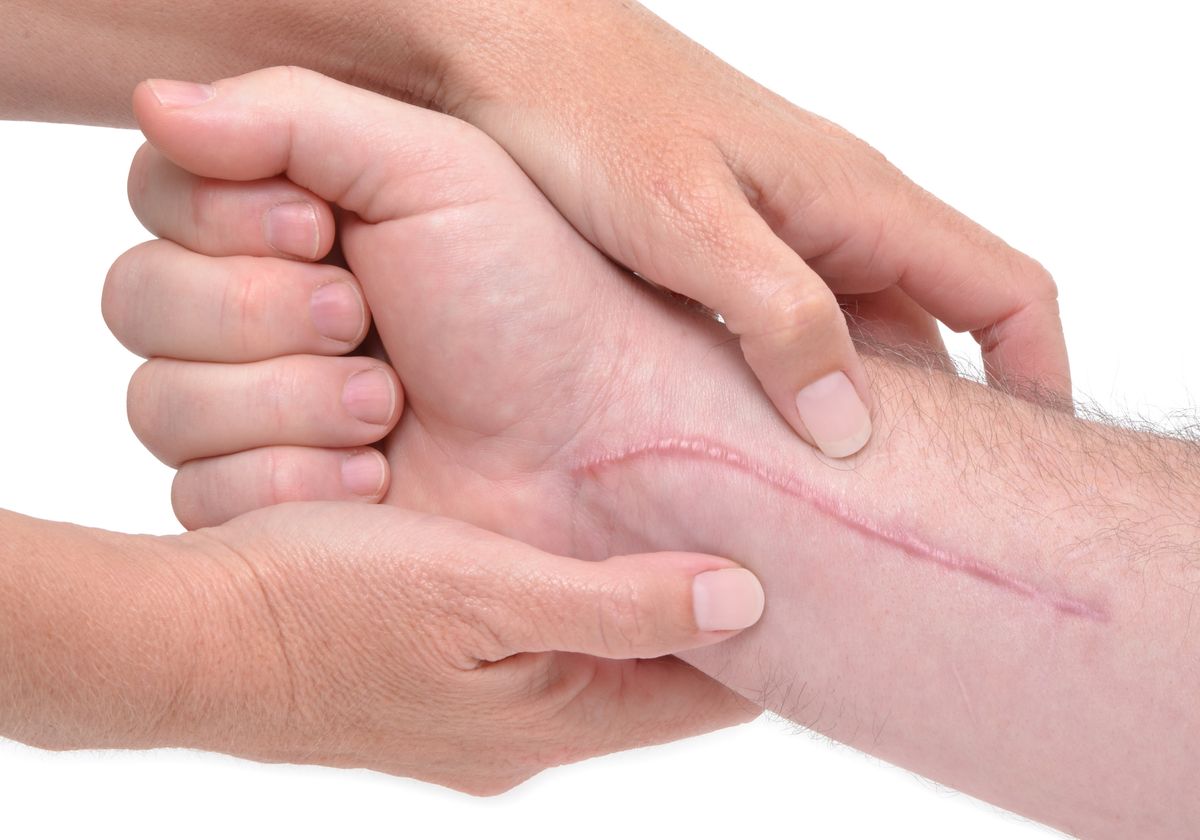
A cut, scrape, burn, or surgical incision can leave behind a mark long after the original injury has disappeared. Sometimes the skin returns so close to its original appearance that the injury is barely noticeable. Other times, a wound heals with a visible scar that may be lighter or darker than the surrounding skin, raised or indented, firm or soft.
Scarring is not simply a sign that the body failed to heal correctly. In many cases, it is the normal result of an effective repair process. The body has to close damaged tissue quickly enough to protect it from bleeding, dehydration, and infection. When an injury destroys enough of the skin’s structure that the original tissue cannot be perfectly reconstructed, the body fills and reinforces the damaged area with a different kind of tissue. That replacement tissue is a scar.
Understanding why this happens requires looking at what the skin is made of, what happens immediately after an injury, and how the body’s repair system decides between rebuilding tissue and creating a durable patch.
What a scar actually is
A scar is an area of fibrous tissue that forms during the healing of damaged tissue. In the skin, it is produced mainly when the body replaces disrupted connective tissue with newly deposited collagen and other extracellular-matrix components.
Normal skin is an intricately organized structure. Its connective tissue contains collagen fibers, elastic fibers, blood vessels, nerves, immune cells, and other components arranged in patterns that give skin its strength, flexibility, and distinctive appearance. The skin also contains structures such as hair follicles and sweat glands.
After a sufficiently deep injury, this architecture may be destroyed. The body can restore the surface of the skin relatively effectively, but it often cannot reconstruct all of the original microscopic organization. Instead, it creates a strong fibrous matrix that bridges the damaged area. That matrix becomes remodeled over time and forms a scar.
This explains why scar tissue can look and feel different from uninjured skin. A scar may have less normal elasticity, a different arrangement of collagen fibers, fewer or absent skin appendages, and altered pigmentation or blood-vessel patterns.
A scar is therefore best understood as a structural record of the body’s repair process. It is not necessarily evidence of an abnormal healing process.
Why the body does not simply regenerate the original skin
The human body is capable of regeneration in some circumstances, but regeneration and repair are not the same thing.
Regeneration replaces damaged tissue with tissue that closely resembles the original in structure and function. Repair restores physical integrity, but the replacement tissue may not have the same organization as the tissue that was lost.
The outermost layer of skin, the epidermis, has a substantial capacity for regeneration. Cells in the epidermis can multiply and move across a superficial wound, restoring the protective barrier. If an injury affects only this upper layer, it may heal without a permanent scar.
The deeper layer, the dermis, is different. It contains much of the skin’s structural framework. When an injury significantly damages the dermis, the body must rebuild connective tissue as well as close the surface. The repair process tends to produce collagen rapidly and organize it differently from the collagen in uninjured skin.
The deeper and more destructive the injury, the more likely it is that this repair response will leave a visible scar.
The skin has several stages of wound healing
Wound healing is a coordinated biological process rather than a single event. Its major phases overlap, and different cell types and signaling molecules participate at different times.
The immediate response stops bleeding
When a blood vessel is damaged, the body responds almost immediately. Blood vessels constrict, platelets gather at the injury, and a clot forms. The clot helps stop bleeding and creates a temporary physical barrier.
The clot is more than a plug. It also acts as a provisional scaffold and contains signaling molecules that help recruit cells involved in healing. As the clot develops, a network of fibrin helps stabilize the injured area.
Inflammation cleans the wound
After bleeding is controlled, the immune system becomes highly active at the injury site. Inflammation helps remove damaged cells, microorganisms, and debris.
White blood cells enter the area and release substances that coordinate the repair process. Some immune cells destroy microbes, while others remove damaged material and release signals that influence the next stages of healing.
Inflammation is essential, but its intensity and duration matter. A controlled, temporary inflammatory response supports healing. Prolonged or excessive inflammation can interfere with normal repair and contribute to abnormal scarring.
New tissue begins to fill the wound
During the proliferative phase, cells multiply and move into the damaged area. New blood vessels develop, connective-tissue cells called fibroblasts become active, and a temporary tissue known as granulation tissue forms.
Fibroblasts are particularly important because they produce collagen and other components of the extracellular matrix. This new matrix provides structural support while the wound is being rebuilt.
At the same time, cells at the edges of the wound migrate across the surface, helping restore the skin’s protective barrier.
The wound contracts and the tissue remodels
As healing progresses, the newly formed tissue is reorganized. Some fibroblasts develop into specialized cells called myofibroblasts, which can generate forces that pull the edges of a wound toward one another.
The body also modifies the collagen that was deposited earlier. Enzymes break down portions of the extracellular matrix while new collagen is produced and reorganized. This remodeling can continue for months or longer.
The resulting scar often becomes flatter, softer, and less noticeable with time, although it may never become identical to the surrounding skin.
Why shallow wounds often do not scar
Whether a wound scars depends largely on which parts of the skin have been damaged.
A very superficial injury can be repaired primarily by replacing epidermal cells. The underlying dermal structure remains sufficiently intact that the body does not need to construct a substantial fibrous replacement.
For example, a mild abrasion that removes only the outermost skin may heal with little or no permanent structural change. Temporary redness, discoloration, or a change in texture can occur during healing without necessarily becoming a permanent scar.
By contrast, an injury that extends deeply into the dermis disrupts the collagen framework and other structures that give skin its organization. The body then needs a more substantial repair response, making permanent scarring much more likely.
Why deeper wounds are more likely to scar
The dermis provides much of the skin’s mechanical strength. When a wound destroys significant portions of this layer, the original arrangement of collagen and other structures cannot simply be restored by having surface skin cells grow over it.
The body instead builds a replacement matrix. Collagen is deposited relatively quickly to stabilize the damaged area. This is biologically sensible because leaving a large gap unsupported would compromise the skin’s strength and barrier function.
The resulting tissue is functional, but it is not a perfect reconstruction of the original dermis. Its collagen is initially more abundant and arranged differently. During remodeling, some of that material is removed and reorganized, but the original architecture is generally not completely recreated.
This is one of the fundamental reasons deep wounds leave scars.
Why scars can look different from normal skin
A scar is made of living tissue, but its structure differs from that of normal skin.
Collagen fibers in a scar tend to be more densely packed and less regularly organized than the collagen network in uninjured dermis. Elastic fibers may also be reduced or altered. The scar may contain fewer normal skin appendages, and its blood supply can change substantially as it matures.
These differences can affect the scar’s texture, flexibility, thickness, and color.
A new scar may appear pink, red, or purplish because of increased blood flow and vascular activity during healing. As the scar matures, blood-vessel activity often decreases and the color may become less noticeable.
Pigment changes can also occur. Some scars become darker than the surrounding skin, a change known as post-inflammatory hyperpigmentation. Others can become lighter. These color changes are particularly noticeable in people with more deeply pigmented skin, although they can occur in anyone.
A scar may also feel numb, itchy, tight, tender, or unusually sensitive, particularly while it is still developing. These sensations can result from changes in nerves, inflammation, and mechanical tension in the healing tissue.
Why some scars are raised
Not all scars simply become flat patches of tissue. Some produce excessive amounts of collagen and remain elevated above the surrounding skin.
A hypertrophic scar is a raised scar that generally remains within the boundaries of the original wound. It can become thick, firm, red, or itchy. Hypertrophic scars often become less prominent over time.
A keloid is another type of excessive scar formation. Unlike a typical hypertrophic scar, a keloid can extend beyond the original boundaries of the injury into surrounding skin. Keloids can continue growing after the wound itself has closed.
The biological reasons some people develop keloids are complex and involve differences in inflammation, fibroblast activity, collagen production, and signaling during wound healing. Genetics also play an important role, which is why keloids can be much more common in some families and populations than in others.
A person’s tendency to form keloids can also vary depending on where the injury occurs. Certain parts of the body, including the chest, shoulders, upper back, and earlobes, are particularly prone to keloid formation.
Why some scars are sunken or indented
Scars do not always contain too much tissue. Some contain less structural tissue than the surrounding skin and appear depressed.
Indented scars can develop when inflammation or tissue destruction damages the dermis and the healing response does not replace the lost volume adequately. Acne scars are a familiar example. Some types of acne cause deep inflammation that damages collagen beneath the surface of the skin, leaving depressions after the inflammation resolves.
Other depressed scars can result from infections, surgery, trauma, or other processes that destroy substantial amounts of tissue.
The shape of a depressed scar depends on the pattern and depth of tissue damage and on how the wound heals.
Why wounds on different parts of the body can heal differently
The mechanical environment around a wound influences scarring.
Skin is constantly exposed to movement and tension. A wound across an area that is frequently stretched can experience more mechanical forces during healing than one in a relatively protected location.
Wounds that are under greater tension may stimulate stronger fibroblast activity and collagen deposition. This is one reason surgeons consider the direction of natural skin tension when planning incisions and closing wounds.
The body’s healing environment also differs from one anatomical site to another. Blood supply, skin thickness, movement, exposure to sunlight, and the amount of underlying tissue can all influence how a wound heals and how noticeable the resulting scar becomes.
Why genetics influence scarring
People do not all heal wounds in exactly the same way. Genetic differences affect immune responses, inflammation, fibroblast behavior, collagen production, and the regulation of tissue remodeling.
These differences help explain why two people can sustain similar injuries and develop scars that look quite different.
Genetics are particularly relevant to keloids, but inherited biology can influence other aspects of scarring as well. Age and hormonal state can also affect wound healing and collagen metabolism.
Individual variation is therefore an important part of the explanation for why one person’s wound leaves a prominent mark while another person’s comparable injury heals with relatively little visible evidence.
How age affects wound healing and scars
Wound healing changes throughout life.
Children and younger adults generally have strong regenerative and repair responses, although their healing can sometimes produce prominent scars, particularly after significant injuries. Younger skin can generate collagen actively, and some young people are prone to raised scars.
As people age, several aspects of healing tend to slow. Skin becomes thinner, blood supply and cellular activity can change, and the production and remodeling of connective tissue become less robust. Older wounds may therefore take longer to close and remodel.
Age alone does not determine whether a scar will form or how it will look. The depth and location of the injury, overall health, inflammation, and many other factors remain important.
Why infection can make scarring worse
A wound that becomes infected may experience prolonged inflammation and additional tissue destruction.
Microorganisms can damage tissue directly, while the immune response directed against them can produce enzymes and inflammatory molecules that affect surrounding structures. If an infection delays closure or causes the wound to become larger or deeper, more repair tissue may be required.
This helps explain why preventing and treating wound infection is important not only for immediate safety but also for the eventual quality of healing.
A wound that becomes increasingly painful, swollen, warm, red, or produces pus can be showing signs of infection and may need medical evaluation, particularly when symptoms are worsening rather than improving.
Why repeated injury can produce more noticeable scars
The healing process depends on the amount and type of tissue that has been damaged. Repeated trauma can reopen a wound before the underlying tissue has fully matured, extending the period of repair and potentially increasing the amount of scar tissue.
Repeated scratching or picking can similarly injure newly healing skin. This can prolong inflammation and increase the likelihood of persistent discoloration or a more prominent scar.
The same principle applies to wounds that repeatedly experience friction or tension. The body is trying to maintain tissue integrity under challenging conditions, and prolonged disruption can alter the final appearance of the repair.
Why burns can produce extensive scarring
Burns illustrate particularly clearly why the depth of an injury matters.
A superficial burn may affect primarily the epidermis and can heal with little permanent scarring. A deeper burn can destroy substantial portions of the dermis and sometimes deeper tissues. When that happens, the body must construct a larger replacement matrix.
Deep burns can therefore produce thick, tight scars. When scar tissue contracts across a joint or other moving area, it can restrict movement. This type of tightening is called a contracture and can be an important complication of serious burns.
Extensive burns can require specialized medical care, including surgical procedures and prolonged rehabilitation, because restoring function can be as important as closing the wound.
Why surgery can leave scars even when healing goes well
A surgical incision is deliberately created and then carefully closed, but it still represents an injury to the skin.
Surgeons generally try to minimize unnecessary tissue damage, align wound edges, and place incisions where healing can produce an acceptable result. Nevertheless, if an incision cuts through the dermis, some degree of scar formation is expected.
A well-healed surgical scar may gradually become flatter and less noticeable, but its final appearance depends on the incision’s size and depth, location, skin tension, individual biology, surgical technique, and the healing process.
The presence of a surgical scar therefore does not, by itself, indicate that something went wrong.
Why scars usually change over time
Scar tissue is not static once a wound closes.
During the early stages of healing, a scar may be relatively red, raised, firm, or itchy. As remodeling continues, collagen is broken down and reorganized. Blood-vessel activity can decline, and the scar often becomes paler and softer.
This maturation process can take many months and sometimes considerably longer, particularly after substantial injuries.
The final appearance is influenced by how much tissue was damaged and how the body’s repair mechanisms behaved during healing. Some scars become difficult to notice. Others remain clearly visible because the underlying tissue architecture was substantially altered.
Why scars usually do not regrow hair or sweat glands
When a deep wound destroys hair follicles, sweat glands, and other structures within the dermis, ordinary scar formation generally does not recreate them.
Instead, the repaired region is largely composed of fibrous connective tissue. It may restore the skin’s basic barrier and strength but lack some of the specialized structures present in normal skin.
This is another important distinction between repair and true regeneration. The body can restore continuity without reproducing every component of the original tissue.
Researchers have long studied how certain animals regenerate tissue more completely and whether aspects of those biological mechanisms might eventually help improve human tissue regeneration. Human wound healing, however, normally favors rapid repair and scar formation rather than complete regeneration of complex skin architecture.
Why the body favors scar formation
From the body’s perspective, rapid closure and structural reinforcement are extremely valuable.
A large open wound creates several immediate problems. It can bleed, lose fluid, allow microorganisms to enter, and expose underlying tissue to the environment. The body therefore needs to establish a physical barrier and restore strength relatively quickly.
Producing collagen and other extracellular-matrix components is an effective way to bridge damaged tissue. Although the resulting scar may not perfectly reproduce normal skin, it can provide durable structural support.
In evolutionary terms, the ability to repair serious tissue damage quickly is more immediately useful than waiting for a slow and highly precise reconstruction of every microscopic feature.
This tradeoff helps explain why human healing is so good at repair but comparatively limited at scar-free regeneration.
Can every wound be expected to leave a scar?
No.
The simplest predictor is the depth of the injury, particularly whether the dermis has been substantially damaged. Very superficial wounds can heal without a permanent scar because the basic dermal architecture remains intact.
However, there is no perfectly reliable line separating “scar-forming” and “scar-free” wounds. The body’s inflammatory response, wound size, location, infection, mechanical tension, genetics, age, and other factors all influence the outcome.
Even when a wound does not produce a conventional permanent scar, temporary changes in color or texture can remain for a while after the surface has healed.
How wound care affects the eventual scar
Good wound care cannot guarantee scar-free healing after a deep injury, because the depth of the original damage is a major determinant of scarring. It can, however, help create conditions that support orderly healing.
Keeping an appropriate wound environment, protecting the injury from additional trauma, and following medical instructions for significant wounds can reduce complications that interfere with healing.
Sun exposure is also relevant after a wound has healed. Newly healing skin and scars can be more vulnerable to noticeable changes in pigmentation. Protecting a healing area from excessive ultraviolet exposure can help reduce persistent discoloration.
For substantial wounds, burns, surgical complications, or scars that become increasingly raised, painful, itchy, or restrictive, clinicians can assess the tissue and discuss treatments appropriate to the specific type of scar. Treatments may include silicone-based products, pressure therapy, injections, laser procedures, surgical revision, or other approaches depending on the scar and the individual situation. No single scar treatment works equally well for every type of scar.
When a scar may signal a problem
Most scars are simply the normal endpoint of tissue repair. A scar itself is not usually a medical problem.
Some changes, however, warrant attention. A scar that continues becoming larger and extends beyond the original wound may be a keloid. A scar that becomes very thick, painful, itchy, or increasingly restrictive may also benefit from medical evaluation.
More importantly, problems can arise before a wound has fully healed. Increasing redness, warmth, swelling, pain, drainage, fever, or separation of the wound edges can indicate infection or another complication.
People with conditions that impair circulation, immune function, or the body’s ability to repair tissue may also need more careful wound management.
A clinician can distinguish ordinary scar maturation from complications that require treatment.
Why scar-free healing remains difficult in humans
The central challenge is that wound healing is a balancing act.
The body must stop bleeding, defend against infection, remove damaged material, rebuild the tissue, and restore mechanical strength. These processes depend on inflammation, immune signaling, fibroblasts, collagen deposition, blood-vessel growth, and tissue remodeling.
Turning off or greatly reducing scar formation could potentially improve the cosmetic and functional outcome of some injuries, but scar formation also performs an essential structural role. Suppressing repair indiscriminately could leave damaged tissue weak or poorly closed.
The biological goal is therefore not simply to eliminate every scar. A more precise goal is to understand how the body could repair tissue strongly while reproducing more of its original architecture.
For now, the visible scar left by a sufficiently deep wound is a consequence of this fundamental repair strategy: when the body’s original tissue framework has been damaged beyond what it can readily regenerate, it builds a durable replacement instead.