You can get goosebumps from a frightening movie, a sudden blast of cold air, a moving piece of music, or even a powerful memory. The skin on your arms rises into tiny bumps, the hairs stand up, and for a moment your body seems to be reacting to something far more primitive than the situation requires.
That reaction is real, automatic, and deeply rooted in mammalian biology. Goosebumps are not simply a curious feature of human skin. They are the visible result of a small but revealing interaction between the nervous system, muscles, hair follicles, and the body’s stress-response machinery.
The odd part is that the response makes much more sense in a furry animal than it does in a mostly hairless human. In other mammals, making the hair stand up can help conserve heat or make an animal appear larger when it is threatened. Humans still have the same basic mechanism, even though our relatively sparse body hair makes it much less useful.
Understanding why goosebumps happen therefore offers a glimpse into an older layer of human biology—one that evolved when our ancestors were much hairier and when rapid, involuntary responses to cold and danger could have mattered considerably more.
What exactly are goosebumps?
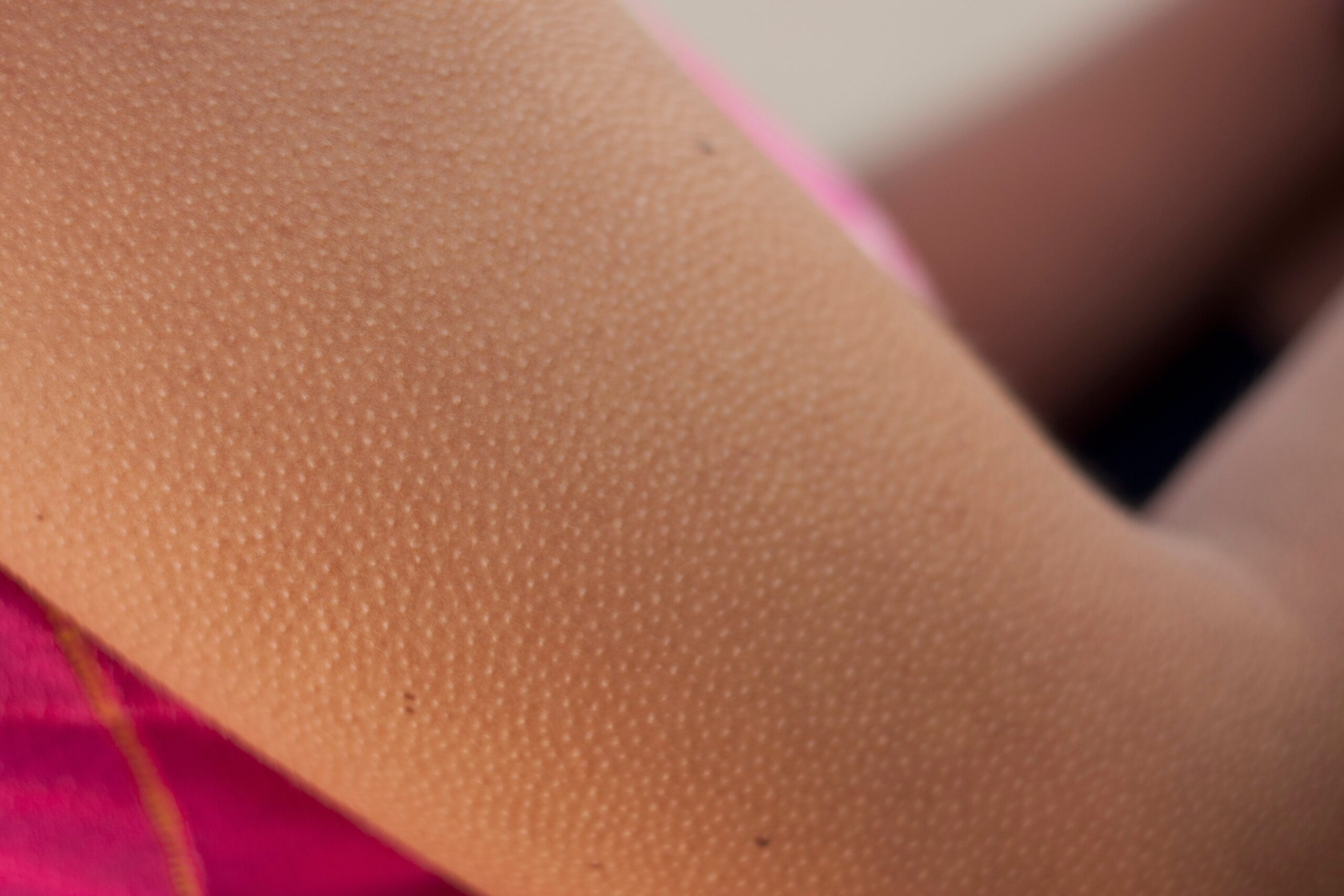
Goosebumps are the small raised bumps that appear on the skin when the tiny muscles attached to individual hair follicles contract. The technical term for this phenomenon is piloerection, from words referring to hair and erection or standing upright.
Each hair on a hairy part of the body grows from a structure called a hair follicle. Connected to many follicles is a microscopic smooth muscle called the arrector pili muscle. When this muscle contracts, it pulls on the follicle and causes the hair to stand more upright. At the same time, the surrounding skin is pulled slightly upward, producing the familiar bump.
The bumps are therefore not caused by the hairs themselves swelling. They are produced by the mechanical action of these tiny muscles beneath the skin.
Humans can experience piloerection over much of the body, although it is particularly noticeable on areas such as the arms and legs. The effect can also occur on the scalp and other hair-bearing regions.
The name “goosebumps” comes from the resemblance between the raised human skin and the bumpy skin of a plucked goose. Other English expressions include “gooseflesh” and “goose pimples.” The underlying biological process, however, is the same regardless of what it is called.
Why does cold give you goosebumps?
One of the most straightforward triggers for goosebumps is cold.
Your body has an internal temperature-regulation system that constantly monitors conditions inside and outside the body. Specialized sensory systems detect changes in temperature, while the brain coordinates responses designed to keep core body temperature within a relatively narrow range.
When you become cold, the nervous system can activate several responses. Blood vessels near the skin may constrict, reducing blood flow to the body’s surface and limiting heat loss. Metabolic activity can increase, and muscles may begin to contract rapidly in the form of shivering. Piloerection can occur as part of the same general response.
In a furry mammal, raising the hairs can create a layer of trapped air next to the skin. Hair is a poor conductor of heat compared with many other materials, so a dense coat can help reduce the movement of heat away from the body. Standing the hairs more upright can alter the insulating properties of the coat.
Humans have retained the ability to raise their hair, but our body hair is too sparse and short for the effect to provide much meaningful insulation. A modern human covered in goosebumps does not suddenly acquire an effective fur coat.
The response is therefore an example of a biological mechanism whose original usefulness can become greatly reduced as anatomy and lifestyle change while the underlying nervous circuitry remains.
Why do fear and danger cause goosebumps?
Cold is not the only trigger. Strong emotional states can produce exactly the same physical response.
Fear, surprise, excitement, anticipation, and other forms of intense arousal can activate the sympathetic nervous system, a major component of the autonomic nervous system. This system controls many bodily functions that do not require conscious attention.
The sympathetic nervous system is especially important when the brain interprets a situation as demanding rapid action. It can increase heart rate, redirect blood flow, widen the airways, alter digestion, stimulate sweating, and prepare muscles for action. Piloerection can occur alongside these changes.
This is one reason the expression “fight or flight” is associated with goosebumps. The body is not consciously deciding to raise the hairs. Instead, neural signals reach the tiny muscles attached to hair follicles and cause them to contract.
The reaction can happen remarkably quickly because it does not depend on a person making a deliberate decision. The autonomic nervous system is designed to produce rapid physiological adjustments before conscious thought has fully caught up.
Importantly, goosebumps themselves are not a reliable measure of how frightened someone is. A person can be extremely afraid without developing noticeable goosebumps, while another person may get them from relatively mild emotional stimulation.
What does the nervous system have to do with goosebumps?
The connection between goosebumps and the nervous system is central to understanding the phenomenon.
The muscles responsible for piloerection are smooth muscles, meaning they are not controlled voluntarily in the same way skeletal muscles are. You cannot normally decide to contract an arrector pili muscle on your forearm and deliberately create a goosebump there.
Instead, these muscles receive signals through the autonomic nervous system. In particular, sympathetic nerve activity can stimulate them.
This makes goosebumps part of a much larger network of automatic physiological responses. The same broad nervous-system machinery that helps regulate temperature and respond to perceived threats can influence the tiny muscles around hair follicles.
The process also illustrates an important principle of biology: a single physiological system can participate in responses to very different experiences. Cold and fear seem psychologically unrelated, yet both can activate pathways that ultimately produce piloerection.
The body does not necessarily have a completely separate mechanism for every sensation. Evolution often works by modifying and reusing existing biological machinery.
Why would standing up your hair help an animal?
To understand the evolutionary logic of goosebumps, it helps to imagine a mammal with a thick coat rather than a nearly hairless human.
When a mammal is cold, raising its fur can increase the thickness or loft of its coat and help trap a layer of air close to the skin. The exact insulating effect depends on the animal’s coat, hair density, environment, and other factors, but the basic principle is familiar from human clothing: trapped air can provide useful insulation.
Piloerection can also serve another function during social or threatening encounters.
An animal that suddenly raises its fur may appear larger than it actually is. This can be useful when confronting a predator, rival, or other potential threat. A larger-looking animal can sometimes discourage an opponent from attacking or signal heightened arousal.
The classic visual example is a cat with its back arched and its fur standing on end when startled or threatened. The cat is not merely “getting goosebumps” in the human sense. Its entire appearance can change dramatically because its coat responds to sympathetic activation.
A similar principle operates in many mammals. Raised fur can communicate a state of high arousal while potentially making the animal appear more imposing.
For a heavily furred mammal, then, piloerection can have both thermal and behavioral functions.
For humans, most of the original physical advantages have largely disappeared.
Why do humans still get goosebumps if we don’t have much fur?
Evolution does not redesign an organism from scratch every generation.
A trait can remain because the biological machinery supporting it is intertwined with other systems, because eliminating it would provide little advantage, or because the evolutionary forces acting on it are weak. A mechanism that was useful in ancestral mammals does not automatically disappear simply because it becomes less important in a later species.
Human hairlessness is also relative rather than absolute. Humans still have hair follicles over most of the body, although much of our hair is fine and short compared with the dense coats of other mammals.
Because the follicles and their associated muscles remain, the neural mechanism capable of activating those muscles remains as well.
There is little reason to imagine that humans evolved goosebumps specifically for modern emotional experiences. Rather, the nervous system can trigger an old physiological response in circumstances that include emotional arousal.
This is a recurring pattern in evolutionary biology. Modern humans inherit many physiological systems that developed under conditions very different from those of contemporary life. Some remain highly useful, some have been repurposed, and others are simply less consequential than they once were.
Goosebumps are a particularly visible example because we can still see the ancient mechanism operating on our skin.
Why can music give you goosebumps?
One of the most interesting aspects of piloerection is that it can occur during experiences that pose no obvious physical threat.
Music is a well-known example. A powerful passage in a song or performance can cause a person to feel chills or develop visible goosebumps.
This does not mean the body is confusing music with a predator. Emotional processing is more complicated than that.
Music can produce strong changes in emotional arousal. The brain continuously evaluates sensory information, memories, expectations, novelty, and patterns. A sudden musical change, an anticipated resolution, a particularly expressive vocal performance, or an emotionally meaningful passage can produce a strong physiological reaction.
When emotional arousal becomes sufficiently intense, autonomic nervous-system activity can change. Piloerection may be one of the resulting bodily responses.
The experience is often described as a “chill,” although emotional chills and the sensation of being physically cold are not necessarily the same thing. A person can feel a wave of chills while sitting in a warm room.
The important point is that the goosebumps are a physical manifestation of emotional arousal, not proof that the body has detected a change in environmental temperature.
Why can memories trigger goosebumps?
The same principle helps explain why a memory can sometimes produce goosebumps.
The brain does not store memories as completely isolated records. Remembering an emotionally important event can reactivate patterns of neural activity associated with the original experience, including emotional and bodily responses.
A song associated with a major event in someone’s life can be particularly powerful because sound, memory, emotion, and expectation can become tightly connected.
When recalling something emotionally intense produces strong autonomic activation, the sympathetic nervous system can again influence the muscles surrounding hair follicles.
In this sense, goosebumps demonstrate something important about the relationship between mind and body: emotional experiences are not purely abstract mental events. The brain can translate them into measurable changes throughout the body.
Why do people sometimes get goosebumps from awe?
Not every emotional trigger is negative.
People can experience piloerection during moments of awe, profound beauty, wonder, inspiration, or intense emotional connection. A dramatic landscape, a moving performance, an extraordinary achievement, or a deeply meaningful moment can sometimes produce the same physical response associated with fear or cold.
This makes sense once goosebumps are understood as a response linked to autonomic arousal rather than as a dedicated “fear reaction.”
The autonomic nervous system responds to changes in emotional and physiological state, not simply to categories such as good and bad. An experience can be pleasurable and still produce a strong physiological response.
That is why the same person can get goosebumps from being frightened and from hearing a favorite piece of music. The psychological causes are different, but both can generate enough arousal to engage overlapping bodily pathways.
Are goosebumps caused by adrenaline?
Adrenaline, also called epinephrine, is an important hormone and signaling molecule involved in the body’s response to stress and arousal. It is tempting to explain every physical reaction during fear by simply saying that adrenaline causes it.
The reality is more precise.
Goosebumps are produced by contraction of the arrector pili muscles under autonomic nervous-system control. Sympathetic nerve activity is especially important in this process. Adrenaline participates broadly in sympathetic stress responses, but goosebumps should not be thought of as a simple one-step reaction in which adrenaline enters the bloodstream and directly creates every bump on the skin.
The sympathetic nervous system can act through nerve endings that release signaling chemicals directly near their target tissues. Hormonal and neural components of the stress response work together, but they are not interchangeable.
This distinction matters because it illustrates how the body’s emergency-response system actually works: it is a coordinated network rather than a single hormone switch.
Why does hair stand up when the skin rises?
The visible goosebump and the standing hair are two parts of the same mechanical event.
An arrector pili muscle is positioned between the hair follicle and the deeper layers of the skin. When the muscle contracts, it changes the angle of the follicle. The hair therefore becomes more upright.
At the same time, the contraction pulls on the skin around the follicle. Because neighboring tissues are connected, this produces a small mound or ridge around the hair.
Multiply that action across hundreds or thousands of follicles and the skin takes on its characteristic pebbled appearance.
The effect is especially easy to see on human skin because the bumps contrast with the relatively smooth surrounding surface. In a thickly furred animal, the same underlying activity may be much more visually dramatic because the hairs themselves become prominent.
Why don’t you get goosebumps everywhere at exactly the same time?
Piloerection is not necessarily a perfectly uniform response.
Different parts of the body can respond differently depending on the strength and distribution of autonomic activity, the density and characteristics of hair follicles, local temperature, and other physiological factors.
You may notice goosebumps primarily on your arms, legs, or upper body rather than observing an identical reaction across your entire skin surface.
Individual hair follicles also have their own associated muscles and nerve supply. The visible pattern is therefore the result of many small local contractions rather than one large muscle underneath the whole skin suddenly tightening.
This is another reason the phenomenon can look irregular. The body is coordinating thousands of microscopic structures rather than producing a single simple movement.
Why do chills sometimes feel different from goosebumps?
The words “chills” and “goosebumps” are often used interchangeably, but they describe different aspects of an experience.
Goosebumps are a visible physical sign: raised areas of skin produced by piloerection.
A chill is a subjective sensation that can involve a sudden feeling of coldness, tingling, shivering, or a wave-like bodily sensation. Emotional chills can occur even without an actual drop in body temperature.
A person can therefore experience chills without obvious goosebumps, goosebumps without a strong subjective sensation of chills, or both at once.
Shivering is also different from piloerection. Shivering involves rapid, involuntary contractions of skeletal muscles throughout the body and generates heat. Goosebumps involve tiny smooth muscles attached to hair follicles and do not generate significant body heat.
These responses can occur together because they can be recruited by overlapping physiological situations, particularly cold and strong autonomic arousal.
Why can stress make your hair stand on end?
Stress activates systems designed to help the body respond quickly to challenges.
When the brain perceives danger or intense uncertainty, sympathetic activity can increase. Heart rate and breathing may change, muscles can become more prepared for action, and sensory attention can become heightened.
Piloerection can occur as part of this general state.
The phrase “hair standing on end” is therefore more than a metaphor. Under certain conditions, the hair really does become more upright because the tiny muscles surrounding its follicles have contracted.
In a furry animal, this reaction can be obvious enough to change the animal’s silhouette. In humans, the hair may barely be visible, leaving the raised skin as the most noticeable sign.
Can you give yourself goosebumps on purpose?
Most people cannot simply command their autonomic nervous system to produce goosebumps in the same direct way they can voluntarily move an arm.
However, some people report an unusual ability to intentionally produce goosebumps or chills. This phenomenon has been described as voluntary piloerection.
The exact mechanisms behind unusually strong conscious control of this response are not completely understood. The existence of the phenomenon does not mean that the arrector pili muscles have become ordinary voluntary muscles. Rather, it suggests that some individuals may have learned or developed unusual access to neural processes that normally operate automatically.
For most people, emotional imagery, music, memories, or environmental cold may be much more effective triggers than deliberate effort.
Why does touching your skin sometimes cause goosebumps?
Temperature and emotion are not the only sensations that can influence piloerection.
The skin contains a large network of sensory receptors that detect touch, pressure, temperature, pain, and other physical changes. Sensory information from the skin reaches the nervous system, where it can influence autonomic responses.
A strong or unusual tactile sensation can therefore sometimes be associated with goosebumps, especially when it also produces an emotional reaction.
This helps explain why the experience can be highly individual. The nervous system does not simply react to isolated physical stimuli; it interprets them in context.
A touch that feels ordinary in one situation may feel startling, intimate, frightening, or emotionally significant in another. The physiological response can change accordingly.
Why are goosebumps more obvious on some people?
The visibility of goosebumps varies from person to person.
Skin thickness, hair density, hair length, hair characteristics, the distribution of follicles, and individual differences in autonomic responses can all influence how noticeable piloerection is.
People with relatively sparse or fine body hair may notice the raised skin more clearly, while thicker body hair may make the standing hairs themselves more obvious.
The surrounding skin also matters. Goosebumps are easier to see when there is a strong contrast between the raised follicles and the rest of the skin.
This variation does not necessarily indicate that one person’s nervous system is “stronger” than another’s. A visible response and the underlying physiological intensity are not always the same thing.
Do goosebumps have any useful function in humans today?
They can still occur as part of normal physiological responses, particularly to cold and emotional arousal, but their practical value in modern humans is limited.
Our sparse body hair means that raising it does little to provide the kind of insulation available to a fur-covered mammal. It also cannot make a human appear dramatically larger in the way raised fur can make a cat or other furry animal look more imposing.
That does not make the response biologically meaningless. It remains connected to functioning autonomic pathways involved in thermoregulation and arousal.
A biological mechanism does not have to be highly useful in its present form to persist. Human anatomy contains many structures and responses whose current roles differ from the circumstances in which they originally evolved.
Goosebumps are especially interesting because the mechanism is easy to see even though much of its original physical advantage has diminished.
What does goosebumps reveal about human evolution?
Goosebumps provide a small but vivid example of evolutionary continuity.
Humans are mammals, and many of the systems that regulate our bodies are inherited from mammalian ancestors. Our ancestors had hair, and their ancestors had even more extensive body coverings. The neural machinery controlling hair follicles therefore predates modern humans by a very long evolutionary interval.
As the human lineage changed, our body hair became much less dense than that of many other mammals. Other characteristics changed as well, including behavior, technology, clothing, and the ability to control our environment.
But the underlying nervous system did not need to eliminate every old mechanism simply because its original advantage had diminished.
The result is a fascinating mismatch. The body still contains a sophisticated system for raising individual hairs, but the human version of the hair coat is too sparse for the response to have the dramatic thermal or defensive effects it can have in other mammals.
When you get goosebumps, you are therefore seeing an ancient mammalian mechanism operating through a modern human body.
Is getting goosebumps ever a sign of illness?
In most ordinary circumstances, goosebumps are completely normal. Cold, fear, excitement, emotional experiences, and other forms of autonomic arousal can all produce them.
Goosebumps by themselves are not generally evidence of disease.
However, piloerection can also occur alongside some medical conditions that affect temperature regulation, the autonomic nervous system, infections, hormonal systems, or other physiological processes. In those situations, the goosebumps are usually only one part of a larger pattern of symptoms.
The important distinction is between ordinary, temporary goosebumps and unexplained or persistent episodes accompanied by other concerning symptoms.
A person who repeatedly experiences unusual episodes of chills or goosebumps without an obvious trigger, particularly when they occur with symptoms such as fever, severe weakness, confusion, fainting, significant changes in heart rate, or other new health problems, should discuss the pattern with a healthcare professional.
Goosebumps alone, however, are an ordinary feature of human physiology.
Why do goosebumps feel so strangely primitive?
Part of the fascination comes from the fact that the reaction is visible but largely outside conscious control.
A person can understand perfectly well that a horror movie is fictional and still experience a racing heart, sweaty palms, tightened muscles, and goosebumps. The conscious mind may know that there is no physical danger, while older physiological systems respond to the emotional information generated by the experience.
That apparent mismatch is not a malfunction. The brain’s emotional and autonomic systems do not require a threat to be physically real before they can produce a bodily response.
A frightening story, a remembered event, an unexpected sound, a piece of music, or a sudden change in temperature can all activate neural circuits that ultimately converge on familiar physiological responses.
The goosebump is simply the part of that process that happens to be visible on the surface of the skin.
Underneath each tiny bump is a microscopic muscle, a hair follicle, a network of nerves, and an evolutionary history stretching far beyond our species. What looks like a minor skin reaction is actually a small window into how the nervous system connects sensation, emotion, temperature regulation, behavior, and the inherited biology of the mammalian body.