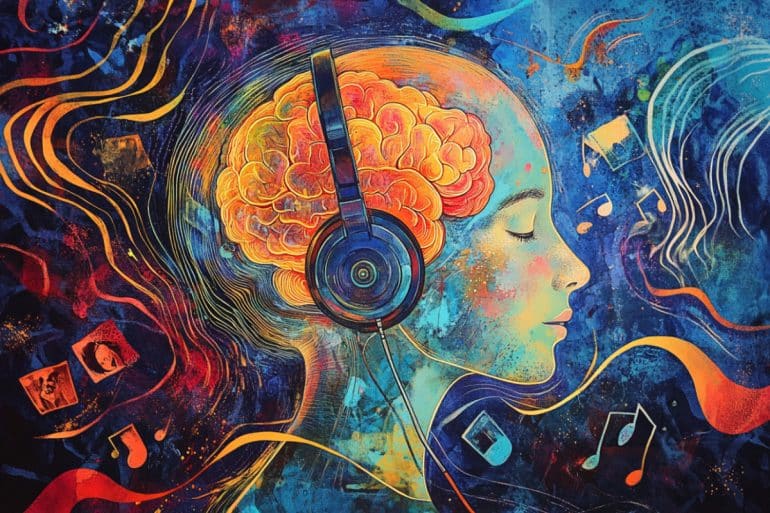
A few notes of a familiar song can suddenly transport you somewhere else. You may be driving and hear a song you have not heard in years, only to find yourself remembering a particular apartment, a summer vacation, a high school hallway, a first relationship, or a person you had almost forgotten. Sometimes the memory arrives with surprising sensory detail: what the room looked like, what the air smelled like, what you were wearing, or how you felt at the time.
This experience is not simply a poetic metaphor. Music has unusually strong connections with the brain systems involved in memory, emotion, attention, and reward. Because these systems interact closely, a piece of music can become linked to the circumstances in which it was heard. Later, hearing the same music can reactivate part of that network and help bring the associated autobiographical memory back into awareness.
Scientists sometimes refer to music’s ability to evoke personal memories as music-evoked autobiographical memory. It is one example of a broader phenomenon in which sensory experiences become powerful cues for recalling the past. Smells can do something similar, which is why a particular perfume or the smell of a familiar kitchen can suddenly bring back an old experience. Music, however, has several distinctive properties that make it an especially effective memory cue.
Why music and memory become connected in the first place
A memory is not stored in the brain like a file sitting in a particular location, waiting to be opened. Remembering is an active process in which different groups of brain regions reconstruct aspects of a previous experience.
When you experience something meaningful, your brain is simultaneously processing many kinds of information. You may hear sounds, see a place, experience physical sensations, notice other people, experience emotions, and think about what is happening. These elements become associated with one another through activity in interconnected neural networks.
Music can become one of those elements.
Imagine hearing a particular song repeatedly during your first year of college. The song itself is processed through auditory systems, while the surrounding circumstances are represented by other brain networks. Perhaps you usually heard it while spending time with particular friends, driving a certain car, living in a particular dorm, or experiencing a period of excitement and uncertainty. Over time, the song and those experiences can become associated.
Later, the song does not need to contain a literal reference to the original event. Its familiar pattern can serve as a retrieval cue. Hearing it again may partially reactivate the neural associations established when the song and the experience repeatedly occurred together.
This is one reason music can feel as though it “takes you back.” The brain is not literally sending you into the past. Rather, a present auditory experience is activating a network that has become strongly connected with information about your past.
The hippocampus helps connect music with personal experiences
One of the most important brain structures involved in forming and retrieving episodic memories is the hippocampus, a curved structure located deep within the temporal lobe.
Episodic memory refers to memory for personally experienced events. It includes not only knowing that something happened but, to some degree, being able to mentally reconstruct the event and its context.
The hippocampus helps bind together different components of an experience. It is therefore important when an event involves a particular combination of people, places, times, objects, and circumstances.
When music accompanies an experience, it can become part of that contextual network. A familiar melody can subsequently provide a pathway for retrieving associated information.
The hippocampus does not work alone. Memory retrieval depends on interactions among the hippocampus and many cortical regions that represent the different elements of an experience. When a song evokes an old memory, the brain is effectively using the present musical signal as a cue for reconstructing information distributed across those networks.
This also helps explain why music can evoke a memory without producing a complete, perfectly detailed recollection. A song may immediately make you think of a person or period of your life while leaving other details inaccessible. Different components of the original experience can have different strengths of association.
Emotion makes the memory connection stronger
Music is particularly powerful as a memory cue because it is capable of generating emotion on its own.
A song can produce excitement, calm, sadness, tension, nostalgia, joy, or a mixture of several feelings. The emotional response to music involves interactions among auditory processing regions, limbic and paralimbic structures, reward systems, and areas involved in evaluating and regulating emotion.
Emotion matters for memory because emotionally significant experiences often receive enhanced processing. During emotionally arousing events, systems involving the amygdala interact with memory-related regions, including the hippocampus. Hormonal and neuromodulatory changes associated with arousal can also influence how strongly experiences are encoded.
This does not mean that every emotional memory is perfectly accurate. Strong emotion can increase the subjective vividness and sense of importance of a memory without guaranteeing that every detail is correct.
The important point is that emotion can help give an experience a distinctive biological signature. When music becomes associated with that experience, the song may later serve as a particularly effective reminder.
The amygdala helps give memories their emotional character
The amygdala is often described as a fear center, but that description is too narrow. It is involved more broadly in detecting and processing emotionally significant information and in coordinating responses to it.
Music can engage the amygdala and related emotional systems, especially when the music is personally meaningful or emotionally intense. These systems interact with memory circuits, helping determine which aspects of an experience receive greater attention and how emotionally significant the event becomes.
This helps explain why a song can bring back not just facts about an earlier period but something resembling the feeling of that period.
You may remember that you listened to a song during a particular relationship, for example, but the experience can go beyond factual knowledge. The song may reproduce some of the emotional atmosphere associated with that time. The resulting experience can feel unusually immediate even though the original event occurred years ago.
The prefrontal cortex helps turn a song into a personal memory cue
The prefrontal cortex, located toward the front of the brain, contributes to many aspects of memory and cognition. It helps organize information, guide attention, evaluate significance, and support the strategic retrieval of memories.
A song can become meaningful partly because the brain has learned that it is associated with a particular person, place, period, or set of experiences. When the song is encountered later, prefrontal and memory networks can help guide the search for associated information.
This is especially relevant to autobiographical memory, because recalling one’s own past involves more than simply retrieving isolated facts. The brain has to reconstruct a coherent personal narrative from stored information.
Music can act as an unusually effective entry point into that process because it provides a rich and recognizable pattern that can be identified rapidly.
Why familiar songs can feel almost instantly recognizable
Music is highly structured. Melodies, rhythms, harmonies, timbres, lyrics, and repetitions provide the brain with multiple features to learn and recognize.
Repeated exposure strengthens familiarity. The brain becomes increasingly efficient at predicting what will come next in a familiar piece. A song can therefore be recognized from a very small fragment, sometimes before the listener consciously identifies it.
That rapid recognition matters for memory retrieval. The more strongly a musical pattern has been learned and associated with personal experiences, the more efficiently it can function as a retrieval cue.
This is also why the opening seconds of a song can sometimes be enough to trigger a flood of memories. The brain does not necessarily need to hear the entire piece. A distinctive introduction may contain enough learned information to activate the representation of the song, which in turn can activate associated autobiographical information.
Music activates the brain’s prediction and reward systems
Music is not simply a sequence of sounds that the brain passively records. The brain continually makes predictions about what it expects to hear next.
When a familiar melody unfolds, listeners anticipate upcoming notes, rhythms, and harmonic changes. Music can be pleasurable partly because it plays with these expectations, sometimes confirming them and sometimes violating them in meaningful ways.
The brain’s reward circuitry is involved in responses to pleasurable music. Regions associated with motivation and reward can become active during particularly enjoyable musical experiences, and dopamine signaling appears to play an important role in musical pleasure and anticipation.
This creates another route through which music can become memorable.
Experiences that are rewarding or emotionally significant receive strong attention. If a particular song repeatedly accompanies pleasurable experiences, the music itself can become associated with those positive states. Later, hearing the song may reactivate aspects of that learned association.
In other words, the song can become more than a sound. It becomes a learned signal for an experience that mattered.
Why the songs of adolescence and young adulthood can be especially powerful
Many people notice that songs from their teenage years and early adulthood evoke unusually vivid memories. This pattern fits into a broader phenomenon in autobiographical memory sometimes called the reminiscence bump.
People often remember a disproportionate number of personal events from adolescence and early adulthood compared with some other periods of life. Several factors may contribute to this pattern.
These years commonly involve rapid changes in identity, social relationships, independence, education, work, and romantic experience. People may encounter many important “firsts” during this period. Events that help define a developing sense of self can receive substantial attention and emotional processing.
Music is also deeply integrated into social and personal life during these years for many people. Teenagers and young adults often use music to explore identity, form friendships, express emotions, and mark important experiences.
As a result, music encountered during this period may become densely connected to autobiographical information.
This does not mean that everyone experiences the same pattern. A person’s strongest musical memories can come from childhood, adulthood, later life, or any other period that contained meaningful experiences.
Why a song can bring back a whole period rather than one event
Music does not always retrieve a single, neatly defined episode.
Sometimes a song evokes what psychologists might describe as a broader period of life. Instead of remembering one specific afternoon, you may suddenly experience a general sense of what it was like to live in a particular city, attend a particular school, have a certain group of friends, or be at a particular stage of adulthood.
This happens because autobiographical memory exists at multiple levels of specificity. People can remember specific events, repeated or extended events, and broad knowledge about their own lives.
A song that was repeatedly played throughout a particular period may therefore become associated with a collection of experiences rather than one isolated event. Hearing it years later can activate that broader network.
This is one reason nostalgia and music are so closely connected.
Why music can evoke sensory details that seem unrelated to the song
A particularly striking feature of music-evoked memories is that they can sometimes contain details that have nothing obviously to do with the music itself.
A song might remind you of the smell of a particular restaurant, the appearance of a bedroom, the weather on a particular day, or the feeling of sitting in the passenger seat of a car.
The explanation lies in how experiences are encoded.
When you originally heard the song, you were not experiencing the sound in isolation. Your brain was processing the entire surrounding situation. The song became one element within a larger network of associations.
When you hear the music again, activation can spread through that network. The result may be the retrieval of information associated with the original context.
The song is therefore functioning as a cue rather than as a container holding the entire memory.
Why personally meaningful music is usually more powerful than unfamiliar music
A familiar song has a history with you.
You may have heard it hundreds of times. You may associate it with specific people, places, activities, or periods of your life. You may also know its lyrics, anticipate its structure, and have emotional reactions to it.
An unfamiliar song generally lacks those autobiographical associations.
This is why a technically beautiful piece of music does not necessarily produce the same kind of memory response as an ordinary song that happens to be tied to an important period in your life. The personal meaning of the music can matter more than its musical sophistication.
Two people can hear exactly the same song and have completely different experiences because their learning histories are different.
For one person, the song might be associated with a wedding. For another, it might be associated with a long commute. For someone else, it might have no meaningful autobiographical connection at all.
Lyrics can add another layer of memory
Songs combine several forms of information that the brain normally processes through partially distinct systems. Melody, rhythm, speech, language, and emotional expression can all contribute to the experience.
Lyrics can provide explicit semantic meaning. A particular phrase may describe something that happened during the listener’s life, or simply become associated with a situation because it was repeatedly heard during that period.
Music and language can also reinforce one another. The melody may make the words easier to recognize and remember, while the words provide additional meaning and associations.
At the same time, instrumental music can evoke powerful autobiographical memories without any lyrics. This demonstrates that personal memory associations do not depend on verbal content.
Why hearing a song can feel different from intentionally trying to remember
There is an important distinction between deliberate memory search and cue-driven retrieval.
If you deliberately try to remember a vacation from ten years ago, you might consciously search through your memories and attempt to reconstruct what happened.
A song can work differently. You may not be thinking about the vacation at all when the music begins. The memory seems to arrive spontaneously.
Psychologists sometimes describe these as involuntary autobiographical memories. They are memories that enter awareness without an intentional attempt to retrieve them.
Music is particularly well suited to producing this experience because it is often encountered in everyday activities. People listen while driving, exercising, cooking, studying, working, socializing, or relaxing. Those repeated contexts provide countless opportunities for musical cues to become connected with personal experiences.
Why some memories feel more vivid than they actually are
A powerful memory is not necessarily a perfectly accurate memory.
Human memory is reconstructive. When we remember an event, the brain reconstructs it from stored information rather than replaying an exact recording.
A strong emotional response can make a memory feel exceptionally vivid and certain. Music can intensify that subjective sense of reliving because it can reproduce elements of the emotional state associated with the original experience.
But vividness and accuracy are not the same thing.
Over time, memories can change. Details can be forgotten, combined with information from other experiences, or influenced by later knowledge. A song may reliably remind you that something happened during a particular period while your memory for the precise date, sequence of events, or peripheral details remains imperfect.
This distinction is important because the emotional power of a music-triggered memory can be completely genuine even when some of its factual details have changed.
Why sad music can produce pleasurable nostalgia
It may seem contradictory that people sometimes seek out music that makes them sad.
The apparent contradiction disappears when emotional experience is understood as more than a simple pleasant-versus-unpleasant scale. A sad song can evoke nostalgia, tenderness, reflection, beauty, or a sense of connection. The listener may experience sadness while also finding the overall experience rewarding.
Music can therefore allow people to engage with difficult emotions in a controlled context.
A song associated with someone who is no longer part of your life may bring sadness, but it can also provide a sense of connection with that person’s memory. Similarly, music associated with an earlier stage of life can produce both grief for what has changed and appreciation for what once existed.
The resulting experience can be emotionally complex rather than simply negative.
Why music can be especially useful for people with memory problems
The relationship between music and memory has attracted considerable interest in the context of aging and neurological conditions.
Some people with dementia or other forms of cognitive impairment can retain aspects of musical knowledge and emotional responses even when other kinds of memory have become difficult. This does not mean that music universally preserves memory or that every person with dementia will respond strongly to familiar songs. The effects vary considerably among individuals and conditions.
One reason music can remain meaningful is that musical memory draws on multiple interacting brain systems rather than relying on a single memory mechanism.
Familiar music can sometimes encourage engagement, communication, movement, or emotional expression. Caregivers may also use personally meaningful songs to create opportunities for connection or to help establish a familiar atmosphere.
Music-based interventions are an active area of clinical and scientific research, but they should not be confused with a cure for dementia. Their potential value is better understood as part of broader approaches to communication, quality of life, emotional well-being, and rehabilitation.
What happens when a familiar song is heard after many years
When a long-forgotten song suddenly becomes recognizable, several processes may occur in rapid succession.
The auditory system analyzes the incoming sound. The brain matches the pattern against previously learned musical representations. Familiarity emerges, and associated emotional and autobiographical networks may become active. If the song has strong personal associations, retrieval processes involving the hippocampus and cortical memory networks can then bring related experiences into conscious awareness.
The speed of this process can make the experience feel almost instantaneous.
The song may also activate several memories in succession. One association can lead to another, producing a chain of recollections. A song might first remind you of a person, then a particular place, then a broader period of life.
This cascading quality is one reason musical nostalgia can feel surprisingly intense.
Why repeated listening can strengthen an association
The more often two experiences occur together, the more opportunity the brain has to learn their relationship.
Suppose you listened to the same album repeatedly during a particular period. Each listening episode gives the brain another opportunity to connect the music with the people, places, thoughts, and activities occurring at the same time.
Repetition is not the only factor, however. Meaning and emotional significance also matter. A song heard once during a highly consequential event may become memorable even without hundreds of repetitions.
What ultimately matters is the network of associations formed around the music.
Context matters more than people sometimes realize
The same song can produce different feelings depending on when and where it is heard.
A song associated with a joyful period may feel uplifting when heard later. But if circumstances change, the same music can acquire new associations. Hearing it after a breakup, during a major life transition, or after the death of someone associated with it can change its emotional meaning.
Memory is continually updated by experience. A song is therefore not permanently locked to one emotional interpretation.
Music can accumulate layers of meaning over a lifetime. The song you once associated with high school might later become associated with nostalgia for your family, a particular city, or the period when you became a parent.
In this sense, musical memories are dynamic rather than frozen.
Why live music can create particularly strong memories
Live performances add many contextual elements that recorded music does not necessarily provide. The listener may remember the venue, crowd, lighting, physical sensations, people nearby, and the emotional intensity of sharing the experience with others.
These details create a dense autobiographical context around the music.
The social dimension can be especially important. Humans are highly social creatures, and shared emotional experiences can become significant autobiographical events. A song heard with thousands of other people at a concert can therefore become linked to an unusually rich memory network.
The music is only one part of the memory, but it can later provide the cue that activates the rest.
Why music can make a memory feel like it is happening again
People sometimes describe a powerful music-evoked memory as feeling as though they have temporarily returned to the original moment.
This sensation is related to the way autobiographical remembering can involve mental re-experiencing. Rather than simply knowing that something happened, people can retrieve elements of the original event and experience a sense of mental time travel.
Music may strengthen this feeling because it can simultaneously activate recognition, emotion, expectation, and personal associations.
Importantly, this does not mean the brain is literally replaying the original neural state. The present experience is a reconstruction influenced by both the original memory and everything that has happened since.
That distinction explains why a memory can feel intensely immediate while still being a reconstruction of the past.
Why the effect differs from person to person
There is no universal “memory power” of music.
People differ in musical preferences, listening habits, emotional responsiveness, life experiences, memory abilities, and the extent to which they naturally engage with music.
Personal relevance is especially important. A song that is deeply meaningful to one listener may be emotionally neutral to another.
Cultural background also matters. Music is learned within social and cultural environments, and people develop associations with particular genres, instruments, sounds, songs, and musical traditions.
Even within the same family, people can develop very different musical memory networks because their individual experiences differ.
Music, memory, and the brain are more interconnected than they appear
The remarkable thing about music-evoked memory is not that the brain has a special “music memory center.” It does not.
Instead, music can simultaneously engage systems responsible for auditory perception, pattern recognition, attention, emotion, reward, language, autobiographical memory, and social experience.
Those systems communicate with one another.
A familiar song can therefore become a remarkably efficient cue because it represents far more than an arrangement of sounds. Through years of experience, it may become linked to particular people, places, emotions, identities, and periods of life.
That is why a song lasting only a few minutes can sometimes unlock a memory from decades ago.
The music has not preserved the past in perfect biological storage. Rather, the brain has woven the music into the network of experiences that make up a person’s life. When the familiar sound returns, it can provide a route back into that network, allowing pieces of the past to become present again in the mind.