Quantum computing uses the principles of quantum physics to process information in ways that differ fundamentally from conventional computing. Its most important potential advantage is not that it can solve every problem faster, but that it may solve certain specialized problems far more efficiently than even the most powerful classical computers.
That distinction matters. Quantum computers could eventually help researchers simulate molecules, investigate new materials, improve some mathematical optimization methods, and perform calculations that underpin certain cryptographic systems. Yet they remain difficult to build and operate, and many proposed applications have not demonstrated a practical advantage over conventional methods.
Understanding what quantum computers can actually do requires looking at how they represent information, how they manipulate it, and why the strange behavior of particles at the quantum scale can become a computational resource.
What makes quantum computing different?
Conventional computers process information using bits, which represent either a 0 or a 1. These bits are physically implemented through systems such as electrical charges in transistors, but their logical behavior is straightforward: each bit has one of two possible values.
Quantum computers use quantum bits, or qubits. A qubit is a controllable quantum system that can be prepared in a state combining the possibilities associated with 0 and 1.
This property is called superposition. It is often described as allowing a qubit to be both 0 and 1 at the same time, but that phrase can be misleading. A qubit in superposition does not behave like an ordinary bit whose value is merely unknown. Instead, its state includes quantum amplitudes associated with both possible measurement outcomes. Those amplitudes can interact in ways that have no direct counterpart in ordinary probability.
When a qubit is measured in the usual computational basis, the result is either 0 or 1. The outcome is probabilistic, with probabilities determined by the quantum state. A qubit prepared in an equal superposition of 0 and 1, for example, produces either result with equal probability when measured in that basis.
The distinction becomes more interesting with multiple qubits. A system of two qubits can represent a quantum state involving four computational basis states: 00, 01, 10, and 11. Three qubits involve eight such states, and a system of n qubits has 2ⁿ basis states.
This exponential growth is one reason quantum computing attracts so much attention. But it does not mean a quantum computer can simply read out 2ⁿ answers from a single calculation. Measurement yields a limited classical result, not a complete list of all the amplitudes in the quantum state. The challenge is to manipulate those amplitudes so that measurement is likely to reveal useful information.
How qubits store and process information
A qubit can be built from different physical systems. Examples include the internal energy states of trapped ions, electrical circuits engineered to behave quantum mechanically, and the polarization or other properties of photons. Each approach has its own strengths and engineering challenges.
Regardless of the hardware, quantum information must be controlled through carefully designed operations called quantum gates. These are the quantum counterparts of logic operations in conventional computing, although their mathematical behavior differs.
Quantum gates change a system’s state. Some create superpositions, while others alter the relative phases of quantum amplitudes or establish relationships between qubits. By applying sequences of gates, a quantum computer carries out a quantum circuit: a prescribed series of operations followed by measurements.
Unlike ordinary classical logic gates, ideal quantum gates are reversible. They transform quantum states without simply discarding information. Their action can be described mathematically using linear algebra, with quantum states represented by vectors and gates by transformations that preserve the state’s total probability.
The relative phases of amplitudes are particularly important. Two quantum states can have the same probabilities for immediate measurement yet behave differently after additional operations because their amplitudes have different phases. A quantum algorithm can exploit these differences to influence its eventual measurement results.
This is where quantum computing becomes more than a different way to store bits. Its potential advantage comes from controlling how quantum possibilities combine, not merely from representing many possibilities at once.
Why entanglement and interference matter
Two of the most important concepts in quantum computing are entanglement and interference.
Entanglement occurs when the quantum state of a system cannot be described as a collection of independent states for its individual parts. Measurements of entangled qubits can exhibit correlations that cannot be explained by treating each qubit as having its own independent quantum state.
These correlations are not a means of sending messages faster than light. Instead, entanglement provides a resource for quantum information processing, allowing algorithms to represent and manipulate relationships between qubits that classical descriptions may find difficult to reproduce efficiently.
Interference is the process by which quantum amplitudes combine. Like waves, amplitudes can reinforce one another or cancel one another out. In a quantum algorithm, operations can arrange for amplitudes associated with certain outcomes to grow while amplitudes associated with other outcomes diminish.
A useful way to think about a quantum algorithm is as a carefully engineered interference experiment. The computer does not automatically explore every possible answer and reveal the correct one. Rather, it applies a sequence of operations designed to make desirable outcomes more likely when the system is measured.
This distinction explains why quantum computers are not universally faster. A problem must have a structure that a quantum algorithm can exploit. Without an effective method for directing interference toward useful results, a large quantum state offers little practical advantage by itself.
How a quantum calculation produces an answer
A typical quantum computation begins by preparing the qubits in a known initial state. The computer then applies a sequence of quantum gates designed for a particular task. During this process, amplitudes and correlations evolve according to the rules of quantum mechanics.
At the end, the system is measured. The measurement converts quantum information into an ordinary classical result, such as a string of bits or a numerical sample.
Because measurement is probabilistic, a single run may not provide enough information. The same circuit may need to be executed repeatedly, producing a distribution of outcomes. Classical software then analyzes those results, estimates quantities of interest, or uses them as part of a larger calculation.
This repeated execution is called sampling when the goal is to collect outcomes from a probability distribution. It is central to many quantum algorithms, but it also introduces costs. The computer must prepare and control the quantum state many times, and the resulting data must be processed and interpreted.
Practical quantum computing therefore often involves both quantum and classical hardware. A conventional computer may prepare a problem, translate it into quantum operations, control the device, analyze measurements, and determine whether another quantum run is needed.
The useful unit of progress is not simply the number of qubits. It is whether the complete system can perform a valuable task accurately, reliably, and at a competitive cost.
Why quantum computers are so difficult to build
Quantum systems are delicate. Interactions with their surroundings can disrupt the relationships between amplitudes that an algorithm depends on. This loss of quantum coherence is called decoherence.
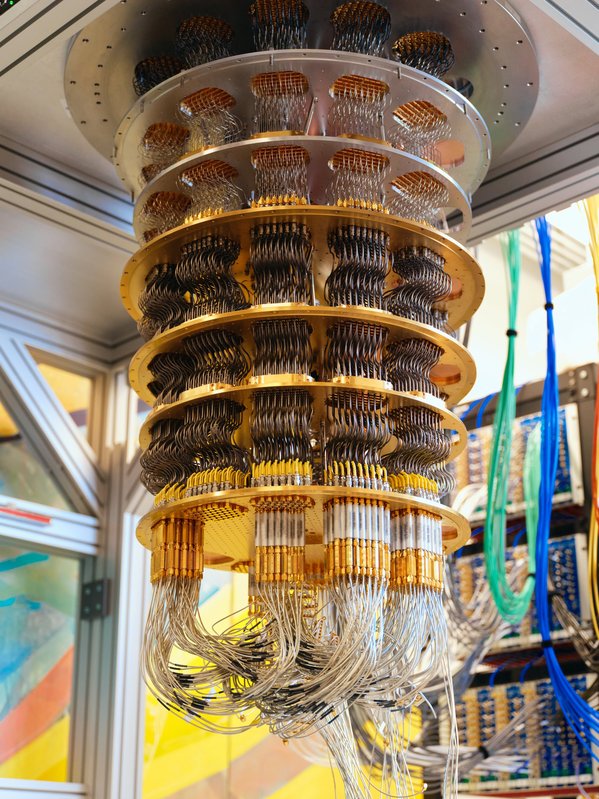
Heat, electromagnetic disturbances, material defects, unwanted interactions, and imperfections in control equipment can all contribute to errors. Some hardware platforms must operate at extremely low temperatures, while others require carefully controlled isolation or vacuum conditions.
Errors can also arise when gates are applied imperfectly or measurements misidentify a qubit’s state. Even small error rates can become serious when a computation requires a long sequence of operations across many qubits.
Conventional computers also experience physical errors, but their digital circuits can often correct them using well-established techniques. Quantum error correction is more complicated because an unknown quantum state cannot simply be copied to create backup versions, and directly measuring a qubit can destroy the information being protected.
Instead, quantum error-correcting codes distribute information across a larger collection of physical qubits. Additional measurements detect certain error patterns without directly revealing the encoded quantum information. A control system can then use those results to correct errors or track them mathematically.
A logical qubit is a qubit encoded across multiple physical qubits in this way. The physical qubits are the actual devices, while the logical qubit is the more reliable unit of quantum information that the computer aims to use for computation.
This protection comes at a cost. A single logical qubit can require many physical qubits, along with substantial control and error-correction resources. The overhead depends on the hardware, the error rates, the code, and the demands of the calculation. Large, reliable quantum computations may therefore require much more equipment than a raw physical-qubit count suggests.
Building a useful quantum computer is not simply a matter of adding more qubits. Researchers must also improve their quality, connectivity, control, measurement, and error correction while keeping the overall system manageable.
What quantum computers can actually do
Quantum computing is best understood through the problems for which quantum algorithms offer a plausible or demonstrated advantage. Several areas are especially important, although they differ substantially in how close they are to practical use.
Simulating molecules and materials
One of the strongest scientific motivations for quantum computing is the simulation of quantum systems themselves.
Molecules, chemical reactions, magnetic materials, and many other physical systems obey quantum mechanics. Their behavior can become extremely difficult to calculate accurately as the number of interacting particles grows. A conventional computer can approximate many such systems successfully, but the computational demands of some high-accuracy simulations grow rapidly with system complexity.
Quantum computers are built from quantum systems, so they may represent certain aspects of molecular and material behavior more naturally than classical computers can. In principle, a sufficiently capable quantum computer could help calculate molecular energies, investigate reaction mechanisms, or study materials whose properties are difficult to predict with existing methods.
These calculations could support the search for better catalysts, batteries, superconducting materials, and chemical processes. For example, understanding a catalyst’s electronic structure more accurately could help researchers identify conditions under which a reaction becomes more efficient.
However, this is a potential scientific pathway, not a guarantee of rapid breakthroughs. Useful simulations must account for the relevant physics, produce sufficiently accurate results, and outperform the best available classical techniques. Many chemical problems are already handled effectively by conventional computing, and practical quantum advantage for a particular application must be established rather than assumed.
Quantum computers are also unlikely to replace laboratory experiments. Their most valuable role would be to provide predictions and insights that guide experiments, help interpret measurements, and narrow the range of promising candidates.
Breaking certain cryptographic systems
Quantum computing has a particularly important theoretical consequence for cybersecurity.
Much of today’s public-key cryptography relies on mathematical problems that are believed to be difficult for classical computers to solve efficiently. RSA, for example, relies on the difficulty of factoring large integers, while widely used elliptic-curve systems rely on related mathematical structures.
In 1994, mathematician Peter Shor developed a quantum algorithm that can factor integers and solve the discrete logarithm problem efficiently in principle. A sufficiently large, fault-tolerant quantum computer running an appropriate implementation could therefore undermine these cryptographic systems.
That does not mean today’s quantum computers can routinely break modern public-key encryption. The calculations would require a much more capable machine than noisy, limited-scale devices can currently provide. The resources needed for a particular attack depend on the cryptographic system, the implementation, and the required reliability.
Nevertheless, the risk matters before such a machine exists. Encrypted information collected today could remain sensitive for years or decades. An adversary who stores encrypted data now might attempt to decrypt it later if quantum technology advances enough.
This concern has encouraged the development and adoption of post-quantum cryptography: cryptographic methods designed to resist attacks from both classical and quantum computers. These methods run on conventional computers and do not require quantum hardware.
Quantum computing would not make all encryption obsolete. Some widely used symmetric encryption and cryptographic hash methods are affected differently, and appropriate parameter choices can preserve substantial security against known quantum attacks. The central concern is that certain public-key systems require replacement or adjustment, not that every security mechanism will suddenly fail.
Searching and analyzing data
Quantum algorithms can also offer advantages for certain search and mathematical tasks.
Grover’s algorithm, for example, can search an unstructured collection of N possibilities using a number of oracle queries that grows roughly with the square root of N, rather than linearly with N as in a straightforward classical search. An oracle in this context is a procedure that identifies whether a candidate satisfies the search condition.
This is a genuine theoretical improvement, but it is not equivalent to making every database search instantly faster. A real application must encode its data, implement the search condition, perform the quantum operations, and extract the result. Loading large datasets into quantum states can itself be costly. If the classical problem has exploitable structure, conventional algorithms may already perform much better than an unstructured search.
Quantum methods can also provide advantages for particular mathematical tasks involving linear algebra, sampling, and probability distributions. But these advantages often depend on assumptions about the input, the desired output, and the operations that can be performed efficiently.
A speedup for one carefully defined mathematical problem does not automatically translate into a faster spreadsheet, search engine, recommendation system, or general-purpose data analysis pipeline.
Tackling optimization problems
Optimization involves finding the best choice among many possibilities while satisfying a set of constraints. Examples include planning delivery routes, scheduling manufacturing, allocating resources, and selecting portfolios.
Some optimization problems become extremely difficult as their size grows. Because quantum computers can manipulate complex quantum states, researchers have developed algorithms that might help with selected optimization tasks. These include quantum approximate optimization methods and approaches based on quantum annealing, a technique that uses quantum behavior in a physical system to seek low-energy solutions to an encoded problem.
The potential applications are attractive, but the evidence must be evaluated carefully. Many optimization problems can be solved effectively using classical heuristics, specialized algorithms, and large-scale computing. A quantum method that performs well on a small demonstration may not retain an advantage when realistic constraints and operational costs are included.
There is no general quantum algorithm known to solve every hard optimization problem efficiently. Nor is there a broad, established result showing that quantum computers consistently outperform classical computers on practical business optimization tasks.
The most useful research question is therefore specific: Does a particular quantum method deliver better solutions, faster, more reliably, or at lower total cost than the strongest available classical alternative for a defined real-world problem?
What quantum computers cannot do
Quantum computing is not a faster version of every operation performed by a conventional processor. It is a specialized approach to computation whose advantages depend on the mathematical structure of a task.
A quantum computer cannot simply try every possible answer and then print the correct one. Although a quantum state may involve exponentially many basis states, measurement provides limited information about that state. Algorithms must be designed to concentrate useful information into outcomes that can be observed.
Quantum computers also do not automatically make artificial intelligence more intelligent, generate better predictions from poor data, or solve scientific questions without appropriate models. Some machine-learning methods have quantum variants, but a practical advantage over classical machine learning has not been established generally. The costs of data preparation, quantum operations, and measurement can outweigh a theoretical benefit.
They are not inherently superior at ordinary tasks such as editing documents, running a website, playing a video, or processing routine business transactions. Conventional computers are exceptionally effective at these jobs and benefit from decades of improvements in processors, memory, software, and engineering.
Nor does quantum computing eliminate the need for algorithms. A powerful machine can still be ineffective when no suitable method exists for turning a problem into a computation that the hardware can execute efficiently.
The important limitation is not that quantum computers are useless outside a narrow list of tasks. It is that their value must be established problem by problem, with a realistic accounting of the resources needed.
How quantum computers compare with classical computers
Classical and quantum computers are more likely to complement each other than to compete as interchangeable machines.
Classical computers excel at general-purpose computation, data management, control systems, numerical calculations, and the everyday tasks that make modern digital technology work. They are reliable, comparatively inexpensive, and supported by mature software ecosystems.
Quantum computers may be valuable when a problem has a structure that a quantum algorithm can exploit, particularly when the problem involves quantum physics or certain mathematical operations. Even then, a quantum processor is likely to work alongside classical systems that prepare inputs, manage experiments, process results, and handle most of the surrounding computation.
This relationship makes comparisons more complicated than simply measuring processor speed. A fair comparison must include the complete workflow: preparing the problem, converting it into a suitable representation, executing the computation, correcting errors, repeating measurements when necessary, and interpreting the output.
A quantum computer might perform one stage of a task more efficiently while the overall process remains slower or more expensive. Conversely, a strong advantage in a critical stage could eventually make an otherwise impractical application feasible.
The meaningful benchmark is not whether a quantum device can produce an impressive result. It is whether it can solve a useful problem better than the best practical alternative.
The difference between a quantum demonstration and a practical advantage
Quantum computing research often involves demonstrations that a device can perform a particular operation, implement an algorithm, or produce results that are difficult to reproduce with a conventional simulation. These are important scientific milestones, but they do not all establish the same kind of achievement.
One demonstration may show that a quantum processor can maintain control over a complex state. Another may show that it can perform a task for which a particular classical simulation is computationally expensive. A third might establish an advantage on a specialized calculation with little immediate commercial value.
A quantum advantage is a demonstrated improvement over classical computing for a defined task, under a specified comparison. The significance of that advantage depends on what is being measured and whether the result matters outside the experiment.
A calculation that is difficult for classical computers to simulate may have no useful application. Meanwhile, a modest improvement in the time or cost required for a scientifically important calculation could have considerable value, even if the task is not spectacularly difficult for a conventional computer.
Researchers must also account for classical progress. Classical algorithms and hardware continue to improve, sometimes narrowing or eliminating advantages previously thought to be significant. Comparisons should therefore use strong, current classical methods rather than deliberately weak baselines.
For practical use, reliability matters as much as speed. A chemical simulation must be accurate enough to guide research. A cryptographic calculation must complete with the necessary confidence. An optimization method must produce solutions that meet real-world constraints. A result that is fast but unreliable may be of little use.
The most persuasive evidence of practical quantum computing will come from repeatable results on relevant tasks, supported by transparent comparisons with classical alternatives.
What the future of quantum computing may look like
The long-term prospects of quantum computing depend on several difficult engineering and scientific challenges. Researchers must develop qubits with better performance, reduce operation and measurement errors, improve control systems, and build reliable error-corrected logical qubits. They must also discover and refine algorithms that justify the expense and complexity of the hardware.
Progress in one area does not guarantee progress in all the others. A device with many physical qubits may still be unsuitable for a long calculation if its operations are too error-prone. A highly reliable system may remain limited if it lacks enough logical qubits or if the available algorithms offer no useful advantage for the intended task.
There is also uncertainty about the timing and scale of future applications. It is reasonable to expect continued advances in hardware and error correction, but the emergence of commercially valuable quantum advantage across multiple industries is not guaranteed on any particular schedule.
Some applications may arrive earlier than others. Specialized scientific calculations could become useful before quantum computers can execute the largest cryptographic attacks. Other proposed applications may prove less valuable once their full costs are understood or once classical alternatives improve.
For the public, the most important distinction is between what quantum mechanics permits in principle, what researchers have demonstrated experimentally, and what can be done reliably and economically in practice. These are separate milestones, and progress through them requires more than increasing a qubit count.
Why quantum computing matters
Quantum computing matters because the physical rules governing information at the smallest scales may provide new ways to solve certain problems that challenge conventional computation. Its promise rests on specific mathematical and physical mechanisms: superposition, entanglement, interference, and algorithms designed to use them.
Those mechanisms do not make quantum computers universally faster, and they do not guarantee breakthroughs in every field. Their strongest potential applications include simulating quantum systems, threatening particular forms of public-key cryptography, and improving selected mathematical calculations. The practical value of each application depends on hardware reliability, algorithm design, and comparison with classical methods.
The technology’s future will be measured not by how mysterious quantum mechanics sounds or how many qubits a machine contains, but by whether reliable quantum systems can solve important problems that conventional computers cannot solve as effectively. That is a demanding standard, but it is also what makes quantum computing a serious scientific and engineering endeavor rather than simply a more powerful version of the computers people already use.