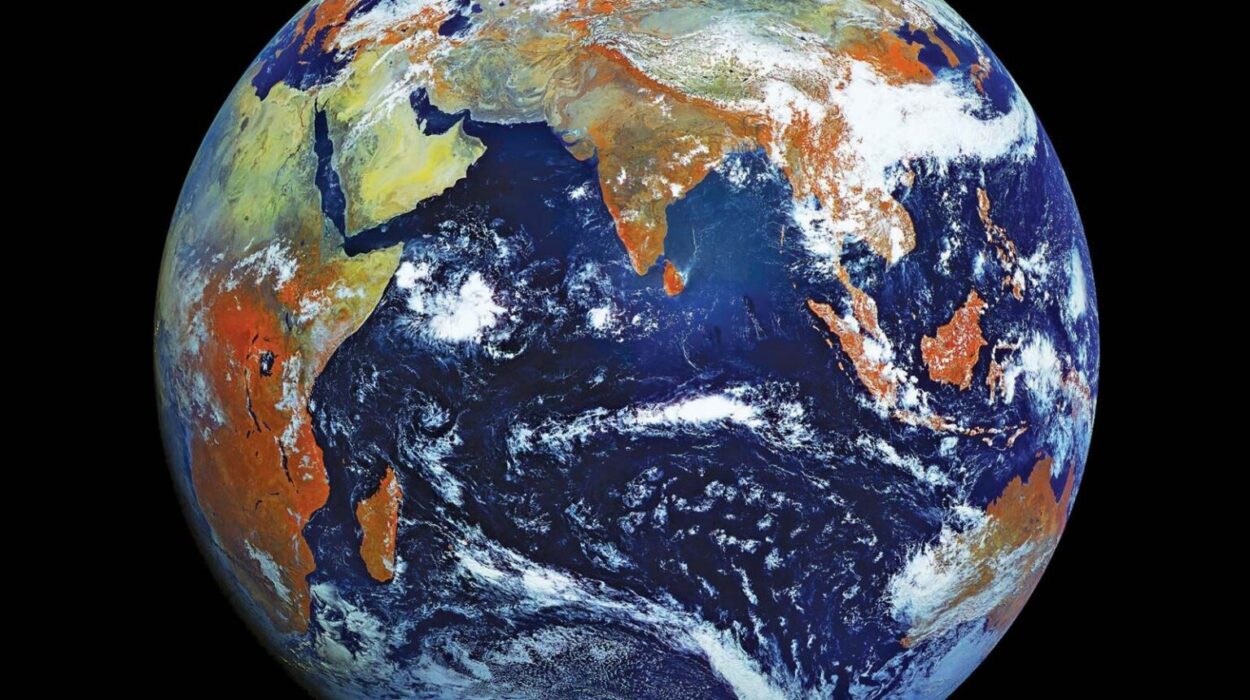
Gravity is one of the most familiar forces in nature. It keeps people and objects on Earth, holds the Moon in orbit, and helps maintain the structure of the solar system. Yet scientists have developed two very different ways of explaining how gravity works: Isaac Newton’s law of universal gravitation and Albert Einstein’s general theory of relativity.
The central difference is that Newton described gravity as a force of attraction between objects with mass, while Einstein explained gravity as the curvature of space-time caused by mass and energy. Newton’s theory provides an excellent description of gravity in everyday situations and many astronomical applications. Einstein’s theory offers a deeper explanation that accounts for phenomena Newton’s model cannot fully describe, particularly when gravity is extremely strong or measurements require exceptional precision.
Both theories remain important in modern physics. Understanding their differences reveals how scientific ideas evolve and why Einstein’s work did not simply make Newton’s discoveries obsolete.
How Newton explained gravity
In 1687, Isaac Newton published Philosophiæ Naturalis Principia Mathematica, commonly known as the Principia. In this work, he presented the law of universal gravitation, proposing that every object in the universe attracts every other object through gravity.
According to Newton, the strength of this attraction depends on two factors: the masses of the objects and the distance between their centers. Larger masses produce stronger gravitational attraction, while greater separation produces weaker attraction.
Newton expressed this relationship mathematically as:
F = G(m₁m₂/r²)
In this equation, F represents the gravitational force, m₁ and m₂ represent the masses of the two objects, r is the distance between their centers, and G is the universal gravitational constant.
The equation describes an inverse-square relationship. If the distance between two objects doubles, the gravitational force between them becomes one-fourth as strong. If the distance triples, the force decreases to one-ninth of its original strength.
This principle explains many familiar astronomical phenomena. Earth’s gravity attracts the Moon and keeps it moving along an approximately elliptical orbit. The Sun’s gravitational attraction holds the planets in their respective orbits. Earth’s gravitational pull also causes objects released near its surface to accelerate downward.
Newton’s theory was revolutionary because it connected events on Earth with the motion of celestial objects. Rather than treating falling objects and planetary orbits as unrelated phenomena, it explained both through the same universal principle.
How Einstein changed the understanding of gravity
More than two centuries after Newton published his theory, Albert Einstein introduced a fundamentally different explanation of gravity.
In 1915, Einstein completed his general theory of relativity. Instead of treating gravity as a conventional force acting across space, he proposed that mass and energy change the geometry of space and time.
To understand this idea, it helps to recognize that space and time are not completely separate in Einstein’s theory. They form a unified four-dimensional structure called space-time. Three dimensions describe space, while the fourth describes time.
Massive objects, such as stars and planets, curve space-time around them. Other objects move through this curved space-time along paths determined by its geometry. What observers experience as gravitational attraction is, in this description, the result of motion through curved space-time.
For example, Earth does not orbit the Sun because an invisible force pulls it through otherwise empty space in the Newtonian sense. Instead, the Sun’s mass curves the surrounding space-time, and Earth follows a natural path through that geometry.
Einstein’s theory also explains why gravity affects time itself. Clocks closer to a massive object run more slowly relative to clocks farther away, assuming the clocks are compared under otherwise suitable conditions. This phenomenon is known as gravitational time dilation.
General relativity therefore changed the scientific understanding of gravity from an interaction between masses into a property of the structure of space-time.
The key differences between Newton’s gravity and general relativity
Although both theories describe gravitational phenomena, they differ in their fundamental assumptions, mathematical frameworks, and predictions.
1. Gravity as a force versus curvature of space-time
Newton treated gravity as an attractive force between objects with mass. The force acts between objects even when they are separated by vast distances.
Einstein described gravity through the curvature of space-time. Mass and energy influence this geometry, while objects and light follow paths through it.
This is the most important conceptual distinction between the theories.
2. Absolute space and time versus dynamic space-time
Newton’s framework assumes that space and time provide a fixed background for physical events. Time passes uniformly, regardless of an observer’s location or motion.
Einstein showed that measurements of space and time depend on an observer’s motion and gravitational environment. Space and time are interconnected and can be affected by mass, energy, and motion.
In general relativity, gravity does not simply operate within space and time. It is connected to the geometry of space-time itself.
3. Instantaneous action versus the finite speed of gravity
In Newton’s original framework, gravitational interactions are treated as acting instantaneously across distance. A change in the position of one object would affect the gravitational interaction elsewhere without a built-in propagation delay.
General relativity predicts that changes in the gravitational field propagate at the speed of light in a vacuum.
This distinction is important when considering rapidly changing astronomical systems. For example, gravitational waves produced by accelerating massive objects travel outward through space-time at the speed of light.
4. Different predictions under extreme conditions
Newton’s law works remarkably well when gravitational fields are relatively weak and objects move much more slowly than light.
However, it becomes insufficient in situations involving extremely strong gravity, very high speeds, or highly precise measurements.
General relativity accounts for these conditions. It successfully describes phenomena near black holes, the behavior of light in strong gravitational fields, and subtle changes in planetary orbits.
5. Different mathematical descriptions
Newton’s gravitational theory uses relatively straightforward equations involving mass, distance, and force. These equations make it practical for calculating ordinary gravitational interactions.
General relativity uses advanced mathematics involving differential geometry and tensors. Its central equations describe how the distribution of matter and energy determines the curvature of space-time.
Although more mathematically demanding, this framework provides a broader description of gravitational behavior.
Why Newton’s theory still works so well
If Einstein’s theory provides a more complete explanation of gravity, why do scientists and engineers continue to use Newton’s laws?
The answer is that Newton’s theory is an extremely accurate approximation under many ordinary conditions.
On Earth, Newton’s equations can predict the motion of falling objects, the trajectories of projectiles, and the behavior of satellites with excellent accuracy for many practical purposes.
They also work well for calculating the motion of most planets, moons, and spacecraft when the required precision does not demand relativistic corrections.
General relativity itself explains why Newton’s predictions are so successful. In weak gravitational fields and at speeds much lower than the speed of light, its equations produce results that closely approximate Newtonian gravity.
This relationship is an example of the correspondence principle: a newer scientific theory should reproduce the successful predictions of an older theory within the conditions where the older theory has been verified.
Newton’s theory is therefore not useless or fundamentally wrong in every situation. It is a limited but highly effective description of gravity.
Where Newton’s theory falls short
Despite its success, Newton’s gravitational model cannot explain every observed gravitational phenomenon.
One important example involves Mercury, the planet closest to the Sun. Mercury follows an elliptical orbit, but the orientation of its orbit slowly changes over time. This movement is called the precession of the perihelion, referring to the gradual rotation of the orbit’s closest point to the Sun.
Newtonian calculations account for most of this orbital movement through the gravitational influence of other planets and additional effects. However, a small remaining discrepancy could not be fully explained using Newton’s theory alone.
Einstein’s general relativity provided the missing explanation. The Sun’s curvature of space-time slightly changes Mercury’s orbit, producing the additional precession predicted by Einstein’s equations.
Another limitation concerns light. Newton’s gravitational law was formulated around the attraction between objects with mass. It does not provide a complete description of how gravity affects light, which has no rest mass.
General relativity predicts that light follows curved paths through curved space-time. This effect, called gravitational light deflection, has been confirmed through astronomical observations.
Newton’s framework also cannot adequately describe black holes, where gravity becomes so strong that space-time curvature produces effects beyond the theory’s capabilities.
How general relativity has been confirmed
General relativity is not simply a mathematical alternative to Newton’s theory. It has passed numerous experimental and observational tests.
One of the earliest major confirmations came in 1919, when observations of a solar eclipse provided evidence that the Sun bends the paths of passing starlight. The measured deflection supported Einstein’s prediction that gravity affects light through curved space-time.
The theory has also successfully explained Mercury’s orbital precession, as well as gravitational effects that influence the passage of time.
A particularly important modern application is the Global Positioning System (GPS). GPS satellites carry highly accurate atomic clocks. Because these satellites experience weaker gravity than clocks on Earth’s surface and move at high speeds, their clocks run at different rates.
General relativity predicts the gravitational contribution to this difference, while special relativity accounts for the effect of satellite motion. Both corrections are necessary for accurate GPS timing and positioning. Without relativistic corrections, positioning errors would accumulate significantly.
Another major confirmation came in 2015, when scientists detected gravitational waves for the first time using the Laser Interferometer Gravitational-Wave Observatory (LIGO). These waves were produced by the collision and merger of two black holes.
Gravitational waves are ripples in space-time that travel outward from accelerating masses. Their detection provided direct evidence for a major prediction of general relativity and opened a new way to study the universe.
What happens near black holes?
Black holes provide some of the clearest examples of where Einstein’s theory is essential.
A black hole forms when a sufficient amount of mass becomes concentrated within a sufficiently small region, producing an extremely strong gravitational field. Its defining boundary is called the event horizon. Once something crosses this boundary, it cannot escape back into the outside universe, not even light.
Newton’s gravitational theory cannot fully describe this situation. Its equations do not account for the structure of space-time or the behavior of light in the extreme gravitational environment surrounding a black hole.
General relativity, by contrast, predicts the existence of black holes and describes their gravitational effects.
Near a black hole, space-time becomes strongly curved. Objects moving nearby follow paths shaped by this geometry, while clocks experience substantial gravitational time dilation relative to distant observers.
The theory also predicts that black holes can distort light from objects behind them, creating gravitational lensing effects. These predictions have become important tools for studying black holes and their surroundings.
Although general relativity describes black holes successfully at the classical level, the precise physics of their deepest interiors remains an open challenge. A complete understanding may require a theory that combines general relativity with quantum mechanics.
Are Newton’s gravity and Einstein’s relativity competing theories?
It is tempting to think that Newton and Einstein proposed competing explanations, with one simply replacing the other. In practice, their relationship is more nuanced.
Newton’s law remains a useful approximation of Einstein’s broader theory. It describes gravitational behavior accurately when the gravitational field is weak, the objects involved move relatively slowly, and extremely high precision is unnecessary.
Einstein’s general relativity covers a wider range of conditions and explains observations that Newton’s theory cannot adequately account for.
The difference resembles the relationship between a simplified map and a detailed geographic model. A simplified map can be extremely useful for everyday navigation, even though it does not represent every feature of the landscape. A more detailed model becomes necessary when greater accuracy or additional information is required.
Similarly, scientists choose the gravitational framework that best suits the problem. Newtonian mechanics is often simpler and sufficiently accurate for engineering and many astronomical calculations. General relativity is necessary for precision measurements, strong gravitational fields, and the study of phenomena such as gravitational waves and black holes.
What scientists still do not know about gravity
Despite the extraordinary success of general relativity, gravity remains one of the major unresolved subjects in fundamental physics.
The central challenge is reconciling general relativity with quantum mechanics, the framework that describes matter and interactions at extremely small scales.
General relativity treats space-time as a continuous geometric structure. Quantum mechanics describes physical systems through quantum states and probabilistic processes. Both theories are highly successful in their respective domains, but combining them into one consistent framework has proved difficult.
This problem becomes especially important in environments where both quantum effects and strong gravity matter, such as the extreme conditions associated with black hole interiors and the earliest moments of the universe.
Scientists are investigating approaches to quantum gravity, including string theory and loop quantum gravity. However, no experimentally confirmed theory has yet replaced general relativity as the established description of gravity.
There are also unanswered questions about dark matter and dark energy. Observations of galaxies and the expansion of the universe suggest that the universe contains components whose nature is not fully understood. General relativity provides the framework used to describe these large-scale gravitational effects, but the underlying physical explanations remain active areas of research.
These open questions do not undermine the established success of Einstein’s theory. They show that even a remarkably successful scientific framework can have limits and may eventually become part of an even more comprehensive understanding.
The lasting importance of Newton and Einstein
Newton and Einstein transformed humanity’s understanding of the universe in different but connected ways.
Newton established that the same gravitational principle governs falling objects and planetary motion. His mathematical description made it possible to predict the movement of celestial bodies with extraordinary accuracy and laid the foundation for classical mechanics.
Einstein took the understanding of gravity further by showing that mass and energy shape space-time itself. His theory explained previously unresolved observations and revealed gravitational phenomena that Newton’s framework could not describe.
The essential distinction remains straightforward: Newton explained gravity as a force between masses, while Einstein explained it as the curvature of space-time caused by mass and energy.
Both ideas are indispensable to modern science. Newton provides the practical foundation for understanding gravity in everyday life, while Einstein reveals how gravity operates across the universe, from planetary systems to black holes and gravitational waves.