General relativity explains the motion of planets by describing gravity as a consequence of the curvature of spacetime. According to Albert Einstein’s theory, massive objects such as the Sun change the geometry of the space and time around them. Planets move through this curved spacetime along natural paths called geodesics. What we experience as gravitational attraction is, in this description, the effect of moving through curved spacetime rather than being pulled by an invisible force in the traditional Newtonian sense.
This explanation builds on Isaac Newton’s laws of motion and universal gravitation, which successfully describe most planetary motion. However, general relativity provides a more complete picture, particularly when gravitational fields are strong or extremely precise measurements are required. One of its most famous achievements was explaining a small but persistent irregularity in the orbit of Mercury.
Gravity changes the geometry of spacetime
To understand how general relativity explains planetary motion, it helps to begin with the concept of spacetime. In everyday experience, space and time seem like separate things. Space describes where objects are, while time describes when events happen. Einstein’s theory combines them into a four-dimensional structure called spacetime, consisting of three dimensions of space and one dimension of time.
General relativity proposes that matter and energy influence the geometry of this structure. The more mass and energy an object contains, the greater its influence on the surrounding spacetime.
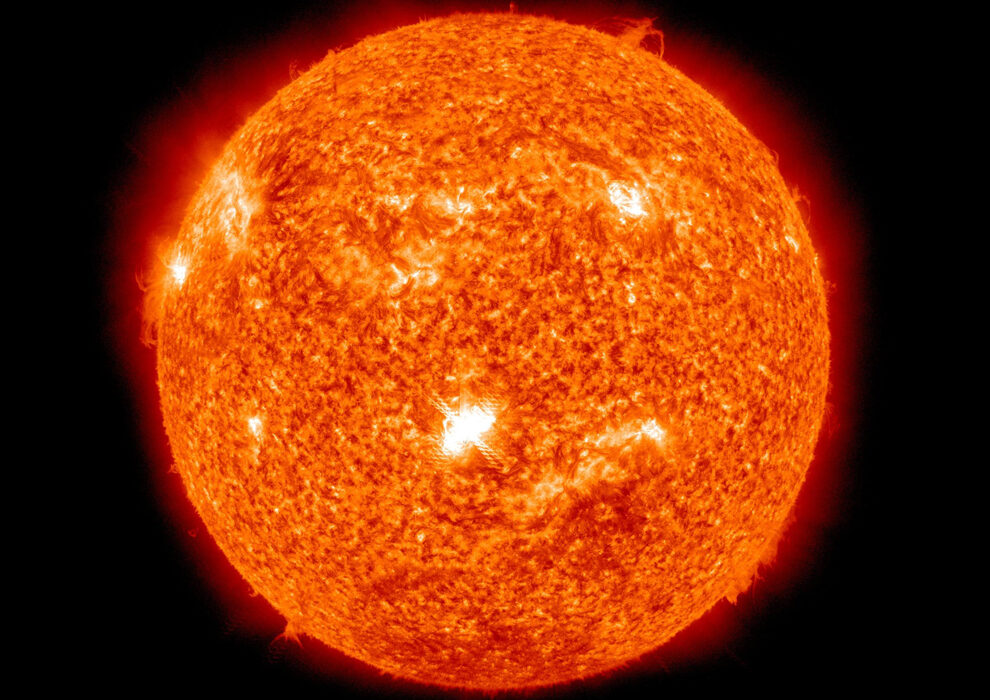
The Sun, for example, contains most of the mass in the solar system. Its presence significantly curves the spacetime around it. Earth and the other planets move within this curved region.
A useful way to imagine this idea is to think of a heavy ball resting on a flexible sheet. The ball creates a depression, and smaller objects moving nearby may follow curved paths around it. Although this analogy can help illustrate the idea of curvature, it is not a complete representation of general relativity. Real spacetime has four dimensions, and its curvature affects both space and time.
Importantly, the planets do not need to be pushed or pulled along their paths by a conventional gravitational force in Einstein’s description. Instead, they follow the straightest possible paths through curved spacetime. These paths are called geodesics.
A geodesic is the natural path an object follows when no non-gravitational force acts on it. On a flat surface, the shortest path between two points is a straight line. On a curved surface, the corresponding path may appear curved to an outside observer. Similarly, a planet following a geodesic through curved spacetime can appear to accelerate or change direction when viewed from an ordinary three-dimensional perspective.
How planets follow curved paths around the Sun
The Sun’s mass curves the spacetime around it, influencing how nearby planets move. A planet traveling through this region follows a geodesic determined by the geometry of that spacetime.
From our perspective, the planet travels around the Sun in an orbit. Its path is not generally a perfect circle. Instead, planetary orbits are usually elliptical, meaning they have an oval shape.
An orbit results from the planet’s motion and the geometry of the surrounding spacetime. A planet has forward motion, so it does not simply move directly toward the Sun. At the same time, the Sun’s gravitational influence continuously changes the planet’s direction of travel.
In Newtonian physics, this behavior is explained by gravitational attraction. The Sun pulls the planet inward while the planet’s sideways velocity carries it forward. Together, these effects produce a curved orbit.
General relativity describes the same observable motion through spacetime geometry. The planet follows a geodesic, and its changing position relative to the Sun produces the familiar orbital path.
The two descriptions are closely related. Under ordinary solar system conditions, general relativity produces results that are extremely close to Newton’s predictions. This is why Newtonian mechanics remains useful for calculating most planetary orbits.
However, Einstein’s theory includes small corrections that become important when measurements are sufficiently precise.
Why Newton’s theory is not the complete explanation
Newton’s law of universal gravitation states that every object with mass attracts every other object with mass. The strength of this attraction depends on the masses involved and the distance between their centers.
The mathematical relationship is:
F = G(m₁m₂/r²)
Here, F represents the gravitational force, G is the gravitational constant, m₁ and m₂ are the masses of the two objects, and r is the distance between their centers.
This equation accurately describes a wide range of gravitational phenomena. It can predict planetary positions, calculate orbital periods, and explain why planets remain in orbit around the Sun.
However, Newton’s theory treats gravity as a force acting through space and time, which are assumed to have fixed geometries. Einstein’s theory changes this underlying assumption.
In general relativity, gravity is connected to the curvature of spacetime itself. Matter and energy determine how spacetime curves, while that curved geometry determines how matter moves.
Einstein expressed this relationship through the field equations of general relativity. In simplified terms, these equations connect the distribution of matter and energy to the curvature of spacetime.
The difference between the theories is especially important in situations involving strong gravitational fields, high precision, or extremely accurate timing. General relativity also explains certain observations that Newtonian gravity cannot fully account for.
For most planets in the solar system, Newton’s equations provide an excellent approximation. General relativity becomes necessary when scientists want to understand the small differences between Newtonian predictions and actual planetary motion.
Mercury’s orbit provides important evidence
One of the most significant early tests of general relativity involved Mercury, the planet closest to the Sun.
Mercury follows an elliptical orbit, but its orbital ellipse does not maintain exactly the same orientation over time. Instead, the ellipse gradually rotates around the Sun. This motion is called the precession of the perihelion.
The perihelion is the point in a planet’s orbit where it comes closest to the Sun. As Mercury completes successive orbits, this closest-approach point shifts slightly.
Newtonian gravitational calculations can explain most of this movement. The gravitational influences of other planets, particularly Venus, Earth, and Jupiter, cause much of the orbital precession.
However, astronomers identified a small remaining difference between the observed motion and the predictions of Newtonian mechanics. The discrepancy amounted to approximately 43 arcseconds per century.
An arcsecond is a very small unit of angular measurement equal to one-sixtieth of an arcminute. The unexplained shift was tiny, but it was too consistent to dismiss as an ordinary observational error.
General relativity provided the missing explanation.
According to Einstein’s calculations, the curvature of spacetime around the Sun produces an additional contribution to Mercury’s orbital precession. This relativistic correction accounts for the approximately 43 arcseconds per century that Newtonian calculations could not explain.
The result was an important success for general relativity. Rather than requiring an additional planet or an adjustment to Newton’s gravitational law, Einstein’s theory explained the observed motion through the geometry of spacetime.
Mercury’s orbit remains one of the clearest examples of how general relativity improves our understanding of planetary motion.
Why planets have elliptical orbits
Planetary orbits are closely connected to the relationship between a planet’s velocity, its distance from the Sun, and the gravitational environment through which it moves.
In Newtonian mechanics, an orbit is determined by the balance between a planet’s motion and the Sun’s gravitational attraction. Depending on the planet’s speed and direction, its path may be circular, elliptical, parabolic, or hyperbolic.
Most planets in the solar system follow elliptical orbits because they have gravitationally bound trajectories.
An ellipse has two important reference points called foci. In the ideal two-body description of planetary motion, the Sun occupies one focus of the planet’s elliptical orbit rather than its center.
A planet moves fastest when it is closest to the Sun and slowest when it is farthest away. This relationship is described by Kepler’s second law, which states that a line connecting a planet to the Sun sweeps out equal areas in equal intervals of time.
General relativity preserves the basic picture of elliptical planetary motion in the weak gravitational field of the solar system. However, it introduces subtle changes to the orbital path.
In particular, a relativistic orbit does not generally return to precisely the same ellipse after every revolution. Instead, the ellipse slowly rotates. This effect is known as relativistic orbital precession.
The size of this correction depends on the mass of the central object, the planet’s orbital distance, and the shape of its orbit. The effect is especially noticeable for planets that travel close to a massive object or have highly elongated orbits.
The role of spacetime curvature and time
An important feature of general relativity is that gravity affects not only space but also time.
A clock closer to a massive object runs more slowly relative to a clock farther away, when their rates are compared under appropriate conditions. This phenomenon is called gravitational time dilation.
Because the Sun curves spacetime, time passes at slightly different rates at different distances from it. This difference contributes to the motion of planets and must be included in precise relativistic calculations.
It is tempting to think of gravity as simply bending the paths of objects through space. However, the time component of spacetime is essential to understanding how gravity works.
In fact, even in the relatively weak gravitational field around the Sun, the curvature of time plays a major role in the gravitational behavior described by general relativity.
This is one reason the flexible-sheet analogy is incomplete. It illustrates spatial curvature but does not adequately represent how gravity changes the passage of time.
The combination of spatial and temporal curvature determines the geodesics followed by planets and other freely moving objects.
How general relativity explains the motion of the entire solar system
The Sun is the dominant gravitational influence in the solar system, but it is not the only source of gravity. Every planet, moon, asteroid, and other massive object contributes to the overall gravitational environment.
Consequently, planetary motion is more complicated than a simple picture of one planet orbiting a stationary Sun.
The planets exert gravitational influences on one another. Jupiter, because of its substantial mass, has a particularly strong effect on the orbits of other solar system objects. Saturn and the remaining planets also contribute to these interactions.
In Newtonian calculations, these influences are treated as gravitational forces between bodies. In general relativity, the matter and energy of all these objects contribute to the geometry of spacetime.
The resulting motion is therefore determined by the combined gravitational environment rather than by the Sun alone.
Another important detail is that the Sun itself is not perfectly stationary. It moves in response to the gravitational influences of the planets, orbiting the solar system’s center of mass, known as the barycenter.
For practical calculations, astronomers must account for these interactions and the motion of the bodies involved. General relativity provides the more complete framework, although Newtonian methods remain sufficiently accurate for many ordinary orbital calculations.
How scientists test general relativity using planetary motion
Planetary motion provides a valuable way to test general relativity because the positions and movements of planets can be measured with great precision.
Astronomers compare observed planetary positions with predictions from mathematical models. These models account for the gravitational influences of other bodies, the motion of the Sun, and relativistic corrections.
If the predictions consistently differ from observations, scientists investigate whether the discrepancy comes from measurement limitations, incomplete modeling, or a possible problem with the underlying theory.
Mercury’s perihelion precession was an early and influential test. Since then, increasingly precise observations and spacecraft tracking have provided additional opportunities to examine relativistic effects.
Radar ranging and radio tracking of spacecraft allow scientists to measure distances and travel times across the solar system. Because general relativity affects both the motion of objects and the passage of time, these measurements can reveal subtle gravitational effects.
One notable example is the Shapiro time delay. When a radar signal or radio transmission passes through a region of curved spacetime near the Sun, its travel time is slightly longer than it would be in a flat-spacetime calculation. This effect has been measured and provides another important test of general relativity.
These observations show that Einstein’s theory is not simply an alternative way of describing gravity. It makes precise predictions that can be compared with measurable physical phenomena.
Why Newtonian gravity still works so well
Although general relativity provides a more complete explanation of gravity, Newtonian mechanics remains extremely useful.
The reason is that the gravitational field of the Sun is relatively weak compared with the extreme conditions found near black holes or neutron stars. Planetary speeds are also much lower than the speed of light.
Under these conditions, the relativistic corrections are generally very small. Newton’s equations therefore produce results that are close to those obtained from general relativity.
This is an example of the correspondence principle: a more comprehensive physical theory should reproduce the successful predictions of an older theory under the conditions where the older theory works well.
For everyday astronomical calculations, Newtonian gravity is often simpler and sufficiently accurate. General relativity is used when greater precision is required or when the physical situation makes relativistic effects significant.
This does not mean Newton’s theory is incorrect in every practical sense. It remains an excellent approximation within its appropriate range of application.
What planetary motion reveals about gravity
The motion of planets demonstrates how general relativity connects the behavior of matter with the structure of spacetime.
A planet orbiting the Sun is not simply moving under the influence of a conventional force in an otherwise unchanging universe. It is following a natural path through spacetime whose geometry is shaped by the Sun and other sources of matter and energy.
This framework explains the familiar elliptical orbits predicted by Newtonian mechanics while also accounting for subtle effects such as Mercury’s additional orbital precession.
It also reveals that gravity influences the passage of time, not just the movement of objects through space. These effects become essential when scientists make highly precise measurements of planetary positions and spacecraft trajectories.
General relativity therefore offers a deeper understanding of why planets move as they do. Newton’s theory describes their motion with remarkable accuracy in ordinary circumstances, while Einstein’s theory explains the underlying relationship between gravity, motion, space, and time.