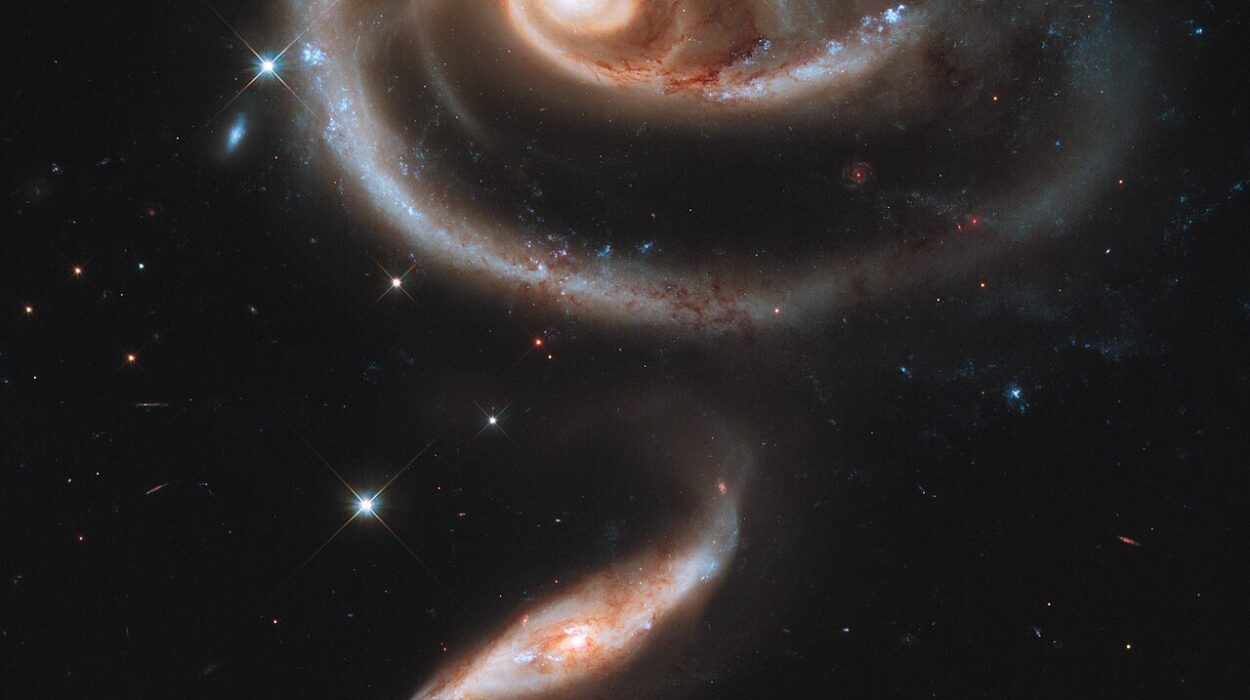
When two black holes collide, they send ripples through the fabric of space and time. These ripples, known as gravitational waves, travel outward at the speed of light, carrying information about the violent event that produced them. Scientists can detect these waves millions or even billions of light-years away, allowing them to study collisions involving some of the most extreme objects in the universe.
Black hole collisions create gravitational waves because two massive objects moving rapidly around each other disturb the geometry of spacetime. As they spiral closer together, their changing gravitational fields produce increasingly powerful ripples. When the black holes finally merge, the resulting disturbance becomes especially intense. The newly formed black hole then settles into a stable shape, releasing its remaining energy through a final burst of gravitational waves.
Understanding this process requires looking at how gravity works, how black holes interact, and what happens during their final moments.
What are gravitational waves?
Gravitational waves are disturbances in spacetime that travel outward from accelerating masses. Spacetime is the combined structure of the three dimensions of space and the dimension of time. According to Albert Einstein’s general theory of relativity, gravity is not simply a force pulling objects together. It is the effect of mass and energy bending the geometry of spacetime.
A familiar way to imagine this is to picture a heavy ball resting on a stretched rubber sheet. The ball creates a depression, and a smaller object placed nearby may roll toward it. Although this analogy cannot fully represent the geometry of four-dimensional spacetime, it helps illustrate how massive objects influence their surroundings.
When an object accelerates in a way that changes its gravitational field asymmetrically, it can produce gravitational waves. These waves spread outward, carrying energy away from their source.
Unlike ordinary waves in water or sound waves traveling through air, gravitational waves do not need a material medium. They are changes in spacetime itself. As they pass through a region, they alternately stretch and squeeze distances in different directions by extremely small amounts.
Gravitational waves travel at the speed of light. They can pass through matter, including stars, planets, and interstellar gas, with very little absorption or obstruction. This makes them particularly valuable for studying events that conventional telescopes may struggle to observe.
Why black holes produce gravitational waves when they collide
Black holes are regions of spacetime where gravity is so strong that nothing, not even light, can escape from within a boundary called the event horizon. They can form when sufficiently massive stars collapse at the end of their lives, although other formation pathways are also possible.
Despite their enormous gravitational influence, black holes do not automatically produce detectable gravitational waves simply by existing. A stationary black hole does not continuously radiate gravitational waves. The waves arise when massive objects accelerate relative to one another and their changing gravitational fields produce disturbances in spacetime.
When two black holes orbit each other, each continuously changes the gravitational environment of the other. Their motion creates a changing distribution of mass and energy, producing gravitational radiation.
The most important feature is that the system has a changing quadrupole moment. This technical term describes how mass is distributed around an object’s center, including how that distribution changes as the objects move.
A perfectly symmetrical, stationary mass distribution does not generate gravitational waves. However, two black holes orbiting each other create a changing, nonspherical distribution of mass. This allows the system to radiate gravitational energy into space.
As energy leaves the orbit through gravitational waves, the black holes gradually lose orbital energy. Their separation decreases, their orbital speed increases, and the system becomes more energetic. This creates a self-reinforcing process that eventually leads to a merger.
The three stages of a black hole collision
A black hole merger is not a single instantaneous impact. It develops through three main stages: inspiral, merger, and ringdown. Each stage produces a distinctive gravitational-wave signal.
Inspiral: The black holes spiral closer together
The inspiral begins when two black holes orbit a common center of mass. They may have formed as a binary system from two massive stars, or they may have become gravitationally bound through interactions in a dense stellar environment.
At first, the black holes may orbit each other at a considerable distance. Their gravitational attraction keeps them moving around one another, much like two objects connected by an invisible gravitational link.
As they orbit, they emit gravitational waves that carry energy away from the system. Because the system loses orbital energy, the black holes gradually move closer together.
Their orbital period becomes shorter, meaning they complete each revolution more quickly. Their orbital speed also increases as their separation shrinks.
This produces an accelerating sequence. The black holes orbit faster, emit stronger gravitational waves, lose more energy, and spiral inward even more rapidly.
Scientists call the increasing frequency and strength of the gravitational-wave signal a chirp. The signal begins at a relatively low frequency and rises as the black holes approach each other.
The inspiral can last a very long time, depending on the black holes’ initial separation and masses. However, the final stages can unfold rapidly.
Merger: The black holes become one
As the black holes approach one another, their event horizons eventually come together. Their gravitational interaction becomes so strong that the system can no longer be described accurately using simple orbital approximations.
The two black holes merge into a single, larger black hole. The merger is an extremely energetic event, releasing a substantial amount of energy as gravitational waves.
Although the newly formed black hole generally has more mass than either original black hole, its mass is slightly less than the combined mass of its predecessors. The difference has been carried away primarily as gravitational-wave energy.
This relationship follows Einstein’s famous equation, E = mc², which shows that mass and energy are interchangeable. A relatively small amount of mass can correspond to an enormous amount of energy because the speed of light squared is such a large number.
The merger produces some of the strongest gravitational waves generated by known astrophysical events. The resulting signal reaches a peak in strength and frequency around the final coalescence.
Ringdown: The new black hole settles down
The merger does not immediately leave behind a perfectly stable black hole. The newly formed object is initially disturbed and may have an irregular gravitational configuration.
It settles into a stable state by emitting additional gravitational waves. This process is called ringdown.
The name comes from the behavior of a struck bell. A bell vibrates after being hit, producing a sound that gradually fades. Similarly, the newly formed black hole undergoes characteristic oscillations that gradually diminish as it radiates energy.
These oscillations depend mainly on the final black hole’s mass and spin, or rotational speed. By examining the ringdown signal, scientists can test whether the remnant behaves as predicted by general relativity.
Once the oscillations fade, the black hole reaches a stable configuration described by its mass, spin, and, in principle, electric charge. Astrophysical black holes are generally expected to have negligible net electric charge.
How gravitational waves carry energy away
Gravitational waves are more than changes in distance. They transport energy and momentum away from their source.
In a binary black hole system, this energy comes from the orbital motion of the two objects. As gravitational waves carry energy outward, the orbit loses energy and angular momentum.
Angular momentum is the physical quantity associated with rotational motion. Its loss helps change the orbital motion as the black holes spiral inward.
The process becomes increasingly dramatic as the separation decreases. Stronger gravitational interactions and faster orbital motion produce more powerful gravitational radiation.
During the final merger, an extraordinary amount of energy can be released over a very short period. For a brief moment, the gravitational-wave power can exceed the combined electromagnetic power of all the stars in the observable universe.
However, this energy does not arrive as light or heat. It travels as gravitational radiation, producing tiny changes in distances as the waves pass through space.
The waves continue moving outward long after the black holes have merged. They can cross enormous cosmic distances before reaching Earth.
How scientists detect gravitational waves from black hole collisions
Detecting gravitational waves is extraordinarily difficult because their effects are incredibly small by the time they reach Earth.
Scientists use instruments called laser interferometers to measure these disturbances. One of the best-known observatories is the Laser Interferometer Gravitational-Wave Observatory, or LIGO.
LIGO uses two widely separated facilities, each containing two long, perpendicular arms. A laser beam is split into two paths and sent down the arms. Mirrors reflect the light back toward the instrument, where the returning beams are combined.
Under normal conditions, the instrument is configured so that the light waves interfere in a predictable pattern. If a gravitational wave passes through Earth, it slightly stretches one arm while squeezing the other. This changes the relative travel times of the laser beams and alters their interference pattern.
The resulting measurement reveals an extremely small change in the lengths of the arms.
The effect is remarkably tiny. A passing gravitational wave can change the relative distance between test masses by a fraction of the width of a proton over the instrument’s several-kilometer length.
To distinguish genuine gravitational-wave signals from ordinary disturbances, researchers use multiple observatories, sophisticated data analysis, and detailed theoretical models.
The European Virgo detector and Japan’s KAGRA observatory also contribute to the global gravitational-wave detection network. When multiple detectors observe a compatible signal, scientists can better determine its origin and location in the sky.
What gravitational-wave signals reveal about black holes
Gravitational waves provide information that astronomers cannot obtain from ordinary light alone.
The frequency, strength, and shape of a signal reveal important properties of the merging black holes. By comparing observed signals with predictions from general relativity, scientists can estimate the masses and spins of the original objects and the properties of the final black hole.
The inspiral signal is especially useful for estimating the masses of the two black holes. Their combined mass influences how quickly the orbital frequency increases as the merger approaches.
The merger and ringdown provide additional information about the final object’s mass and rotation.
The signal can also reveal whether the black holes had aligned or misaligned spins. Spin alignment influences the orbital evolution and can affect the motion of the final black hole after the merger.
In some cases, the merger produces a recoil, or gravitational kick, that sends the newly formed black hole moving through its surrounding environment. This happens when gravitational radiation carries momentum away unevenly.
Gravitational-wave observations therefore allow scientists to investigate black hole populations, binary formation processes, and the environments in which these extreme systems develop.
Why gravitational waves can travel through the universe almost unhindered
One of the greatest advantages of gravitational-wave astronomy is that these signals can travel through regions that block or scatter electromagnetic radiation.
Light from distant astronomical objects may be absorbed by dust, scattered by gas, or obscured by other material. Gravitational waves interact extremely weakly with ordinary matter, so they can pass through these obstacles with little disturbance.
This allows astronomers to study events that may be difficult or impossible to observe using conventional telescopes.
There is another important difference. Light is produced by electromagnetic processes, such as hot gas emitting radiation. Gravitational waves are produced by changes in the distribution and motion of mass and energy.
A black hole merger may produce a powerful gravitational-wave signal even when it generates little or no detectable light. This is particularly true for mergers involving isolated black holes, which may have no surrounding material to emit electromagnetic radiation.
As a result, gravitational-wave detectors provide a fundamentally different way to observe the universe.
What black hole collisions teach us about gravity
Black hole mergers offer some of the strongest available tests of Einstein’s general theory of relativity.
General relativity predicts how massive objects influence spacetime and how gravitational waves are generated and propagated. It also describes the detailed behavior of black holes as they orbit, merge, and settle into their final states.
Scientists compare actual gravitational-wave signals with predictions based on numerical relativity, a field that uses powerful computers to solve Einstein’s equations for complex gravitational systems.
So far, observations of binary black hole mergers have broadly agreed with general relativity’s predictions.
These measurements also allow researchers to investigate whether gravitational waves travel at the speed of light and whether black holes behave according to the properties expected of objects described by general relativity.
Some questions remain open. Scientists are still investigating how black hole binaries form, how frequently mergers occur in different cosmic environments, and how the masses and spins of black holes vary across the universe.
Observations of increasingly diverse mergers may help answer these questions and reveal whether current theories need refinement.
Why black hole collisions matter for astronomy
The discovery of gravitational waves from merging black holes opened a new way to study the universe. Before gravitational-wave astronomy, researchers relied primarily on electromagnetic radiation, including visible light, radio waves, infrared radiation, X-rays, and gamma rays.
Those methods remain essential, but gravitational waves provide information about the motion and gravitational interactions of massive objects directly.
They also make it possible to observe events that may otherwise remain hidden. Black holes are particularly difficult to study when they are isolated because they do not emit light from within their event horizons. A merger, however, can produce a detectable gravitational-wave signal without requiring the black holes to be surrounded by glowing material.
As detectors become more sensitive, scientists can study more distant and varied systems. Future observations may reveal previously unknown populations of black holes and improve our understanding of how these objects formed and evolved.
Black hole collisions demonstrate that gravity can produce measurable signals across enormous distances. When two black holes spiral together, their accelerating motion disturbs spacetime, sending gravitational waves outward. Those waves carry away energy, drive the black holes toward merger, and preserve information about the event long after it has ended.
By detecting these extraordinarily faint ripples, scientists can study some of the universe’s most powerful events and test our understanding of gravity under conditions that cannot be recreated on Earth.