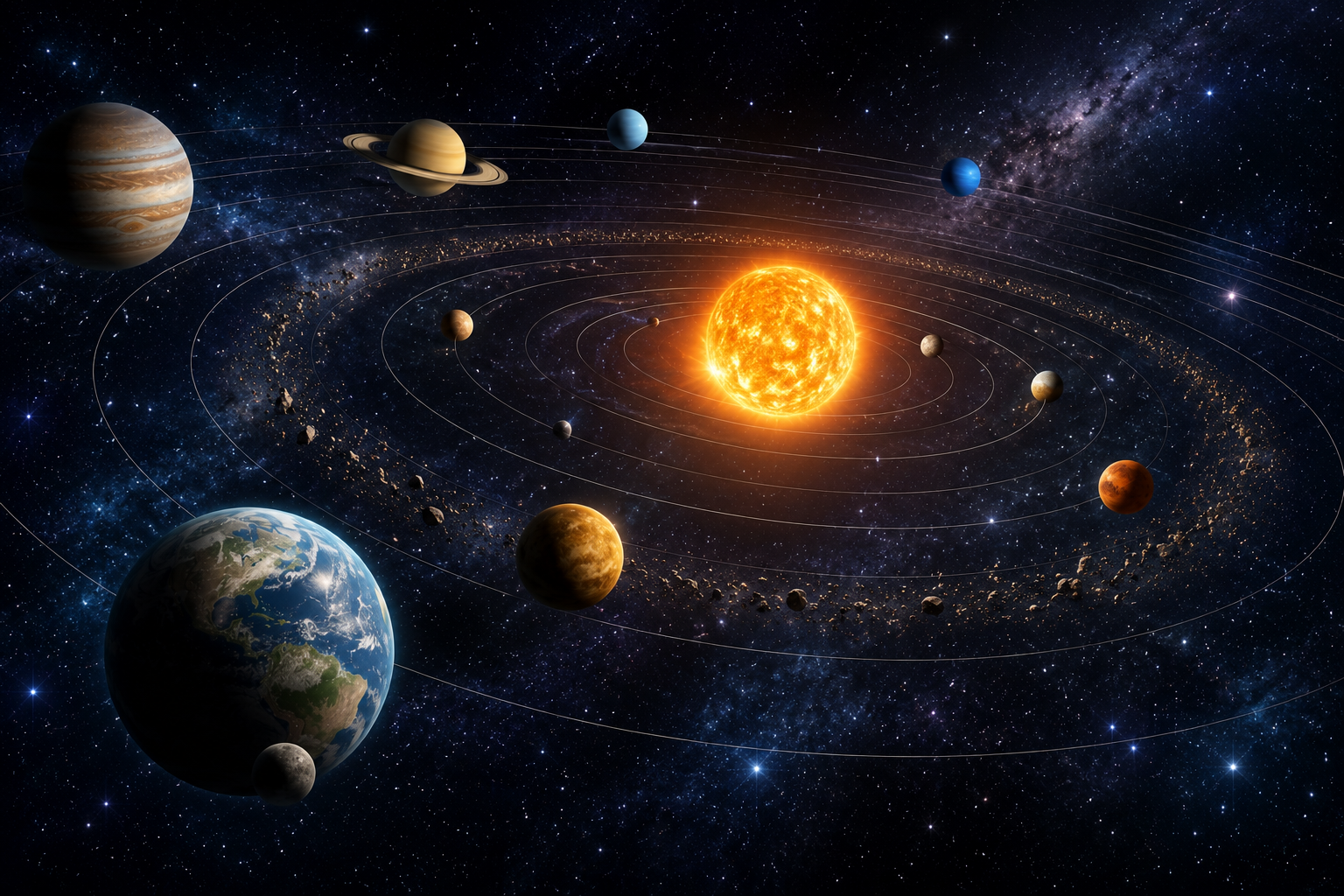
The solar system is our cosmic neighborhood: the Sun and everything gravitationally bound to it, including eight planets, dozens of known moons, dwarf planets, asteroids, comets, dust, and vast amounts of smaller debris. It stretches far beyond the orbit of Neptune, with the Sun’s gravitational influence extending into an enormous region of space.
Although we often picture the solar system as a tidy arrangement of planets circling the Sun, the real system is much more complex. The planets occupy only a small portion of its total volume. Most of the solar system is extraordinarily empty, and the objects within it differ dramatically in size, composition, temperature, geology, atmosphere, and history.
Understanding the solar system also means understanding how it formed, why the planets have different characteristics, how they move, and how scientists know what exists billions of miles from Earth.
What exactly is the solar system?
The solar system is the collection of objects and regions dominated gravitationally by the Sun.
The Sun contains almost all of the solar system’s mass, so its gravity controls the orbits of the planets and most other objects. The planets, dwarf planets, moons, asteroids, and comets all move through space under the influence of the Sun’s gravity as well as the gravity of other objects.
The solar system is not a perfectly flat, stationary structure. Its members orbit at different distances and speeds, and their orbital planes are slightly different. The entire system is also moving through the Milky Way galaxy.
The name “solar system” comes from Sol, the Latin name for the Sun. Astronomers sometimes use “planetary system” more generally for systems containing a star and objects orbiting it. Our solar system is one example of a planetary system.
How did the solar system form?
The solar system formed about 4.6 billion years ago from a vast cloud of gas and dust.
This cloud, known as the solar nebula, was made mostly of hydrogen and helium, along with heavier elements and compounds produced by earlier generations of stars. Gravity caused the cloud to collapse. As it contracted, it began rotating more rapidly and flattened into a broad disk.
Most of the material gathered near the center, where it eventually formed the young Sun. Within the surrounding disk, dust grains collided and stuck together. Over enormous spans of time, these particles grew into larger bodies called planetesimals. Continued collisions and gravitational attraction allowed some of these objects to become protoplanets and eventually planets.
The young solar system was a violent place. Growing planets collided with other large bodies, and leftover material continued to be swept up, scattered, or ejected.
The broad structure we see today is the result of that long process of gravitational assembly and evolution.
Why do the planets orbit the Sun?
The planets orbit the Sun because of gravity and because they inherited motion from the rotating material from which the solar system formed.
Gravity pulls the planets toward the Sun. But the planets also have sideways motion. Instead of falling directly into the Sun, they continually move forward while gravity continually curves their paths inward.
The result is an orbit.
An orbit can be understood as a continuous fall around a massive object. Earth is constantly falling toward the Sun, but its sideways velocity carries it forward, causing it to keep missing the Sun.
The planets’ orbits are generally elliptical rather than perfectly circular. Most, however, are fairly close to circular compared with the highly elongated orbits of some comets.
What is at the center of the solar system?
The Sun is at the center of the solar system’s gravitational structure.
The Sun is a star, not a planet. It is an enormous ball of extremely hot plasma whose energy comes primarily from nuclear fusion in its core.
The Sun’s mass is roughly 330,000 times Earth’s mass and accounts for about 99.8 percent of the total mass of the solar system.
Its gravity governs the large-scale motions of the planets and most smaller bodies. Its energy drives Earth’s climate and weather systems and makes life as we know it possible.
The Sun is also the closest star to Earth, making it far easier to study than any other star.
What are the eight planets?
The solar system has eight officially recognized planets. They are Mercury, Venus, Earth, Mars, Jupiter, Saturn, Uranus, and Neptune.
They are commonly divided into two broad groups: the inner terrestrial planets and the outer giant planets.
Mercury, Venus, Earth, and Mars are terrestrial planets. They are relatively small, dense, and rocky, with solid surfaces.
Jupiter and Saturn are gas giants. They are dominated by hydrogen and helium and are much larger than Earth.
Uranus and Neptune are ice giants. They contain substantial amounts of materials such as water, ammonia, and methane in forms very different from the familiar liquids and gases found on Earth, along with hydrogen and helium in their outer layers.
This division reflects important differences in composition and formation.
Mercury is the smallest planet
Mercury is the closest planet to the Sun and the smallest of the eight planets.
Its surface is heavily covered with impact craters, giving it an appearance somewhat reminiscent of Earth’s Moon. Mercury has a large iron-rich core relative to its overall size.
Because Mercury has almost no substantial atmosphere, its surface experiences extreme temperature differences. Sunlit areas can become extremely hot, while nighttime temperatures can fall dramatically.
Despite being closest to the Sun, Mercury is not the hottest planet. That distinction belongs to Venus, whose dense atmosphere traps heat extraordinarily effectively.
Mercury completes an orbit around the Sun in only about 88 Earth days.
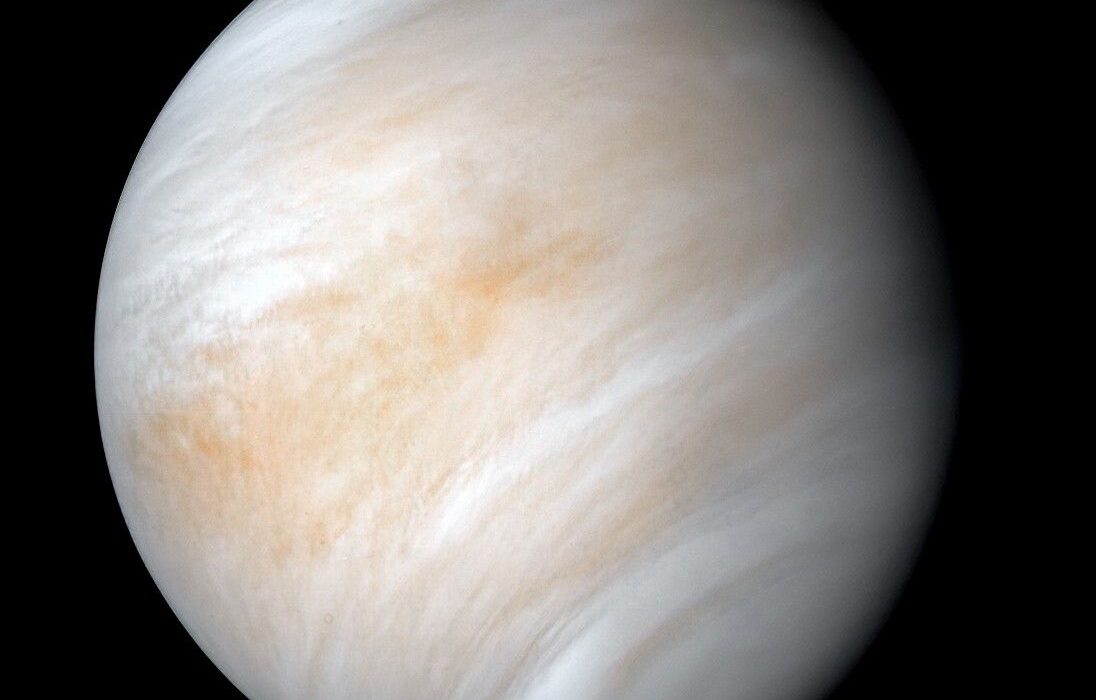
Venus is Earth’s hot, cloud-covered neighbor
Venus is similar to Earth in size and rocky composition, but its surface environment is dramatically different.
Its atmosphere is extremely dense and composed primarily of carbon dioxide, with clouds containing sulfuric acid. The thick atmosphere produces an intense greenhouse effect that makes Venus’s surface hotter than that of any other planet in the solar system.
Surface temperatures are high enough to melt lead.
Venus rotates unusually slowly compared with Earth, and it rotates in the opposite direction from the direction in which most planets orbit the Sun. Its surface is hidden beneath thick clouds, but spacecraft observations have revealed mountains, volcanic features, vast plains, and impact craters.
Venus demonstrates that having a similar size to Earth does not mean having a similar climate.
Earth is the only known world with life
Earth is the third planet from the Sun and the largest of the four terrestrial planets.
It has abundant liquid water at its surface, a nitrogen-rich atmosphere with substantial oxygen, an active water cycle, a protective magnetic field, and a complex system of interacting geological, atmospheric, and biological processes.
Earth’s surface is divided among continents and ocean basins, and its climate varies from polar regions to tropical environments.
As far as established observations show, Earth is the only world in the universe known to support life. Scientists continue to investigate whether life exists elsewhere, but no extraterrestrial life has been confirmed.
Earth also has one unusually large natural satellite relative to the size of its planet: the Moon.
Mars is a cold, dusty world
Mars is the fourth planet from the Sun and the second-smallest planet.
Its reddish appearance comes largely from iron minerals in its surface materials that have oxidized, or rusted. Mars has a thin carbon-dioxide-rich atmosphere, polar ice caps, enormous volcanoes, deep canyons, ancient river valleys, and extensive evidence that liquid water was present on its surface billions of years ago.
Mars is cold and dry today. Liquid water is not stable over most of its surface under present conditions, although water exists as ice and in other reservoirs.
Mars has two small moons, Phobos and Deimos.
Because Mars preserves evidence of a wetter ancient environment, it is one of the most intensively studied worlds beyond Earth. Robotic spacecraft have examined its rocks, soil, atmosphere, climate, and geological history.
Jupiter is the largest planet
Jupiter is the largest planet in the solar system.
It is a gas giant composed primarily of hydrogen and helium. Its atmosphere contains enormous cloud bands and powerful storms, including the Great Red Spot, a gigantic storm system that has persisted for centuries.
Jupiter rotates extremely rapidly, completing one rotation in roughly ten hours. This rapid rotation contributes to its pronounced equatorial bulge.
The planet also has a powerful magnetic field and an extensive system of moons and rings.
Jupiter’s four largest moons—Io, Europa, Ganymede, and Callisto—are known as the Galilean moons because Galileo Galilei observed them telescopically in the early 17th century.
Each is a world in its own right, with distinctive geology and composition.
Saturn is famous for its rings
Saturn is the second-largest planet and is best known for its spectacular ring system.
The rings are not a single solid disk. They consist of enormous numbers of particles made largely of water ice, along with rock and dust. The particles range from tiny grains to much larger pieces.
Saturn is also a gas giant composed mainly of hydrogen and helium. Like Jupiter, it has powerful winds, storms, a rapid rotation, and a strong magnetic field.
Saturn has a large and diverse family of moons. Titan, its largest moon, is especially important because it has a thick atmosphere and lakes and seas of liquid hydrocarbons on its surface. Beneath Titan’s surface, scientists believe a substantial water-rich interior exists.
Another major moon, Enceladus, has a subsurface ocean and releases plumes of water-rich material into space through fractures near its south pole.
Uranus rotates on its side
Uranus is the seventh planet from the Sun and an ice giant.
It has a blue-green appearance caused largely by methane in its atmosphere, which absorbs much of the red light.
One of Uranus’s most unusual characteristics is its extreme axial tilt. Its rotation axis is tilted by about 98 degrees relative to the plane of its orbit, so the planet essentially rotates on its side.
This produces extraordinary seasonal effects. Each pole can experience decades of continuous daylight followed by decades of darkness over the course of Uranus’s long orbit around the Sun.
Uranus also has a faint ring system and numerous moons.
Neptune is the solar system’s most distant planet
Neptune is the eighth and most distant recognized planet from the Sun.
Like Uranus, it is an ice giant with an atmosphere rich in hydrogen, helium, and methane. Its blue color is associated partly with methane’s absorption of red wavelengths, although the exact reason for the difference between Neptune’s and Uranus’s shades is more complicated than methane alone.
Neptune has some of the fastest winds measured in the solar system. Its atmosphere contains large-scale storms and changing cloud patterns.
Neptune’s largest moon, Triton, is particularly unusual. It orbits Neptune in the opposite direction from the planet’s rotation, suggesting that Triton may have originated elsewhere and later been captured by Neptune’s gravity.
Why isn’t Pluto a planet?
Pluto was historically taught as the ninth planet, but it was reclassified as a dwarf planet in 2006.
The change came from a formal definition of “planet.” Under that definition, a planet must orbit the Sun, be massive enough for its own gravity to make it approximately round, and have cleared most other objects from the neighborhood around its orbit.
Pluto satisfies the first two conditions but not the third. It occupies a region beyond Neptune containing many other icy objects, known collectively as the Kuiper Belt.
Pluto is therefore classified as a dwarf planet rather than one of the solar system’s eight planets.
This change did not make Pluto unimportant. Pluto is a complex world with mountains, glaciers, valleys, and a thin atmosphere that changes as it moves along its orbit.
What are dwarf planets?
Dwarf planets are objects that orbit the Sun and are massive enough for gravity to make them approximately round but have not cleared their orbital neighborhoods.
Pluto is one. Other recognized dwarf planets include Ceres, Eris, Haumea, and Makemake.
Ceres is particularly interesting because it is located in the asteroid belt between Mars and Jupiter. Unlike Pluto and the other large trans-Neptunian dwarf planets, Ceres is much closer to the Sun.
The distinction between planets and dwarf planets is based on orbital dynamics, not simply on size. Some dwarf planets are larger than some planetary moons.
What is the asteroid belt?
The asteroid belt is a broad region between the orbits of Mars and Jupiter containing millions of rocky and metallic objects.
Despite illustrations that show asteroids packed tightly together, the actual asteroid belt is mostly empty space. Individual asteroids are generally separated by enormous distances.
The belt contains material left over from the solar system’s formation. Jupiter’s powerful gravity prevented this region from easily assembling into a single planet, and gravitational interactions helped keep the material fragmented.
Asteroids range from tiny pieces of rock to large bodies hundreds of miles across.
Ceres, the largest object in the asteroid belt, is classified as a dwarf planet.
What is the Kuiper Belt?
Beyond Neptune lies the Kuiper Belt, a broad region populated by icy bodies and other remnants of the solar system’s formation.
Pluto is one of the best-known Kuiper Belt objects, but it is only one member of a much larger population.
The Kuiper Belt is a crucial part of understanding the outer solar system. Its objects preserve clues about the materials and conditions that existed when the planets were forming.
Some comets originate in this distant region. Gravitational interactions can occasionally alter their orbits and send them toward the inner solar system.
What is the Oort Cloud?
Far beyond the Kuiper Belt, astronomers infer the existence of a vast, roughly spherical population of icy objects called the Oort Cloud.
Unlike the relatively flattened Kuiper Belt, the Oort Cloud is expected to extend in all directions around the Sun.
No Oort Cloud object has been directly imaged as a member of that distant population. Its existence is inferred from the orbits of long-period comets, which can enter the inner solar system from extremely distant regions.
If the Oort Cloud exists as expected, it represents one of the solar system’s most remote reservoirs of ancient material.
What are comets?
Comets are icy bodies made from a mixture of frozen gases, rock, and dust.
When a comet approaches the Sun, solar heating causes some of its volatile materials to turn directly from solid into gas. This creates a surrounding cloud called the coma.
Solar radiation and the solar wind can push material away from the coma, producing tails.
A comet can develop both a dust tail and an ion tail, and both generally point generally away from the Sun because of the influence of sunlight and the solar wind.
The dramatic tails associated with comets are temporary features. When a comet travels far from the Sun, its active coma and tails largely disappear.
Why do comets have tails?
Comet tails form because sunlight heats the comet’s nucleus and releases gas and dust.
The dust tail consists primarily of small solid particles pushed and shaped by radiation pressure and the comet’s motion. The ion tail consists of electrically charged particles carried away by the solar wind.
A comet’s tails do not necessarily trail directly behind it. Their orientation is governed primarily by their relationship to the Sun and the solar wind.
This is why a comet can have a tail that points in a direction that seems counterintuitive if you think only about the comet’s direction of travel.
What are meteoroids, meteors, and meteorites?
A meteoroid is a relatively small piece of rock or metal traveling through space.
When a meteoroid enters Earth’s atmosphere and produces a visible streak of light, that phenomenon is called a meteor.
If part of the object survives its passage through the atmosphere and reaches the ground, the surviving material is called a meteorite.
Many meteoroids are fragments of asteroids, while others originate from comets or other sources.
Meteor showers occur when Earth passes through trails of debris left along the orbits of comets or, in some cases, asteroids. As particles enter the atmosphere, they can produce many meteors appearing to originate from a common region of the sky.
Do all planets have moons?
No.
Mercury and Venus have no natural moons. Earth has one large moon, while Mars has two small moons.
The giant planets have numerous moons, and many of them are fascinating worlds with their own atmospheres, oceans, geological activity, or unusual orbital histories.
Moons are not merely passive objects circling planets. They can experience tidal heating, geological activity, atmospheric processes, and complex interactions with their parent planets and the solar wind.
Some moons are among the most scientifically intriguing destinations in the solar system.
Why is the Moon important to Earth?
Earth’s Moon is unusually large relative to its planet and has had major effects on Earth’s history.
The Moon’s gravity is the primary cause of Earth’s ocean tides, although the Sun also contributes.
The Moon also helps stabilize Earth’s axial orientation over long periods, reducing the degree of variation Earth experiences in its rotational tilt compared with what would occur without such a large moon.
The leading explanation for the Moon’s origin is the giant-impact hypothesis. According to this model, a large body collided with the young Earth, ejecting material into orbit that eventually assembled into the Moon.
Evidence from lunar rocks and the Moon’s composition supports an impact origin, although the exact details of the event remain an area of scientific study.
What keeps the solar system together?
Gravity is the fundamental force that holds the solar system together.
The Sun’s enormous mass produces the dominant gravitational field. The planets are bound to the Sun, while moons are primarily bound to their planets.
Gravity also governs interactions among smaller bodies. Asteroids can alter one another’s orbits, planets can perturb comets, and planets can exchange energy and angular momentum through gravitational interactions.
Over billions of years, these interactions can substantially change the orbits of individual objects.
The solar system is therefore dynamic rather than frozen in place.
Does the solar system move?
Yes. The solar system is constantly moving.
The Sun and its planetary system orbit the center of the Milky Way galaxy. One complete trip around the galactic center takes roughly 230 million years, although the exact value depends on the details of the Sun’s galactic orbit.
The solar system also moves relative to nearby stars and through the interstellar medium.
At the same time, Earth rotates on its axis and revolves around the Sun, while the Sun and planets travel through the galaxy.
There is no universal stationary frame in which the solar system is simply sitting still.
How big is the solar system?
There is no single universally agreed boundary for the solar system.
If we define it by the orbit of Neptune, the planetary region extends roughly 30 astronomical units from the Sun. One astronomical unit, or AU, is the average distance between Earth and the Sun, about 93 million miles.
The Kuiper Belt extends farther outward, and the inferred Oort Cloud may extend thousands or even tens of thousands of astronomical units from the Sun.
Another useful boundary is the heliopause, where the outward-flowing solar wind encounters the surrounding interstellar medium and its influence becomes subordinate to that external environment. The Voyager spacecraft have crossed this region and entered interstellar space, although they remain gravitationally bound to the Sun and are still part of the solar system in a broader sense.
The solar system is therefore much larger than the region containing the eight planets.
What is the heliosphere?
The heliosphere is the enormous bubble-like region of space shaped by the solar wind.
The solar wind flows outward from the Sun and carries the Sun’s magnetic field with it. As the solar wind travels farther from the Sun, it encounters the interstellar medium surrounding the solar system.
The boundary where the solar wind’s influence gives way to the surrounding interstellar environment is associated with the heliopause.
The heliosphere is not perfectly spherical because the Sun moves through the interstellar medium and because conditions in the surrounding environment vary.
It acts as part of the solar system’s broader space environment and helps shield the planetary region from some incoming charged particles from interstellar space.
How do scientists study the solar system?
Scientists study the solar system using telescopes, spacecraft, radar observations, laboratory measurements, computer models, and samples returned from space.
Ground-based and space-based telescopes can observe planets, moons, asteroids, comets, and distant objects at wavelengths ranging from radio waves to gamma rays.
Spacecraft provide close-up measurements that Earth-based observations cannot. Robotic missions have orbited planets, landed on moons and asteroids, traveled through planetary atmospheres, collected samples, and passed through the outer solar system.
The Voyager spacecraft, for example, explored the outer planets before continuing outward toward interstellar space. Other missions have studied Mercury, Venus, Mars, Jupiter, Saturn, asteroids, comets, Pluto, and numerous moons.
Scientists also study meteorites on Earth because some contain material that formed during the earliest stages of the solar system.
Why are the planets so different from one another?
The planets formed from the same broad disk of material, but they formed at different distances from the young Sun and experienced different environments.
Close to the Sun, temperatures were high enough that volatile substances such as water and methane could not easily remain solid. Rocky and metallic materials therefore dominated the inner planets.
Farther from the Sun, temperatures were low enough for large amounts of ice to exist. More solid material was available for growing planetary cores, allowing the outer planets to become much larger and, in the case of Jupiter and Saturn, to capture large envelopes of hydrogen and helium.
Planetary differences were then amplified by billions of years of geological, atmospheric, gravitational, and chemical evolution.
Earth’s oceans, Venus’s extreme greenhouse effect, Mars’s thin atmosphere, Jupiter’s storms, Saturn’s rings, Uranus’s unusual tilt, and Neptune’s powerful winds are all products of different histories acting on worlds that originated from the same ancient solar system.
Is the solar system unique?
The solar system is not unique in having planets.
Astronomers have discovered thousands of confirmed planets orbiting other stars, known as exoplanets. These systems show that planetary systems can take many forms.
Some stars have planets orbiting extremely close to them. Some systems contain large planets on very short orbits. Others have multiple planets packed into arrangements very different from our own.
Our solar system has several characteristics that make it distinctive, but it is not the only kind of planetary system nature produces.
The study of other planetary systems also helps scientists understand which features of our own system are common and which may be unusual.
Could there be another planet beyond Neptune?
The possibility of an undiscovered large planet in the distant outer solar system has been investigated for years.
Some unusual orbital patterns among distant trans-Neptunian objects have been interpreted as potentially consistent with the gravitational influence of a hypothetical planet sometimes called “Planet Nine.” However, such a planet has not been directly observed, and its existence remains unconfirmed.
This is an important distinction between established solar-system objects and scientific hypotheses. Astronomers continue to search for distant bodies and analyze the orbits of known objects, but an inferred possibility is not the same thing as a discovered planet.
What makes the solar system a planetary system?
The defining feature of the solar system is its organization around a star.
The Sun provides most of the system’s mass and energy, while gravity determines the large-scale architecture. Around it are worlds with radically different characteristics, from small rocky Mercury to enormous Jupiter, from Earth’s life-supporting surface to the frozen landscapes of the outer solar system.
The system also contains countless smaller objects that preserve evidence of its formation. Asteroids, comets, dwarf planets, moons, dust, and meteoroids are not merely leftovers of little interest. They provide clues about the conditions that existed when the planets were forming roughly 4.6 billion years ago.
The solar system is thus both a collection of individual worlds and a single evolving gravitational system, extending from the Sun and the inner planets through the distant icy regions far beyond Neptune.